
What factors should I consider when choosing a provider for a used stairlift?
Choose a used stairlift provider based on the quality of its reconditioning process, the suitability of its assessment and fitting, the clarity of its warranty, and the availability of ongoing maintenance and support. A reputable UK provider should inspect and test the lift, explain its condition and history, confirm compatibility with your staircase, and provide clear costs and aftercare arrangements before installation.
Choose a provider for a used stairlift by checking the quality of its inspection and reconditioning, the suitability of its assessment and installation, the clarity of its warranty, and the support available after fitting. A reputable provider should explain the stairlift’s condition and history, confirm that it is suitable for your staircase and user, provide a full written cost, and make clear who will deal with servicing or faults.
Check whether the provider supplies a genuinely inspected and reconditioned lift. “Used” can describe a lift removed from another home, but it does not by itself explain its condition. Ask what the provider does before offering it for sale. A proper process may include:
- checking the motor, gearbox, batteries, controls, charging system and safety sensors;
- cleaning and examining the seat, arms, footplate, track and covers;
- replacing worn, damaged or unreliable components where necessary;
- testing the lift under operating conditions; and
- recording the work completed and any parts replaced.
Ask whether the stairlift has been refurbished for resale or is being supplied with minimal preparation. The provider should be able to describe its inspection process in plain language rather than relying only on terms such as “refurbished” or “reconditioned”.
Make sure the provider assesses your staircase rather than choosing a lift from a catalogue. Straight, curved, narrow, steep and multi-flight staircases can require different equipment or installation arrangements. A suitable assessment should consider the shape and dimensions of the staircase, available landing space, obstructions such as doors, the position of the charging point, and where the user needs to get on and off the lift.
The assessment should also consider the person using the stairlift. Seat width, weight capacity, control location, transfer ability, footplate position and whether a powered swivel or other option is needed can affect suitability. If more than one person may use the lift, tell the provider, as this could change the appropriate specification.
Compare the fitting service, not only the purchase price. Used stairlifts are often attractive because they can cost less than new equipment, but a low initial price may not include every part of the installation. Request a written quotation that states whether it covers:
- the stairlift and its track;
- site assessment and fitting;
- any alterations or additional components needed for your staircase;
- delivery, testing and demonstration;
- removal of an existing stairlift, if applicable;
- future call-out, labour or parts charges; and
- removal of the lift if it is no longer required, where this service is offered.
Ask whether the quoted price is fixed for the agreed specification and what circumstances could lead to additional charges. The installer should explain any limitations before work begins, rather than identifying them only on the day of installation.
Examine the warranty terms carefully. A warranty should state the length of cover, the components included, and whether it covers parts, labour, call-outs or only specific faults. Check for exclusions relating to batteries, misuse, accidental damage, consumable items or movement of the stairlift to another property. Also ask who provides the warranty and how to report a problem.
A provider that offers a clear written warranty should be able to explain what happens if the lift develops a fault during the cover period. Do not assume that a warranty includes routine servicing or every visit to your home. These details should be confirmed before you agree to buy.
Assess the provider’s aftercare and maintenance arrangements. Used equipment may need replacement parts or adjustments as it continues in service. Ask whether the provider has trained engineers who cover your area, whether routine servicing is available, and how faults are reported outside normal working hours. If the provider uses a third party for repairs, establish who will coordinate the appointment and remain responsible for the work.
It is also sensible to ask about parts availability. Some older or discontinued models can be more difficult to support, particularly if proprietary controls or electronic components are no longer readily available. The provider should tell you if the age or model of the lift could affect future repairs. This is especially important when buying a reconditioned stairlift for long-term use.
Ask for the stairlift’s history and model details. The provider should identify the make, model and, where available, the approximate age of the equipment. Ask where the lift came from, how long it was previously in use, why it was removed, and whether it has been installed in more than one property. A history of previous faults or major repairs does not automatically make a lift unsuitable, but you should know about it when comparing options.
Request details of work carried out during reconditioning and ask whether the batteries, safety components and other key parts are original or have been replaced. Keep this information with the warranty and installation documents. It can help with future maintenance and when discussing a fault with an engineer.
Check the provider’s installation standards and documentation. Installation should be carried out by a suitably trained person who can test the lift on your staircase and explain its safe operation. After fitting, the provider should demonstrate the controls, charging procedure, emergency lowering or manual functions, safety belt, swivel mechanism and any remote controls supplied. They should also explain what to do if the lift stops operating.
Before the installer leaves, check that you receive the relevant paperwork, such as the quotation, warranty, user instructions, service information and details of how to contact the provider. The documentation should relate to the actual stairlift installed, not a different model or generic product.
Look for transparent advice rather than pressure to decide quickly. A suitable provider should explain the advantages and limitations of the available used stairlifts, including when a new or different type of lift may be more appropriate. Be cautious if the provider avoids a proper assessment, cannot explain the equipment’s history, gives only a verbal price, or presents the warranty and aftercare terms as an afterthought.
You should also have time to consider the quotation and ask questions. If the user’s needs may change, discuss whether the proposed stairlift can accommodate those changes or whether a different configuration would provide better long-term value.
Use these questions when comparing providers:
- What checks and repairs are completed before this stairlift is installed?
- Can you provide the model, approximate age and available service history?
- Why was the lift removed from its previous location?
- How have you confirmed that it is suitable for my staircase and the intended user?
- What is included in the quoted price, and what could cost extra?
- What exactly does the warranty cover, and who handles a claim?
- Who will provide servicing and repairs after installation?
- Are replacement parts available for this model?
- What training and documentation will be provided at handover?
- What happens if the lift is unsuitable once installed or develops a fault?
The best provider is not necessarily the one offering the cheapest used stairlift. Compare the condition of the equipment, the quality of the assessment and fitting, the completeness of the warranty, the availability of parts, and the practical support you can expect throughout its service life. A provider that gives clear answers and written terms makes it easier to judge the real cost and suitability of the stairlift before you commit.
A suitable provider for a used stairlift should be able to explain exactly how the equipment was inspected, tested and prepared before installation. Ask whether the motor, batteries, controls, charging system, safety sensors, seat, footplate and track were checked, and whether worn or faulty parts were replaced.
The provider should also confirm that the lift has been assessed against your staircase and the intended user’s needs. This includes checking the track layout, landing space, transfer points, weight capacity and control positions. Request these details in writing, together with the model information, warranty terms, installation costs and arrangements for future repairs.
Be cautious if the provider cannot explain the stairlift’s history, offers only a verbal quotation or avoids questions about parts availability and aftercare. Clear information before purchase makes it easier to compare the true value of different used stairlifts.
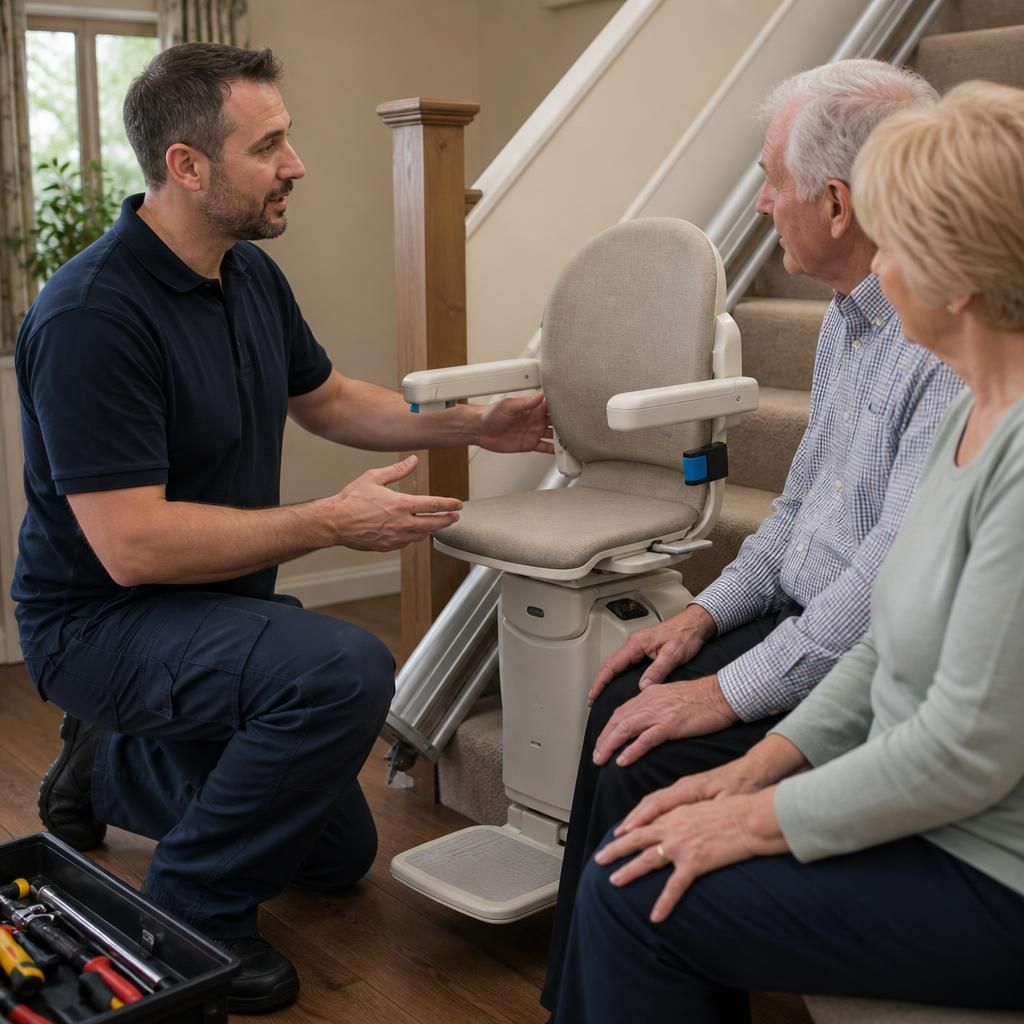
Request a Used Stairlift Assessment
Arrange a used stairlift assessment with Independent Stairlifts to confirm the right equipment, fitting requirements and total costs for your home. Our team can explain the available options and aftercare before you decide.