
How does buying a used stairlift impact overall maintenance and support costs?
Buying a used stairlift can reduce the initial purchase cost, but maintenance and support costs depend on its age, condition, service history, warranty and availability of replacement parts. A professionally inspected and reconditioned stairlift with installation support may offer more predictable overall costs than an older unit sold without aftercare.
Buying a used stairlift usually lowers the initial purchase price, but it does not automatically reduce the total cost of ownership. Maintenance and support costs depend on the stairlift’s age, condition, service history, battery condition, availability of replacement parts, warranty terms and the quality of its installation. A professionally inspected and reconditioned stairlift supplied with installation and aftercare can offer more predictable costs than an older unit sold without support.
What the initial saving may include
A used stairlift may cost less because the main equipment has already been installed in another home, rather than because it is unsuitable or unreliable. If the model is compatible with the staircase and has been properly refurbished, the saving can make accessible living more affordable. However, the quoted price should be assessed alongside what is included, such as:
- an assessment of the staircase and the user’s requirements;
- removal of the stairlift from its previous location, where applicable;
- adaptation or preparation of the rail;
- professional installation and safety checks;
- a replacement or tested battery;
- user instruction and handover;
- warranty cover and access to technical support; and
- future servicing or breakdown assistance.
A low purchase price may become less attractive if essential installation work, travel, call-outs or replacement components are charged separately.
Maintenance costs to consider
Stairlifts are designed for regular use, but components can wear over time. The likely maintenance requirement is influenced more by the condition and usage history of the individual lift than by the fact that it is second-hand. A suitable used stairlift should be inspected before installation, with particular attention paid to the drive system, carriage, controls, sensors, charging points, rail, seat mechanism and safety features.
Batteries are a common ongoing cost. Rechargeable stairlift batteries have a finite service life and may need replacing when they no longer hold charge or the lift begins to stop before reaching the charging point. Other possible costs include replacement remote controls, worn rollers, switches, armrests, seat components and electrical or mechanical parts. Parts availability is especially important for older or discontinued models, as a component may be more expensive or take longer to source.
Routine servicing can help identify wear before it causes a breakdown. The appropriate frequency depends on the model, usage and the manufacturer’s recommendations. A service may include checking operation, safety systems, charging, fixings, track condition and moving parts. Ask whether servicing is included in a support plan or charged separately.
How support affects the overall cost
Aftercare can be as important as the equipment itself. If the stairlift stops working, the cost of support may include a diagnostic visit, labour, travel and any parts required. Some warranties include call-outs and labour, while others cover only selected components. Some providers offer telephone assistance first, which may resolve simple issues such as an isolated power supply, a switched-off socket or a remote control that needs checking. More complex faults normally require an engineer.
Before buying, confirm:
- who provides technical support after installation;
- the areas covered by the service team and any travel charges;
- the response process for a breakdown;
- whether support is available outside standard working hours;
- which parts, labour and call-outs are covered by the warranty;
- whether the warranty can be extended or supported by a service plan; and
- how long support remains available if the model is discontinued.
Support from a provider familiar with the installed model can reduce delays and help ensure that repairs are carried out safely. A stairlift should not be modified with unsuitable parts simply to reduce the immediate repair cost.
Used, reconditioned and older stairlifts
These terms do not always describe the same level of preparation. A reconditioned stairlift should have been assessed, cleaned, tested and serviced as necessary before being offered for installation. The provider should be able to explain what work was completed and identify any components replaced. A used stairlift offered without a documented inspection may carry greater uncertainty, particularly if its previous usage and service history are unknown.
An older model may still be appropriate, but the age of the equipment should be considered alongside its condition, design and parts support. A newer used model with a clear history and current support may provide better value over time than a cheaper, older model with limited parts availability.
Comparing total cost rather than purchase price
To compare options fairly, consider the likely cost across the period you expect to use the stairlift. Include the purchase and installation price, any alterations required, routine servicing, battery replacement, warranty or service-plan charges, possible call-outs and eventual removal or replacement. It is not possible to predict every repair, but a written quotation and clear warranty can reduce uncertainty.
For example, a lower-priced stairlift without aftercare may be economical if it is in excellent condition and replacement parts remain readily available. Conversely, a professionally reconditioned stairlift with a higher initial price may offer better value if inspection, installation, warranty support and early servicing are included. The most suitable option depends on the staircase, the user’s mobility needs, expected frequency of use and the provider’s ability to support the equipment locally.
Ways to manage future costs
- Choose a stairlift that is correctly matched to the user and staircase, reducing strain caused by unsuitable operation.
- Ask for the service history, model details and any known previous faults.
- Confirm that the battery is tested and ask about its condition or replacement policy.
- Read the warranty exclusions, including misuse, accidental damage, consumable items and travel charges.
- Keep the charging points clear and leave the lift parked where it can charge, in line with the manufacturer’s instructions.
- Report unusual noises, jerky movement, charging warnings or repeated stops promptly rather than continuing to use a potentially developing fault.
- Keep the installation and warranty documents available for future support.
Do not attempt electrical or mechanical repairs yourself. If the stairlift is not operating normally, follow the provider’s instructions and arrange an inspection where necessary.
The best-value used stairlift is therefore not necessarily the one with the lowest advertised price. Look for a documented inspection, suitable installation, dependable parts support and warranty terms that are clear about labour and call-outs. These factors make maintenance and support costs easier to anticipate while helping the stairlift remain safe and suitable for continued use.
Buying a used stairlift can reduce the initial cost, but the overall saving depends on what is included in the price and how future maintenance is supported. A professionally inspected and reconditioned lift with installation, tested batteries and clear warranty cover may be more predictable than a cheaper unit supplied without aftercare.
Before comparing quotations, check whether they include:
- professional installation and safety testing;
- battery testing or replacement;
- parts, labour and call-outs under the warranty;
- routine servicing and breakdown support; and
- access to replacement parts for the model’s expected service life.
Ask about travel charges, response arrangements and support if the model is discontinued. These details can have a greater effect on long-term costs than the advertised purchase price alone.
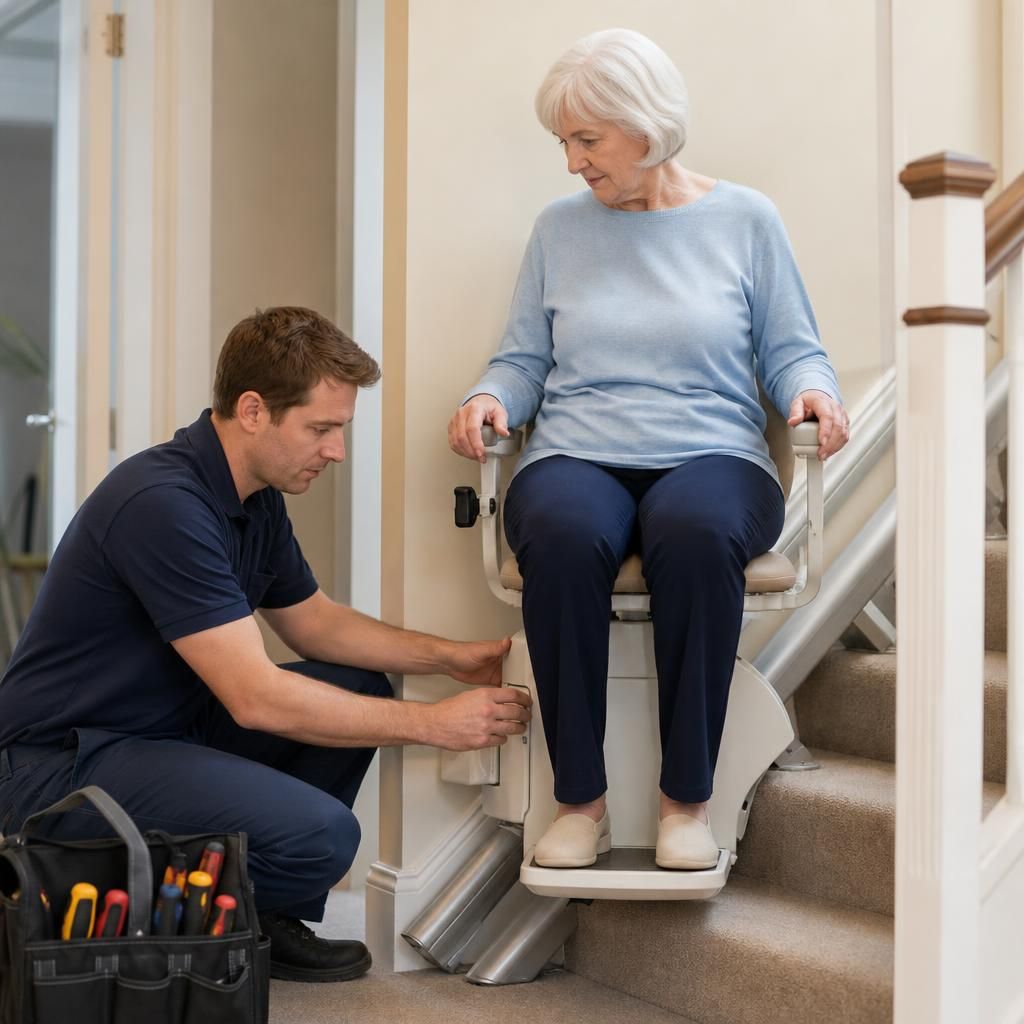
Request a used stairlift assessment and clear cost breakdown
Request a used stairlift assessment and clear cost breakdown, including installation, warranty, servicing and potential support charges, so you can compare the total cost with confidence.