
How do I know if a used stairlift is compatible with my home’s staircase?
A used stairlift is compatible with your home when its rail can be safely fitted to the staircase, with enough space at the top and bottom for you to get on and off. Compatibility depends on the staircase’s shape, width, landings, bends and obstructions, so a professional home assessment is essential before purchase.
A used stairlift is compatible with your home when its rail can be safely installed on your staircase and there is sufficient space for you to use the lift at the top and bottom. Compatibility is determined by the staircase’s shape, width, landings, bends, available clearance and any obstructions, so a professional home assessment should take place before you purchase or reserve a used stairlift.
Start by identifying the type of staircase. A straight stairlift is designed for a staircase without bends, intermediate landings or changes in direction. A curved stairlift has a rail made specifically for the route of a particular staircase. Although some components may be refurbished or reused, a curved rail from another property will not normally fit yours unless it has been correctly designed or adapted for your staircase. A staircase with a half landing, multiple bends, a split-level arrangement or a narrow turning point may require a bespoke curved solution rather than a standard straight model.
The staircase’s width is also important, but it is not the only measurement that matters. An assessor will consider the usable space between the walls, banister, handrail and any other fixed features. The stairlift must leave adequate room for safe travel and should not create an obstruction for other people using the stairs. A lift that physically fits on the steps may still be unsuitable if the seated user, folded footrest or armrests restrict movement or make the staircase difficult to use.
Check the areas at both ends of the rail. At the bottom, there needs to be enough room to approach the seat, sit down safely and clear the staircase when getting off. At the top, the user must be able to turn or transfer safely without being left too close to a wall, doorway, landing edge or other hazard. Depending on the layout, a straight rail may stop short of the top or bottom, or a different rail arrangement may be recommended to improve access. Doorways, radiators, furniture, low ceilings and nearby corridors should all be considered during the assessment.
For a curved staircase, the route of the existing rail is particularly significant. The assessor will examine every bend, landing and change in gradient, along with the position of doors and surrounding walls. A reconditioned carriage may be suitable for your staircase, but it must be paired with a rail that is correctly made or configured for the route. Reusing a rail simply because it appears similar can result in poor clearances, an unsafe stopping position or an installation that cannot be completed.
Consider the user as well as the staircase. The lift needs to accommodate the user’s weight, height, mobility and preferred transfer method. Seat width, swivel-seat operation, footrest position, controls and the direction in which the seat turns can affect whether the stairlift is practical. If the user has difficulty bending their knees, transferring from a wheelchair or operating a control, these points should be discussed before the model is selected. A lift can be technically compatible with the staircase but unsuitable for the person who will use it.
Other points that should be checked during a home survey include:
- whether the rail can be fixed securely to the stairs or, where appropriate, the structure beside them;
- the condition and construction of the steps, walls, banisters and landings;
- clearance from doors, cupboards, radiators, picture rails and other obstructions;
- the position of electrical sockets and the proposed charging points;
- whether the lift can be parked without blocking a doorway, hallway or escape route;
- the accessibility of the controls and the suitability of the seat, belts and footrest; and
- how the lift will be removed or adjusted if the staircase has previously had another stairlift installed.
Do not rely solely on photographs, a previous owner’s measurements or the fact that a used stairlift came from a staircase that looked similar. Small differences in landing depth, wall position or the direction of a bend can affect the fit. Measurements should be taken by a qualified stairlift assessor using the actual staircase, with the intended installation and user in mind.
Before agreeing to buy, ask the provider to confirm whether the assessment covers the complete installation, including the rail, fixings, charging equipment and any alterations needed for safe access. You should also establish whether the quoted price includes removal of an existing lift, installation, testing and any necessary adjustments. For a curved stairlift, ask specifically whether the rail is being reused, adapted or manufactured for your staircase, and whether compatibility has been confirmed rather than assumed.
A suitable provider should explain any limitations clearly and tell you if a used model is not appropriate. If the staircase or user’s requirements cannot be matched safely, a different used model, a reconditioned stairlift with a suitable rail or a new bespoke installation may be more appropriate. The safest way to confirm compatibility is therefore a no-obligation home assessment and written confirmation of the proposed configuration before installation goes ahead.
A used stairlift is only compatible with your staircase if its rail, fixings and stopping points can be safely configured for the exact layout. This is especially important with curved staircases, where a rail from another home will not normally fit simply because the stairs look similar.
An assessor should check every bend, landing, change in gradient and nearby obstruction, as well as the space available for getting on and off. For a straight staircase, the assessment should also consider the usable width, doorways, radiators, banisters and landing clearance. The user’s mobility, weight, transfer method and preferred seat position must be included in the assessment.
Before purchase, ask for written confirmation that the proposed stairlift configuration is suitable for your staircase and that the quotation includes installation, testing and any required adjustments. Do not rely on photographs or measurements from the previous property; a home assessment using your actual staircase is the reliable way to confirm compatibility.
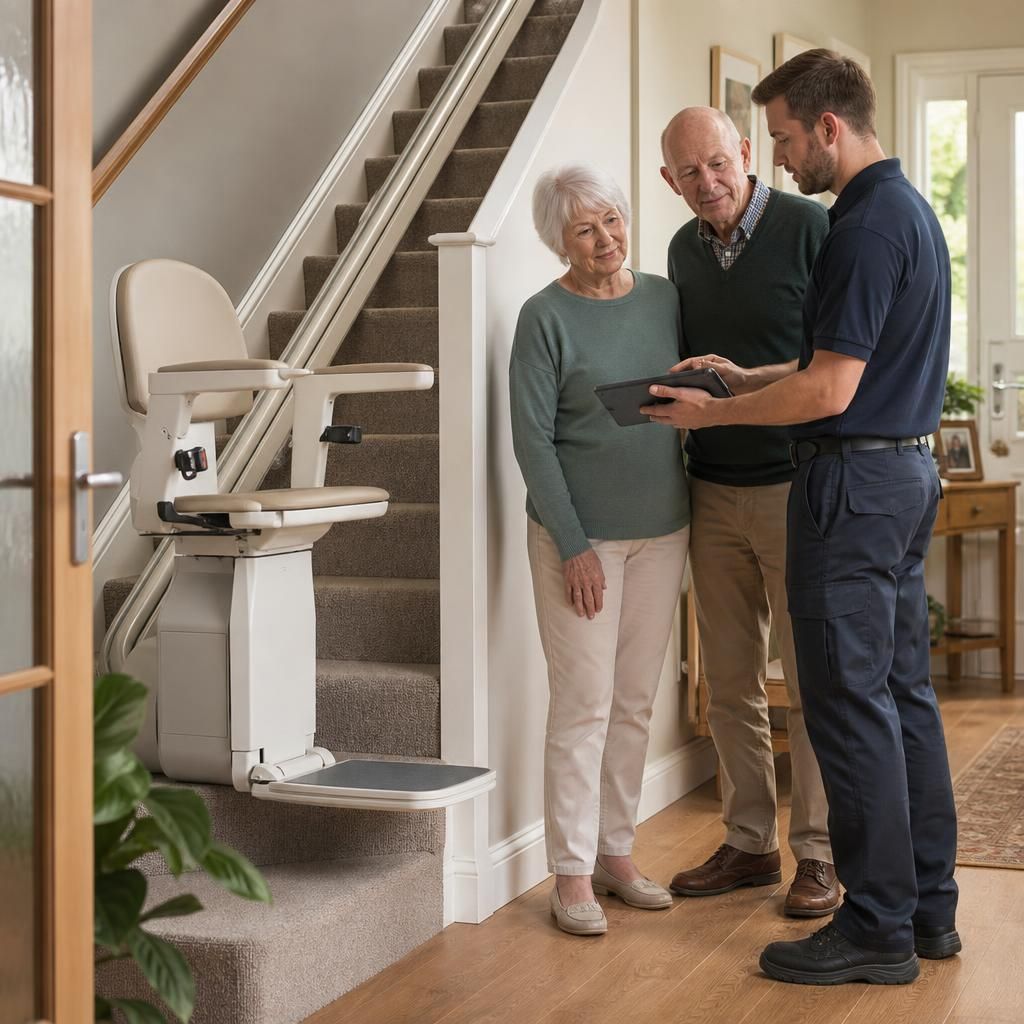
Arrange a home assessment to confirm used stairlift compatibility
Arrange a no-obligation home assessment to confirm whether the used stairlift, rail and installation points are suitable for your staircase and access needs. We can also explain any adjustments required before you commit to a purchase.