
How can I evaluate the suitability of a used stairlift for my home's layout and design?
Evaluate a used stairlift by checking that its rail design, seat dimensions, controls and safety features suit your staircase, including its width, bends, landings and available clearance. A professional home assessment should confirm whether the model can be adapted and installed safely without obstructing doors, walkways or other household users.
A used stairlift is suitable for your home only when its rail, seat, controls and safety features can be safely matched to the staircase and the space around it. Assessment should cover the staircase’s shape and width, bends, landings, doors, headroom, parking positions and the needs of everyone who uses the stairs. A professional home survey is essential because a used stairlift may not be adaptable to the same extent as a newly specified installation.
Start with the staircase layout. Identify whether the stairs are straight, curved, split-level or include intermediate landings. A straight stairlift generally requires a continuous straight rail, whereas a staircase with bends, turns or several flights normally needs a curved rail designed for that specific route. A rail removed from another property will not usually transfer directly to a different curved staircase, even if the general shape appears similar. Some components may be reusable, but the rail and its measurements must be confirmed by the installer.
Consider the following features of the staircase and its surroundings:
- Stair width: Measure the usable width rather than the overall distance between walls, as handrails, dado rails and other fittings can reduce the available space.
- Bends and landings: Note the direction and tightness of every turn, along with the room available at the top and bottom of each flight.
- Headroom: Check that the user can travel beneath low ceilings, beams, bulkheads or staircases above without leaning or striking their head.
- Doors and openings: Establish whether doors open towards the stairs or the proposed parking position, and whether a lift or parked seat would obstruct access.
- Walkways: Make sure other household members can still pass safely when the stairlift is parked or being used.
- Floor and landing space: Confirm that the user can get on and off the lift without standing too close to an edge or blocking a doorway.
Check the lift’s physical dimensions. The folded seat, armrests, footrest and carriage all occupy space beside the stairs. An apparently narrow lift can still restrict a hallway if the seat, controls or footrest project into a landing. Compare the lift’s overall width and folded dimensions with the available clearance at narrow points, particularly on turns and near doorways.
The seat should also suit the user’s posture, mobility and transfer method. Check the seat width and depth, the height of the seat from the stairs, the position of the armrests and whether the user can sit upright comfortably. A swivel seat may be important where the top or bottom landing is tight, but it must lock securely before the user gets on or off. If the user transfers from a wheelchair or uses a walking aid, allow space for the transfer and for the aid to be positioned safely.
Review the parking arrangements. The lift may be designed to park at the top, bottom or an alternative position, depending on the staircase and model. Parking at the bottom can leave the chair in a hallway, while parking at the top may affect a bedroom or landing. A powered or manual hinged rail may help where a door, radiator or walkway is close to the foot of the stairs, but it must be suitable for the property and operated without creating a trip hazard.
For a curved staircase, ask how the used lift would be positioned when parked and whether the rail has been made for the current staircase. The installer should check every bend, transition and stopping point rather than relying on photographs or general measurements. For a straight staircase, confirm that the rail length, fixing points and parking position correspond with the actual flight. A rail that is too short, too long or incorrectly aligned should not be altered informally to make it fit.
Consider the home’s design and daily use. The stairlift should work with the way the property is occupied, not simply fit on the stairs. Check whether it would obstruct a frequently used room, narrow an escape route, interfere with a handrail or affect access to storage. Consider pets, children and visitors, as well as anyone who may need to use the stairs while the lift is parked. The installation should leave adequate access and should not encourage people to walk around an obstruction or use the lift unsafely.
In some homes, the stairlift will need to be installed on the side of the staircase that provides the best clearance, even if that is not where the previous lift was fitted. The position of the charging points, controls and call/send units should also be practical. Controls need to be reachable by the intended user, and any remote controls should have a clear storage point so that they are not left on a step or landing.
Confirm electrical and installation requirements. A survey should identify where the stairlift can charge and whether the proposed route allows the power supply and charging equipment to be installed safely. The installer should assess the condition of the stairs, bannister, walls and fixing surfaces. Fixing to the stair treads is common for many installations, but the appropriate method depends on the construction and the specific model. Existing wiring, sockets and other fittings must not be treated as suitable without being checked.
Assess safety features in relation to the layout. The lift should have working seat-belt or harness equipment, obstruction sensors, swivel-seat locks, armrest and footrest safety mechanisms, braking systems and suitable controls. These features must be tested in the actual staircase environment. For example, an obstruction sensor needs to respond correctly to the stair edges, wall, carpet and any objects that could be left near the route. Ask the installer to demonstrate normal operation, emergency stopping and what happens if the power supply is interrupted.
Do not assume that a used stairlift is suitable because it operates correctly on a test run. A lift can be mechanically sound but unsuitable if the seat is too large, the user cannot transfer safely, the rail blocks a doorway or the parking position creates a hazard. Suitability is a combination of the lift’s condition, its dimensions, the staircase geometry and the user’s capabilities.
Use a professional assessment before agreeing to buy. Provide accurate information about the staircase, but do not rely on measurements taken with a tape measure alone. A trained surveyor should inspect the complete route, discuss how the lift will be used and explain any limitations of the particular reconditioned model. Ask for confirmation of:
- the type of rail required and whether the existing rail can be used or adapted;
- the proposed travel route and parking positions;
- clearance at the narrowest points and around landings;
- the location of charging points and controls;
- how doors, handrails and other household access will be affected;
- any alterations needed to the property before installation; and
- the testing, warranty and aftercare included with the installation.
Be cautious if a provider proposes a specific used stairlift without visiting the property, or if the price depends on accepting a lift before its compatibility has been established. Photographs can help with an initial discussion, but they cannot reliably show every clearance, fixing point or transfer requirement. A written survey or installation specification gives you a clearer basis for checking what has been agreed.
The final decision should be based on safe, comfortable use throughout the home. If the lift fits the staircase but leaves insufficient room to get on and off, prevents a door from opening properly or creates an obstruction for other users, it is not a suitable installation. Independent Stairlifts can assess the staircase, the available space and the user’s requirements before confirming whether a used or reconditioned stairlift is an appropriate solution.
A professional home assessment is the most reliable way to establish whether a used stairlift suits your staircase and surrounding layout. The survey should assess the full route, including stair width, bends, landings, headroom, doorways, transfer space and where the lift will park.
This is particularly important with a curved stairlift. A curved rail is normally made to follow the measurements and turns of a specific staircase, so a rail removed from another property may not be suitable simply because the two staircases look similar. For a straight stairlift, the rail length, fixing points and parking position must still correspond with the actual flight.
Ask the installer to confirm:
- the available clearance when the seat, armrests and footrest are folded;
- whether doors, handrails, walkways or escape routes will be obstructed;
- where the user can transfer safely on and off the seat;
- where the stairlift will charge and park; and
- whether the existing rail can be used safely or a replacement is required.
A test run alone does not prove suitability. The lift must be comfortable for the intended user and leave the rest of the household able to move around the stairs safely.
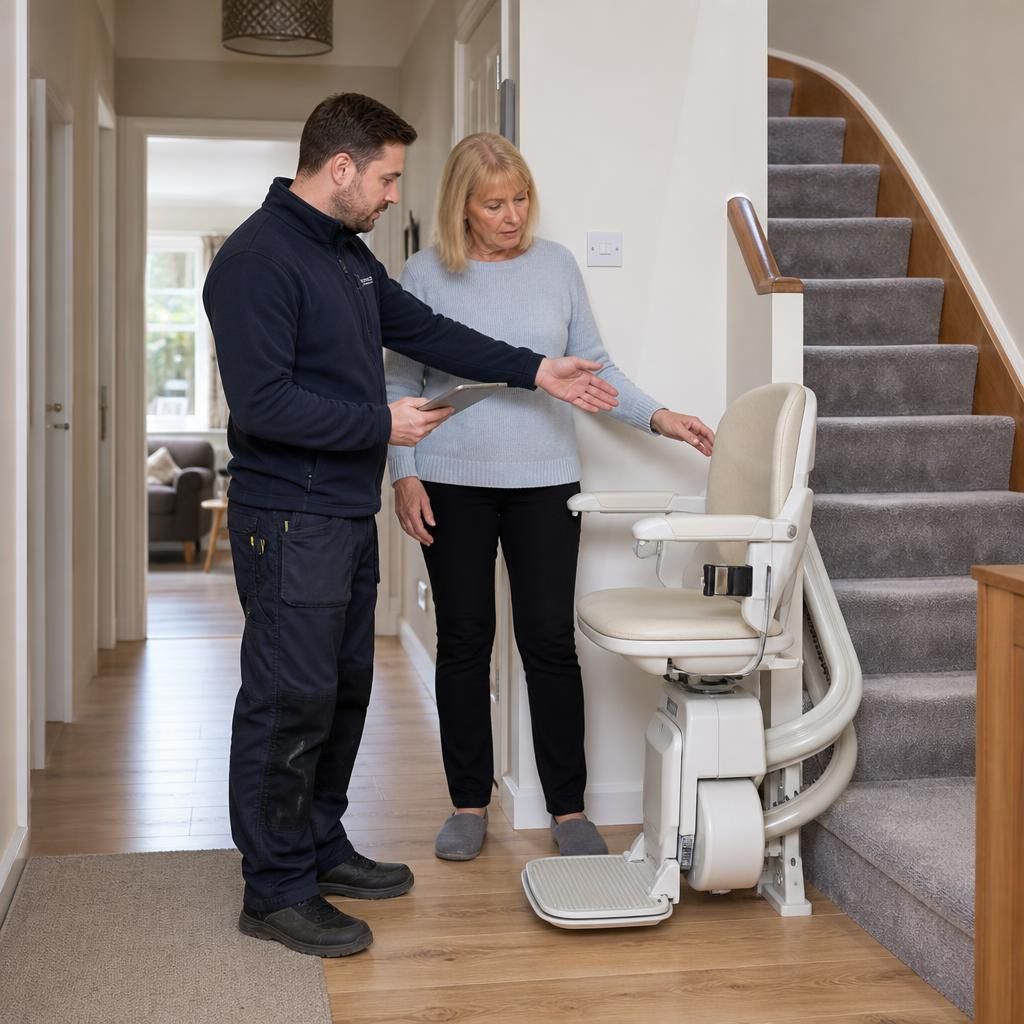
Arrange a Home Assessment for Your Used Stairlift
Arrange a professional home assessment with Independent Stairlifts to confirm whether a used stairlift suits your staircase, layout and transfer needs. We can check the rail, clearances, parking position and installation requirements before you commit to a suitable model.