
Are there specific questions I should ask about the history of a used stairlift before purchasing?
Before purchasing a used stairlift, ask for its age, original installation date, previous location and reason for removal, along with details of servicing, repairs, faults and battery replacement. Also confirm that it has been professionally reconditioned, safety-checked and supplied with appropriate warranty and installation support.
The history of a used stairlift should be checked before you assess its price or arrange installation. Ask for evidence of its age, previous installation, usage, servicing, repairs, faults, battery changes and removal. You should also confirm who has inspected and reconditioned it, whether replacement parts remain available, and what installation and warranty support are included.
A stairlift can be suitable for reuse, but its past may affect reliability, safety and the cost of ownership. A clear service history is more useful than a general assurance that the lift is “in good condition”. Ask the provider to answer the following questions and provide written evidence where it is available.
- How old is the stairlift? Ask for the model name, serial number, approximate manufacture date and original installation date. The manufacture date and installation date may be different, so establishing both helps you understand how long the equipment has been in service.
- Where was it previously installed? Find out whether it was used on a private domestic staircase, in a shared building or in another type of property. Ask whether it was installed indoors or outdoors, and whether the previous environment was particularly damp, dusty or exposed to temperature changes. An outdoor stairlift may have weather-resistant components, but it still needs to be assessed for the conditions at your property.
- Why was it removed? A stairlift may have been removed because the user moved home, no longer needed it or passed away. Those reasons are not necessarily a concern. However, you should ask directly whether removal followed a fault, repeated breakdowns, water damage, an accident or a change in the user’s needs.
- How intensively was it used? Ask whether it was used occasionally or several times each day, and whether more than one person used it. Usage does not by itself determine condition, but it provides useful context when considered alongside the service and repair records.
- Has it always been used on the same type of staircase? Ask whether the previous installation was straight, curved or external, and whether the rail was altered or adapted. Curved stairlifts are generally made to suit a particular staircase, so the existing rail may not be suitable for yours without modification or replacement. A provider should measure your staircase rather than rely on photographs or the previous installation details.
- Is there a complete service history? Request dates of inspections, servicing and significant work, together with the name or type of organisation that carried out the work. Records should ideally identify the model and serial number so that you can be confident they relate to the lift being offered.
- What faults has it had? Ask for details of intermittent faults as well as major breakdowns. Find out what symptoms occurred, what caused them and whether the repair resolved the problem. A history of a minor, properly documented repair is different from repeated unresolved faults or a pattern of component failures.
- Which parts have been replaced? Ask whether the motor, gearbox, charging equipment, control systems, sensors, arm controls, seat components, wiring or safety edges have been replaced. Confirm whether the fitted parts are manufacturer-approved or otherwise appropriate for that model, and whether replacement parts remain available.
- When were the batteries replaced? Batteries are consumable components and can deteriorate with age, lack of use or poor charging. Ask for the replacement date, the battery specification and whether the charging system has been tested. A lift that has been stored for a long period may still need new batteries even if it worked when removed.
- How was it stored after removal? Ask where the stairlift was kept, for how long, and whether it was protected from damp, frost, heat and physical damage. Storage conditions can affect batteries, circuit boards, contacts, upholstery and other electrical or mechanical parts.
- Has it been professionally reconditioned? Clarify what “reconditioned” includes. It should mean more than cleaning the seat and rail. Ask whether the lift has been dismantled as necessary, inspected, cleaned, tested and repaired, and whether safety-related components have been checked. Request a written condition or inspection report if one is available.
- Has it been tested after installation? Ask who will install it and what checks will be completed once it is fitted to your staircase. The provider should explain how the lift, charging points, controls, sensors, seat belt and safety systems will be checked in its new location. A previous pass or successful operation at another address does not prove that the installation is suitable for your home.
- Are there any outstanding advisories or limitations? Ask whether any parts are worn, unavailable or expected to need attention soon. You should also be told if the lift has limitations relating to the user’s weight, stair layout, parking position, travel direction or power supply.
It is also sensible to ask whether the model has manufacturer support and whether technical information, software or specialist parts are still available. Older equipment can remain serviceable, but support may become more difficult if the model has been discontinued. The provider should be open about this and explain how future servicing would be handled.
Before agreeing to buy, ask for the warranty terms in writing. Check what is covered, how long cover lasts, whether batteries and call controls are included, who pays for labour and call-outs, and whether any exclusions apply because the stairlift is second-hand. Confirm whether installation, removal, adjustments and follow-up visits are included or charged separately.
Be cautious if the seller cannot identify the model, will not disclose why it was removed, has no explanation for missing service records, or describes a lift as reconditioned without saying what work was carried out. Missing paperwork does not automatically mean that a stairlift is unsafe, but it makes an independent inspection and a clear written warranty particularly important.
Finally, compare the history with the results of a current assessment at your home. The stairlift must be suitable for the staircase, the intended user and the available parking and transfer space. A documented history, professional reconditioning, competent installation and accessible aftercare provide much stronger evidence of suitability than age or appearance alone.
A used stairlift’s service history provides evidence of how it has been maintained, repaired and prepared for reuse. Ask to see dated records that identify the model or serial number, including inspections, servicing, faults, parts replaced and battery changes.
Pay particular attention to repeated or unresolved faults, lengthy periods in storage and repairs involving safety sensors, controls, charging equipment or the drive system. The provider should also explain what reconditioning and safety checks have been completed before installation, rather than relying only on the stairlift’s appearance or a general statement that it is in good condition.
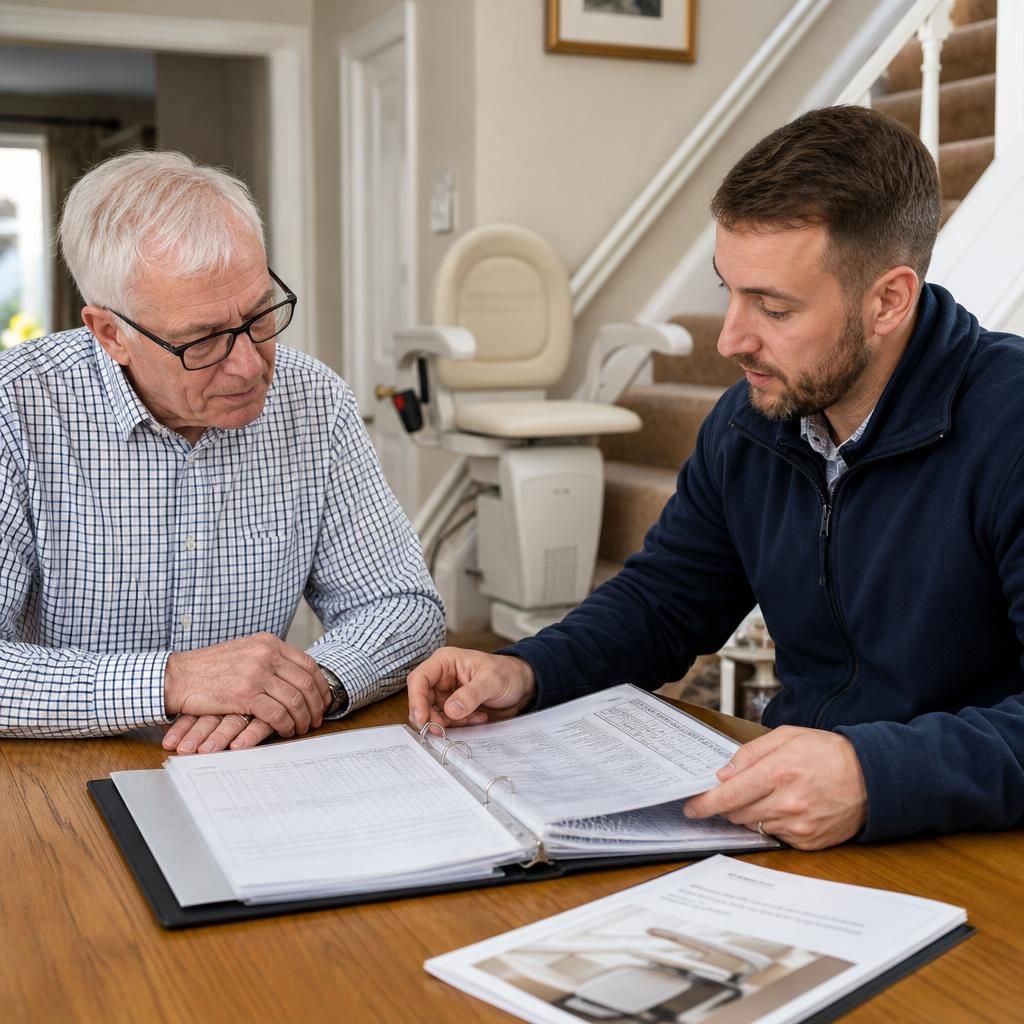
Arrange a used stairlift assessment
Arrange a used stairlift assessment so we can review its history, condition and suitability for your staircase. We can also explain the available installation, warranty and aftercare arrangements before you decide.