
Are reconditioned stairlifts suitable for both straight and curved staircases?
Yes, reconditioned stairlifts can be suitable for both straight and curved staircases. Straight models use standard rails, while curved installations require a compatible reconditioned unit and a rail designed or adapted to follow the staircase, so a home assessment is needed to confirm the safest suitable solution.
Yes. Reconditioned stairlifts can be suitable for both straight and curved staircases, provided the lift, rail and installation are compatible with the staircase and the user’s needs. A reconditioned straight stairlift is usually matched with a standard rail, whereas a curved installation requires a rail designed to follow the individual staircase. For this reason, a home assessment is essential before confirming which reconditioned solution is suitable.
Reconditioned stairlifts for straight stairs
Straight staircases have a continuous flight without bends, landings or changes in direction. Reconditioned stairlifts for these stairs generally use a standard rail that runs directly from the lower to the upper floor. The stairlift itself is inspected, serviced and safety-tested before installation, while the rail is checked to ensure that it is suitable for the staircase and correctly fitted.
A straight reconditioned stairlift may be suitable where the staircase has a standard layout and there is enough space at the top and bottom for safe boarding and dismounting. The assessment will also consider the width of the stairs, the position of doors and hallways, the available parking space and whether the user can transfer safely in and out of the seat.
Because straight staircases are relatively consistent, a reconditioned unit can often be selected from suitable available stock. However, this does not mean that every used stairlift will fit every straight staircase. The rail length, seat dimensions, controls, weight capacity and installation requirements must all be checked before the model is recommended.
Reconditioned stairlifts for curved stairs
Curved staircases include bends, intermediate landings, changes in direction or other features that prevent the use of a standard straight rail. They require a rail that has been manufactured or configured to follow the precise shape of the staircase. The rail is normally the most staircase-specific part of the installation, so a suitable reconditioned curved stairlift may be paired with a rail made for the property or with an appropriate rail solution created following an assessment.
The carriage, seat and operating controls of a curved reconditioned stairlift can be refurbished and tested in the same way as those of a straight model. The key difference is that the rail and travel path must be carefully matched to the staircase. A curved lift that was previously installed elsewhere should not be assumed to fit a new property simply because the two staircases appear similar. Small differences in measurements, angles, landings and clearances can affect whether the installation is safe and practical.
What is checked during the assessment?
- The shape, width and gradient of each section of the staircase.
- Any bends, landings, narrow points, radiators, doors or other obstructions.
- Clearance for other people using the stairs and for closing doors where relevant.
- Safe boarding and dismounting positions at the top and bottom of the staircase.
- Whether the user can sit, stand and transfer safely, including the need for a swivel or powered swivel seat.
- The most suitable controls, armrests, footrest and seat configuration.
- Electrical supply and the position of the charging points.
- Whether the stairlift needs to serve more than one floor or staircase.
The assessment is also an opportunity to identify practical details that may not be apparent from photographs or measurements alone. For example, a tight turn at the top of a curved staircase may influence the parking position, while a narrow hallway may affect the most suitable seat or footrest arrangement.
How reconditioning affects suitability
Reconditioning should involve more than cleaning a previously used stairlift. The unit should be examined for wear, serviced and tested to confirm that its main operating and safety systems are functioning correctly. This can include checks of the motor and drive system, batteries, controls, sensors, safety edges, seat mechanism, charging system and braking components, as appropriate to the model.
Parts that are worn, damaged or no longer suitable should be addressed before installation. The final stairlift must then be installed and commissioned correctly on the customer’s staircase. A reconditioned lift is only a suitable solution when the condition of the equipment and the suitability of the installation have both been considered.
Important differences between straight and curved installations
Straight stairlift installations are generally simpler because the rail follows one uninterrupted line. Curved installations involve more design and fitting considerations, and the rail is usually more closely associated with the individual staircase. This can affect the availability of suitable reconditioned equipment and the total cost of the installation.
A reconditioned curved stairlift is therefore not necessarily a lower-cost version of a straight stairlift. The price depends on the equipment selected, the rail solution, the staircase layout, installation requirements and any additional features needed for safe use. A tailored assessment provides a more reliable indication than comparing the price of the stairlift unit alone.
When a reconditioned stairlift may not be suitable
A reconditioned option may not be appropriate if the available equipment cannot be matched safely to the staircase, if the user’s requirements have changed, or if the property needs features that are not available on the proposed model. A particularly narrow staircase, unusual landing arrangement or complex multi-flight layout may require a different specification.
It is also important to consider future use. The stairlift should be suitable for the user’s mobility, posture and transfer ability now, while allowing for foreseeable changes where possible. If the user needs additional support, such as a powered swivel seat, a powered footrest or a different control arrangement, these requirements should be discussed before a model is selected.
What to ask before choosing a reconditioned model
- Has the stairlift been inspected, serviced and safety-tested?
- Is the proposed model suitable for the staircase layout and the intended user?
- Will the existing or proposed rail fit the staircase precisely?
- Which parts have been replaced or refurbished?
- What warranty is provided for the equipment and installation?
- Who should be contacted if the stairlift develops a fault?
- Are servicing, repairs and ongoing support available after installation?
In summary, reconditioned stairlifts can work effectively on straight and curved staircases, but the selection process is different for each. Straight models are commonly matched with standard rails, while curved installations need a staircase-specific rail solution and more detailed planning. An assessment by a qualified installer confirms whether the reconditioned equipment, rail, features and installation method provide a safe and practical fit for the home.
A reconditioned stairlift can be suitable for a curved staircase, but the rail must match the staircase precisely. Unlike a straight stairlift, a curved model travels around bends, landings and changes in direction, so a rail from another property cannot be assumed to fit safely.
During a home assessment, the installer checks the staircase layout, available clearances, boarding and dismounting positions, and the user’s seating and transfer needs. The carriage, controls and safety features can be refurbished and tested, while the rail solution must be selected or produced for the individual staircase.
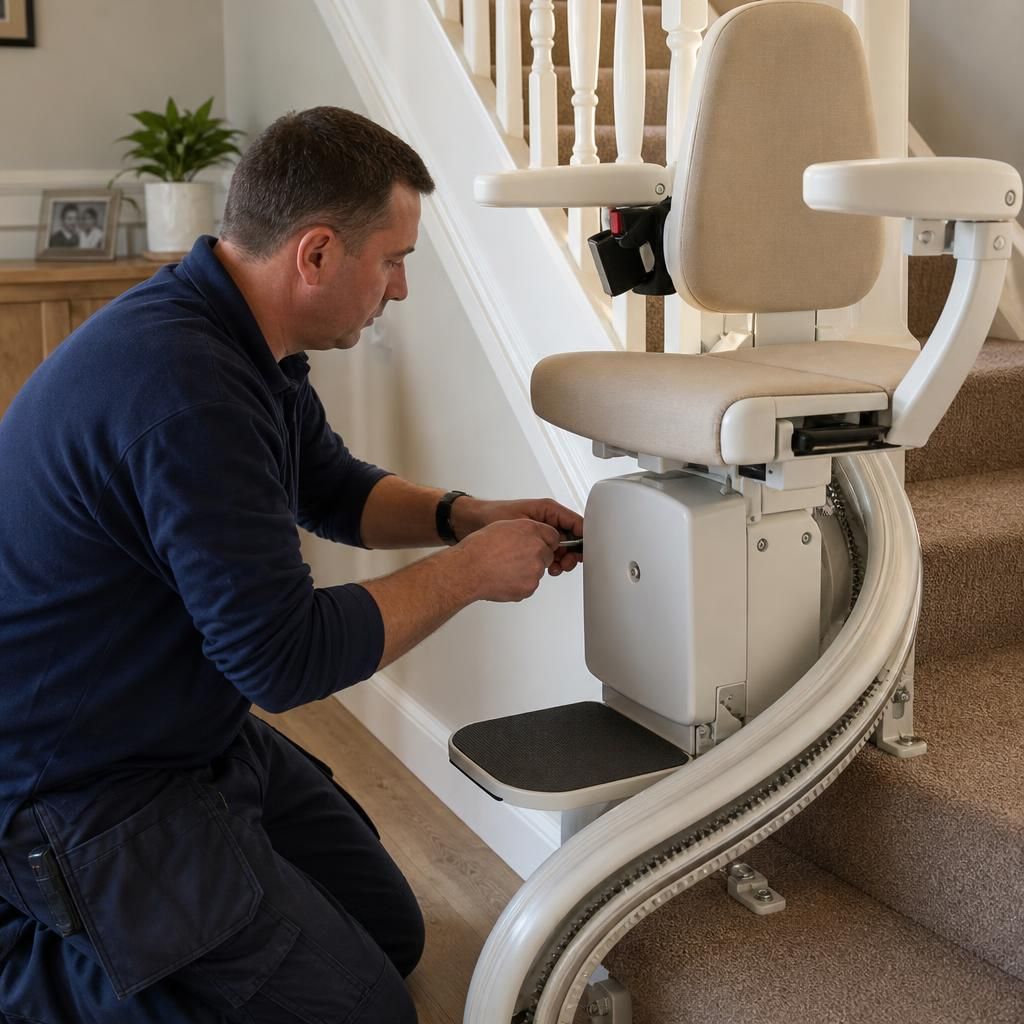
Arrange a home assessment for your reconditioned stairlift
Arrange a home assessment with Independent Stairlifts to confirm whether a reconditioned stairlift is suitable for your straight or curved staircase. We will assess the layout, available clearances and your mobility needs before recommending a safe, practical solution.