
What safety measures should I prioritise when evaluating an outdoor stairlift?
Prioritise reliable stopping and braking, secure seating and restraint, clear controls, obstruction and overspeed protection, and safe access at both ends of the stairs. For outdoor use, also check weather-resistant construction, dependable operation on wet or icy steps, protected charging and controls, and a maintenance plan suited to the exposed location.
The most important outdoor stairlift safety measures are dependable braking and stopping, secure seating and restraint, obstruction and overspeed protection, safe access at the top and bottom of the stairs, and weather-resistant electrical and mechanical components. An outdoor model must also remain predictable when exposed to rain, frost, dirt, leaves and changing temperatures, so assess the whole installation rather than looking only at the chair.
Start with the stairway and the user’s needs. A proper assessment should consider the gradient, width, surface, landings, gates, handrails, lighting and the way the user transfers on and off the lift. The safest model is one that allows a stable transfer without twisting or reaching. Check that the seat, armrests and footrest provide adequate support, and that the lift can stop in a position where the user has enough room to stand or move safely.
Consider whether a powered swivel seat, a manually operated swivel, a powered footrest or a perch-style seat is appropriate. These features may be particularly important where the landing is narrow, the user has limited knee movement or sitting down is difficult. The assessment should also confirm that the weight capacity and seat dimensions are suitable for the intended user, including any winter clothing or essential equipment.
Prioritise reliable stopping and braking. The stairlift should stop smoothly when the control is released and remain securely held on the track. Ask how the normal braking system operates and what protection is available if the motor, drive system or power supply develops a fault. A battery-powered lift should have a suitable backup arrangement so that a power cut does not leave the user without a safe way to reach an appropriate landing, subject to the model’s operating instructions.
Controls should be easy to identify and operate, with a clear direction of travel and a positive response. A key switch or similar control can help prevent unintended use, particularly where children, visitors or other household members have access to the stairs. Remote controls can be useful where the lift needs to be called to another level, but they should not encourage anyone to ride without being seated correctly or without the safety controls engaged.
Check the restraint and seating system. A seat belt or harness should be easy for the user to fasten and release, while remaining secure during travel. The design should discourage the lift from operating if the restraint is not correctly positioned, where that function is provided by the model. Armrests should give sufficient lateral support, and the footrest should support the feet without creating an obstruction when the user transfers.
A swivel seat should lock in the travel position and in the intended transfer position. Do not assume that a swivel feature alone makes a transfer safe: there must be adequate landing space, the user must be able to control the movement, and the lift should not travel unless the seat is correctly positioned. Ask the installer to demonstrate the full transfer process from both ends of the stairs.
Look for obstruction and overspeed protection. Outdoor stairs are more likely to collect leaves, grit, twigs, ice or other debris. Sensors beneath the footrest and around the carriage can help stop the lift if an obstruction is detected, but they are not a substitute for keeping the track and steps clear. Ask where the sensors are located, what they detect and how they should be checked.
Overspeed protection and a mechanical brake provide additional protection if the lift travels faster than intended or the drive system fails. Confirm that the stairlift has a manual emergency stop and that the user or a carer understands when it should be used. The operating instructions should explain how to deal with a stoppage and who to contact rather than encouraging an untrained person to dismantle or move the lift.
Evaluate protection against outdoor conditions. Components exposed to the weather should be designed for exterior use, with suitable protection against water ingress, corrosion, ultraviolet exposure and temperature changes. This includes the motor, track, switches, charging points, batteries, control units and remote controls. Ask specifically how the model is protected rather than relying on the word “weatherproof” alone.
Charging contacts and electrical connections should be positioned and protected so that rainwater cannot collect around them. The installation should include a suitable electrical supply and isolation arrangement, completed in accordance with applicable requirements. Enclosures, covers and seals should remain correctly fitted after servicing, and any signs of cracked covers, corrosion, water ingress or damaged cables should be reported promptly.
Wet or icy steps can make the transfer on and off the lift more hazardous, even when the lift itself is working correctly. The stair surface should have suitable slip resistance, drainage should prevent standing water, and lighting should allow the user to see the steps and landing clearly. In locations that regularly freeze, agree how ice and snow will be removed before use. Never rely on the stairlift to compensate for slippery or obstructed steps.
Make access at both ends part of the safety assessment. The chair should stop at a safe, convenient position that does not leave the user close to an unprotected edge or in the path of a gate or door. Check the clearance required for the footrest, armrests and swivel seat. If the top landing is exposed, consider whether a level platform, handrail, guard or other building measure is needed to provide a safe transfer area.
At the lower end, make sure the user can move away from the chair without stepping into a driveway, path, road or other hazard. Outdoor routes may be shared with visitors, pets or vehicles, so consider whether the lift needs to be folded or parked in a position that keeps access clear. Any gates or barriers should not interfere with the track, controls or emergency access.
Confirm safe operation during a fault. Ask what happens if the battery is low, the charging circuit fails, an obstruction is detected or the lift stops between landings. There should be clear instructions for the user and carers, including how to summon assistance. Keep the service contact details and operating instructions in an accessible, dry location. If someone in the household cannot use a mobile telephone, plan an alternative way to obtain help.
Allow for regular inspection and maintenance. Outdoor exposure increases the importance of cleaning, lubrication where specified, battery checks, inspection of safety sensors, examination of the track and testing of brakes and controls. The service interval should reflect the location and frequency of use. A lift beside the sea, in a wooded area or on an uncovered stairway may need closer attention to corrosion, salt, leaves and moisture than one in a sheltered position.
Before accepting the installation, ask for a demonstration of normal operation, emergency controls, charging, parking and cleaning. Check that all users can fasten the restraint, operate the controls and recognise a fault indication. Report unusual noise, jerky movement, repeated stopping, reduced battery performance, damaged seals or corrosion rather than continuing to use the lift until the problem has been assessed.
Finally, ask the installer to record the agreed safety arrangements, including the user’s transfer method, environmental risks, maintenance requirements and any recommended changes to lighting, handrails, drainage or step surfaces. This gives you a practical checklist for reviewing whether the outdoor stairlift remains safe as the user’s needs and the surrounding conditions change.
Safe access at the top and bottom of an outdoor stairlift is as important as the lift’s braking and restraint systems. The chair should stop on a stable, level area where the user can swivel or stand without reaching, twisting or stepping close to an edge.
During the assessment, check the clearance around the seat, armrests and footrest, along with the position of doors, gates, handrails and nearby paths. Wet leaves, ice, poor lighting and standing water can make a transfer hazardous even when the stairlift is operating correctly. The installer should identify practical improvements, such as better lighting, slip-resistant surfaces, drainage or an additional handrail.
- Confirm that the user can transfer safely at both ends of the stairs.
- Keep the landing and route away from vehicles, gates, pets and other obstructions.
- Agree where the chair should be parked so it does not block access or create a trip hazard.
- Do not use the stairlift until snow, ice, heavy debris or standing water has been dealt with.
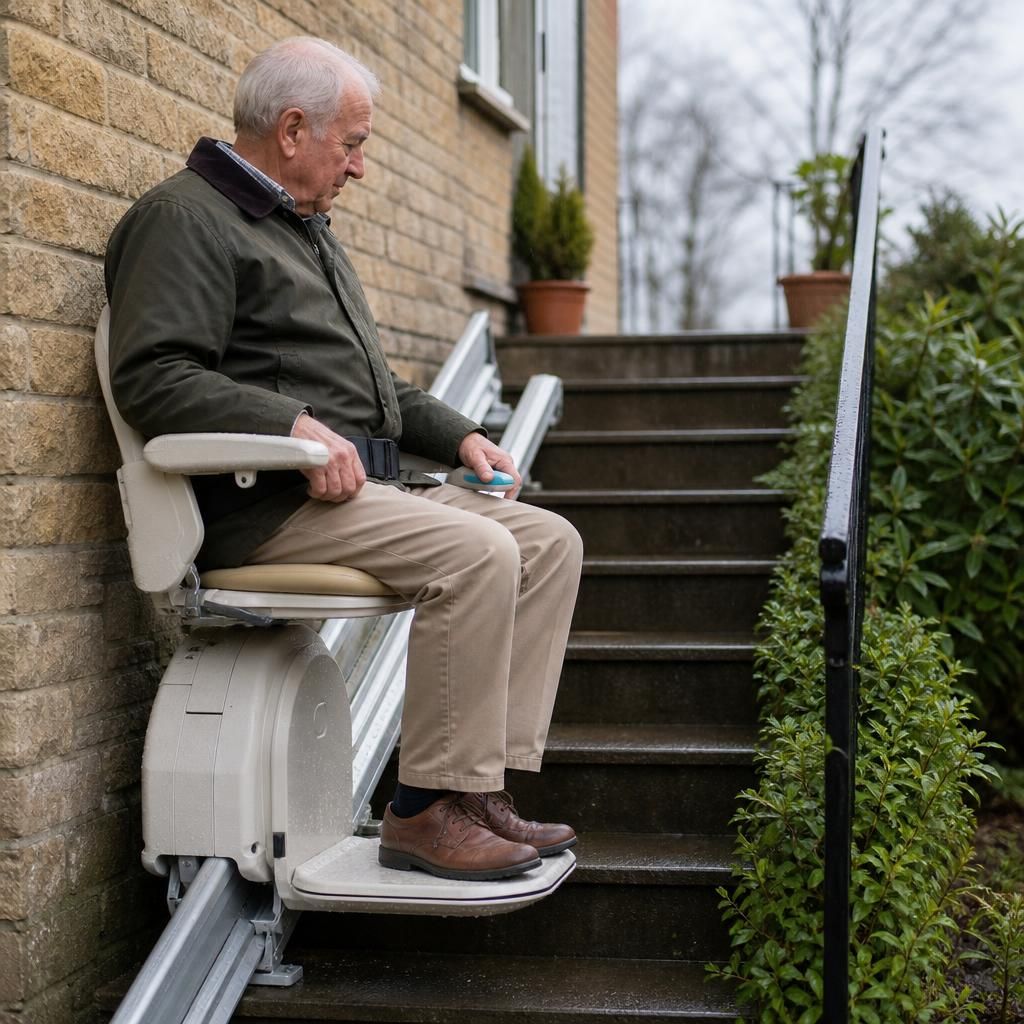
Arrange an outdoor stairlift safety assessment
Arrange an outdoor stairlift safety assessment with Independent Stairlifts to review the stairs, transfer areas, weather exposure and safety features required for your home.