
What factors should I consider when choosing an outdoor stairlift?
When choosing an outdoor stairlift, consider its weatherproofing, safety features, battery performance, suitability for your staircase and the user’s mobility needs. A professional assessment should also confirm installation requirements, access around the lift and the ongoing maintenance needed to keep it reliable in changing weather.
The main factors when choosing an outdoor stairlift are weather resistance, the design and condition of the staircase, the user’s mobility requirements, safety features, power and battery performance, installation practicalities, and ongoing maintenance. An outdoor stairlift should be assessed as part of the whole access route, not selected on the lift specification alone. A professional survey can confirm whether the proposed model is suitable for the steps, landings, exposure and way the user will approach and leave the seat.
Weatherproofing and environmental protection
Outdoor models are designed to tolerate conditions that would damage an indoor stairlift, but weather resistance varies between products and installations. Check that the lift is specifically rated for outdoor use and ask how its electrical components, controls, charging points and upholstery are protected from rain, frost, dust and sunlight.
- Consider whether the staircase is fully exposed or partly sheltered. A sheltered lift may experience less water and wind, but it can still be affected by damp, condensation and temperature changes.
- Look for durable, corrosion-resistant materials, particularly if the property is near the coast or in an area where salt and moisture are persistent.
- Ask how the seat, armrests and controls will withstand ultraviolet light, which can cause some materials to fade or deteriorate over time.
- Check whether a protective cover is supplied or recommended when the stairlift is not in use. A cover should be used in the way specified by the manufacturer and should not obstruct charging or trap moisture.
- Consider drainage around the steps and at the top and bottom of the rail. Standing water, mud, leaves and ice can affect both the staircase and the lift.
Weatherproofing does not make an outdoor stairlift maintenance-free. Keeping the rail, footrest, controls and surrounding steps clear helps reduce the effect of harsh conditions and supports safe operation.
The staircase and surrounding layout
The shape, width, gradient and surface of the stairs determine which outdoor stairlift can be installed. Straight staircases are usually more straightforward, while bends, intermediate landings and changes in direction may require a curved system or a different access solution. The survey should also consider the condition and strength of the steps, walls, handrails and fixing points.
- Measure the available width with the lift parked and in use, allowing enough room for the user to sit safely and for other people to pass where necessary.
- Check the space at the top and bottom of the stairs. The user may need room to turn, stand up, transfer from a wheelchair or open a gate.
- Identify obstructions such as doors, gates, plant pots, drainage channels, low branches and uneven paving.
- Consider where the stairlift will park when it is not being used. A parking position may need to be at the top, bottom or on a suitable landing to keep access clear.
- Review whether the route changes seasonally because of slippery surfaces, fallen leaves, snow or poor lighting.
If the outdoor route is very narrow, the user cannot transfer safely to a stairlift seat, or a wheelchair needs to travel with them, a platform lift or another access arrangement may be more appropriate. This should be decided during the assessment rather than assumed from the appearance of the staircase.
The user’s mobility and transfer needs
The best model is one the user can operate confidently and use without unsafe twisting, reaching or standing. Consider whether they can walk to the seat, sit down, turn, fasten a seat belt and stand safely at the destination. Pain, weakness, balance difficulties, reduced grip, visual impairment and cognitive changes can all affect the most suitable configuration.
- A powered swivel seat may help the user turn towards the landing instead of twisting on the stairs.
- Adjustable armrests, a suitable seat height and an appropriate footrest can make transfers more manageable.
- Simple, clearly marked controls may be important where hand strength, dexterity or vision is limited.
- Remote controls can allow a lift to be called from either end, but they should be easy to hold and operate.
- For users who remain in a wheelchair, a platform model may provide a more suitable route than transferring to a conventional chair.
Ask the assessor to consider the user’s likely needs over time as well as their current ability. A configuration that is manageable now may become difficult if mobility changes.
Safety features and safe access
Safety features should support, rather than replace, safe use of the staircase and careful installation. Depending on the model, useful features may include a seat belt, armrests, a swivel or locking seat, obstruction sensors, controlled stopping, a key switch and diagnostic indicators. Confirm which features are included as standard and which are optional.
Obstruction sensors should stop the lift if an object is detected in its path, but the route should still be kept clear of footwear, toys, tools, leaves and other debris. A seat belt should be used as instructed, and the user should remain seated with their arms and feet within the designated areas while travelling. Outdoor controls and charging points should be positioned so they can be reached without leaning into a hazardous area.
Lighting, non-slip surfaces, handrails and clear edges on the steps are also important. An outdoor stairlift cannot correct a slippery or poorly lit approach, so these surrounding safety issues should be included in the assessment.
Battery, charging and power resilience
Most stairlifts use rechargeable batteries so the lift can continue to operate during a mains power interruption, although the available travel depends on the condition and charge of the batteries. Ask where the charging points are located and whether the lift charges at its usual parking position or at another point on the rail.
- Make sure the user can reliably park the lift in the charging position.
- Check that the charging equipment is protected from rain and accidental damage.
- Ask how cold weather affects battery performance and what signs indicate that batteries need attention.
- Discuss what happens if the lift stops away from a charging point or if there is a prolonged power cut.
Battery condition is particularly important for an outdoor installation because low temperatures and infrequent use can affect performance. Regular servicing can identify declining batteries before they prevent normal use.
Installation requirements and access around the lift
The installation team will need to fix the rail securely while preserving the strength and condition of the staircase. Outdoor structures may require additional consideration where surfaces are uneven, fragile, damp or exposed to movement. The survey should identify cable routes, charging arrangements, drainage and any need to protect walls, paving or external finishes.
Planning or building-control requirements can vary according to the property, the structure and the type of equipment. The installation provider should explain any permissions or coordination needed before work begins, particularly where the lift affects a shared access route, boundary or communal area. The finished installation should leave doors, gates, handrails and escape routes usable wherever practicable.
Maintenance, servicing and warranty support
Before choosing a model, establish what routine care is required, how faults are reported and whether an engineer can support the installation in your area. National coverage is useful, but the important point is that help, replacement parts and trained servicing are available for the specific model installed.
- Ask how often the lift should be professionally serviced.
- Confirm which components are checked, including batteries, charging contacts, safety sensors, fastenings, controls and moving parts.
- Find out how to clean the lift without allowing water into electrical components.
- Check the warranty terms, exclusions and arrangements for call-outs or replacement parts.
- Ask how long parts are expected to remain available, particularly for a reconditioned or older lift.
Between services, keep the rail and steps clear, remove surface debris, follow the recommended cleaning instructions and report unusual noises, jerky movement, warning lights or charging problems promptly. Do not attempt electrical repairs or bypass a safety feature.
Comfort, usability and everyday convenience
The lift should be practical for the way the user actually accesses the garden or exterior area. Consider the seat material, armrest position, footrest size, control layout and whether the user will need to carry shopping, walking aids or personal items. A lift that is technically suitable may still be inconvenient if the user cannot reach the controls or has nowhere safe to place a walking stick when seated.
Think about who else uses the steps. A fold-up seat and footrest can help preserve the passageway, while a parking position away from the main route can reduce obstruction. If more than one person will use the lift, check that the controls and seating can be used safely by everyone.
Cost and the complete ownership requirement
Compare the complete installation rather than only the purchase price. The total cost may depend on the rail design, staircase preparation, electrical work, weather protection, optional seating or controls, installation access and future servicing. A lower initial price may not represent good value if the model is poorly suited to the environment or has limited support.
Ask for a clear specification showing what is included, the warranty arrangements, expected maintenance and any additional work identified during the survey. If considering a reconditioned outdoor stairlift, confirm its condition, suitability for outdoor exposure, battery status, testing and aftercare provision.
What to discuss during the assessment
Before making a decision, explain how often the lift will be used, who will use it, where the user approaches and leaves the stairs, and what difficulties they currently experience. Point out seasonal problems such as flooding, ice, strong wind, coastal spray or heavy leaf fall. It is also helpful to discuss future mobility needs and any wheelchair, walking frame or transfer equipment that must be accommodated.
The assessment should result in a recommendation that covers the model, rail route, parking position, charging arrangement, safety features, weather protection, installation work and maintenance plan. Taking these factors together gives a more reliable basis for choosing an outdoor stairlift than comparing isolated features or prices.
Weatherproofing is a key factor when choosing an outdoor stairlift because the lift must operate reliably despite rain, frost, sunlight, dust and changing temperatures. Check that the model is specifically designed for outdoor use, with suitable protection for its electrical components, controls, charging points and upholstery.
The surrounding environment matters too. Coastal air, standing water, fallen leaves, mud and ice can increase wear or affect safe operation. Ask whether a protective cover is recommended, where the lift will charge and how the rail and steps should be cleaned. A professional assessment can also identify drainage or shelter improvements that may help protect the installation and keep the route clear.
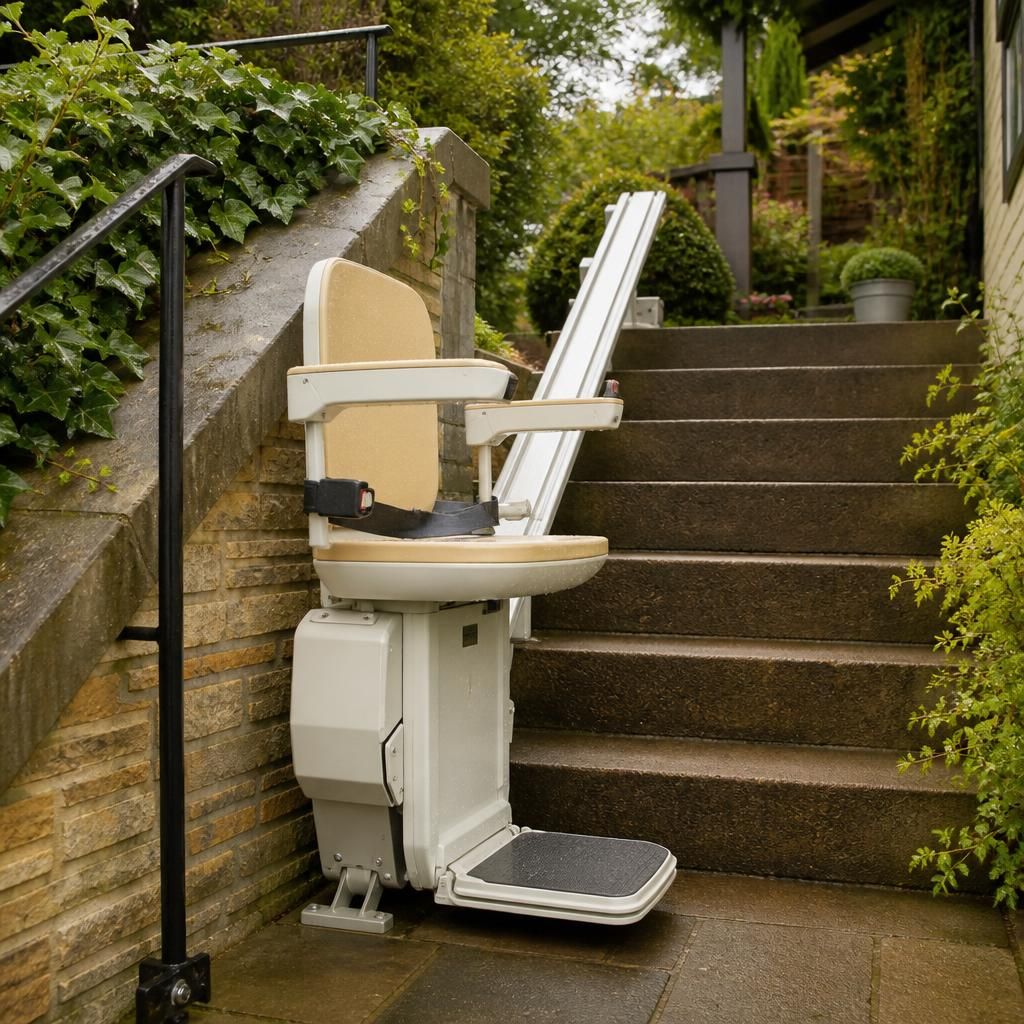
Arrange an Outdoor Stairlift Assessment
Arrange an outdoor stairlift assessment to review your staircase, weather exposure, access needs and the most suitable model. Independent Stairlifts can confirm the installation requirements, safety features, charging arrangements and ongoing care needed for your home.