
What are the installation requirements for outdoor stairlifts?
Outdoor stairlift installation requires a professional assessment of the staircase, access route, fixing surfaces, power supply, drainage and exposure to weather. The lift must be securely mounted, suitably weatherproofed and safety-tested, with the installation adapted to the property and the user’s needs.
Outdoor stairlift installation requires a professional site assessment, a suitable fixing surface, a safe route, an appropriate power supply and protection from the weather. The installer must check the staircase and surrounding access area before recommending equipment. The final installation should be securely mounted, designed for the user and property, electrically safe, weatherproofed and fully tested before handover.
The main installation requirements are:
- A detailed site survey: The installer assesses the number and shape of the steps, the available width, landings, gradients, turning areas and the approach at the top and bottom. They also consider gates, paths, walls, doorways, vegetation and any other obstruction that could affect safe use.
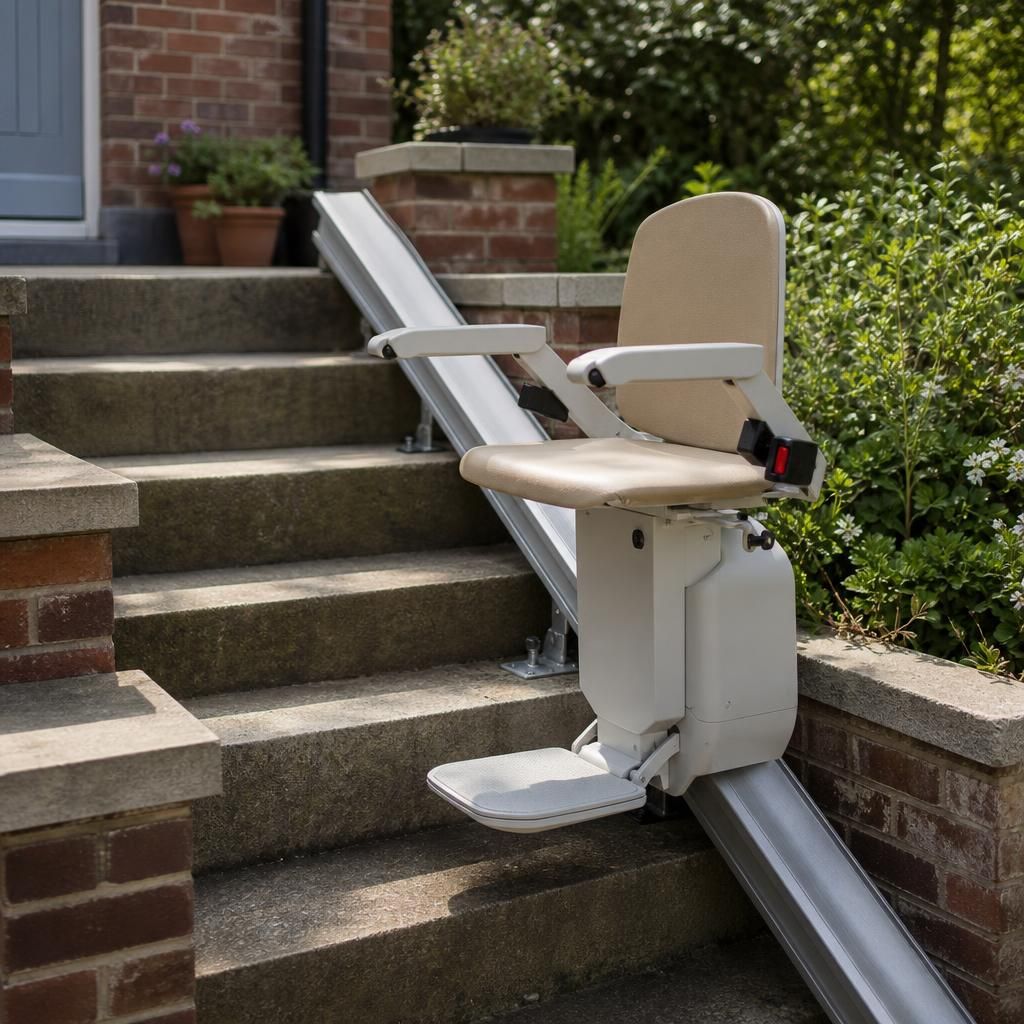
- A sound structure for fixing: The stairlift rail and brackets must be attached to a stable surface capable of supporting the equipment and the user. This may be concrete, masonry, timber or another suitable structure, but its condition and construction must be verified. Loose paving, crumbling masonry, damaged steps or unstable retaining walls may need attention before installation.
- Suitable rail positioning: The rail must follow the staircase while leaving enough clearance for the seat, footrest and user. At the top and bottom, the installer checks that the user can get on and off safely without stepping into a hazard. Where space is limited, the design may need a suitable option such as a different parking position, subject to the manufacturer’s specifications.
- Weather-resistant equipment: An outdoor model is required rather than an indoor stairlift placed outside. Components such as the seat, controls, covers, switches, batteries and charging equipment must be suitable for exposure to rain, damp, sunlight, frost, dust and temperature changes. Protective covers should be fitted and used as instructed when the lift is parked.
- A reliable power supply: The charging point and electrical connections must be installed in an appropriate, protected location. The supply should be suitable for the stairlift and positioned so that cables do not create a trip, crush or water-ingress risk. Any required electrical work must be carried out and tested by a suitably competent person in accordance with applicable UK requirements.
- Effective drainage: Water must be able to drain away from the steps, rail, charging point and landing areas. Persistent pooling, blocked drains or heavy run-off can accelerate corrosion and make steps slippery. The survey should identify these issues and establish whether drainage or surface repairs are needed.
- A safe walking route: An outdoor stairlift does not remove every risk from the staircase. Steps and landings should remain stable, adequately lit and as free from moss, ice, leaves and other debris as reasonably possible. Handrails, gates and surfaces may need adapting where they interfere with the lift or the user’s transfer.
Access and user requirements are assessed alongside the property. The installer considers the user’s height, weight, mobility, balance, ability to transfer on and off the seat, and whether they can operate the controls. A person who cannot safely sit upright or use a standard seat may need an alternative configuration or further clinical advice. If more than one person will use the stairlift, the assessment should account for each user rather than assuming that one setup will suit everyone.
The position of the controls, direction of travel, seat belt, armrests and footrest should all be checked during the assessment. The user must be able to reach and operate the controls without leaning dangerously. If a carer or family member will assist, there must also be enough room for that support without standing on the staircase or obstructing the lift.
Fixings and the installation method depend on the staircase. A straight outdoor staircase may allow a relatively direct rail installation, while a curved or interrupted route requires a rail made to follow the individual staircase. The installer may need to work around walls, posts, drainage channels, uneven paving or changes in level. The rail should not obstruct doors, gates or normal pedestrian access, and fixings should be selected to resist the outdoor environment as well as the forces created during use.
Before work begins, tell the installer about buried services, underfloor heating, drainage pipes, previous building work, fragile surfaces or known structural defects. This information can help avoid damage and may affect where brackets or electrical equipment can be positioned.
Planning and property considerations should be checked before installation. Many domestic stairlift installations do not require a conventional planning application, but requirements can vary for listed buildings, conservation areas, shared properties, rented homes and installations that alter walls, gates or external structures. The property owner, landlord, managing agent or relevant local authority may need to give permission. Where the staircase is shared or forms part of a communal route, fire safety and access arrangements require particular care.
The installation team should protect the surrounding area while working, keep fixings and tools away from the walking route and leave the staircase clean and usable. Any changes to paving, walls, handrails, gates or electrical connections should be explained before they are carried out.
Safety checks are completed before the stairlift is handed over. These normally include checking the rail and brackets, travel path, seat belt, swivel or transfer mechanism, footrest sensors, obstruction sensors, controls, emergency stop functions, batteries, charging points and protective covers. The installer should also test operation at the top and bottom of the staircase and confirm that the lift stops correctly if it encounters an obstruction or reaches the end of its travel.
You should receive operating instructions and information about charging, cleaning, protective covers, emergency procedures and routine maintenance. Ask the installer to demonstrate how to park the lift, isolate it if necessary, report a fault and use any manual lowering or release function. Do not use the stairlift until the installation has been tested and you understand these controls.
Some preparation helps the installation proceed safely. Before the survey, clear personal items, plant pots and furniture from the staircase and landings, and identify any access restrictions. Arrange for pets and other household members to remain away from the work area. If the outdoor steps are currently slippery, damaged or overgrown, mention this when booking the assessment rather than treating it as a minor issue.
After installation, keep the rail and charging area clear, use the supplied weather protection, and follow the recommended maintenance schedule. Remove leaves, grit, moss and standing water promptly, but do not use harsh chemicals or pressure-washing equipment unless the manufacturer specifically permits it. Report unusual noise, intermittent charging, corrosion, damaged covers, rough movement or repeated safety stops promptly. These checks help preserve reliable operation and identify weather-related deterioration before it affects safe use.
In practice, the exact requirements cannot be confirmed from photographs or a general description alone. A professional assessment is needed to verify the structure, access, electrics, drainage, weather exposure and user requirements, then specify an outdoor stairlift and installation method that are appropriate for that particular property.
A sound fixing surface is essential for an outdoor stairlift. The rail and brackets must be secured to stable concrete, masonry, timber or another approved structure that can support the lift and user safely in changing outdoor conditions.
During the survey, the installer checks for loose paving, cracked steps, crumbling walls, unstable retaining structures and hidden services such as drainage pipes. Any defects may need repairing before installation, and the fixing method may need adapting to uneven surfaces or changes in level. Brackets must also be positioned so the rail follows the staircase without obstructing gates, doors or the normal walking route.
Once fitted, the rail, brackets and travel path are checked under operating conditions. This confirms that the lift is securely mounted, clears surrounding obstacles and provides safe access at both ends of the staircase.
Arrange Your Outdoor Stairlift Installation Assessment
Arrange an outdoor stairlift installation assessment so we can check your staircase, fixing surfaces, power supply, drainage and access requirements. We’ll recommend a suitable installation approach for your property and individual needs.