
What maintenance and support services are available to ensure long-term performance of outdoor stairlifts?
Long-term outdoor stairlift performance is supported through scheduled servicing, safety inspections, cleaning and lubrication, battery checks, and prompt repairs when required. Independent Stairlifts can also provide practical operating advice, replacement parts and ongoing support to help keep your lift reliable in changing outdoor conditions.
Long-term outdoor stairlift performance is supported by planned servicing, safety inspections, weather-related checks, battery and charging assessments, cleaning, lubrication, repairs and access to suitable replacement parts. Independent Stairlifts can assess the lift in its installed environment and provide ongoing support in line with the manufacturer’s guidance, the condition of the equipment and how frequently it is used.
Scheduled servicing and safety inspections
A service visit allows a trained engineer to check that the stairlift is operating safely and consistently. The inspection may include the seat, armrests, footrest, swivel mechanism, seat belt, controls, sensors, carriage, charging points and track fixings. The engineer can also check for unusual noise, vibration, hesitation or changes in stopping position, as these may indicate wear or an adjustment requirement.
Outdoor stairlifts should be serviced at intervals recommended for the specific model and installation. More frequent attention may be appropriate where the lift is exposed to severe weather, used heavily, installed near the coast or affected by dirt, leaves, salt or standing water. Keeping service records helps identify recurring issues and provides a useful maintenance history if parts or further investigation are needed.
Cleaning, lubrication and weather-related checks
Outdoor equipment needs practical care because rain, frost, dust and organic debris can affect moving parts and electrical connections. During a service, the engineer can clean accessible components, remove debris from the track and check that relevant moving parts are lubricated with products suitable for the stairlift. Lubrication should not be improvised, as unsuitable oils or sprays can attract grit or damage components.
The engineer may also inspect seals, covers, drainage points and exposed connections for signs of water ingress, corrosion or deterioration. A protective cover can help when the stairlift is not in use, but it must be fitted and removed as instructed so that moisture is not trapped around the equipment. Covers are not a substitute for servicing or for checking the lift after exceptionally wet, cold or windy conditions.
Battery and charging support
Outdoor stairlifts generally rely on rechargeable batteries so that they can continue to operate during a mains power interruption. Servicing includes checking whether the batteries are charging correctly, whether the charging contacts are clean and aligned, and whether the lift is holding charge as expected. Batteries are consumable components and will eventually require replacement.
Customers should leave the stairlift at its designated charging point when it is not being used, unless the operating instructions say otherwise. If the lift sounds an alert, stops short of its charging position or shows reduced performance, contact Independent Stairlifts rather than repeatedly operating it until the batteries are fully discharged.
Fault diagnosis and repairs
Support can include telephone guidance, an initial assessment and an engineer visit where a fault cannot be resolved safely by simple checks. Common repair requirements may involve worn rollers, switches, controls, batteries, charging components, sensors, wiring or weather-affected covers and connections. The engineer should identify the cause of the fault, explain the work required and advise whether a repair or replacement component is appropriate.
Do not attempt to bypass safety sensors, open electrical housings or repair the stairlift yourself. If the lift stops unexpectedly, makes an unfamiliar noise, moves unevenly or shows signs of electrical or water damage, stop using it and request advice. If someone is stranded on the stairs, follow the emergency procedure provided with the lift and contact the appropriate support service.
Replacement parts and longer-term support
When a component reaches the end of its serviceable life, suitable replacement parts can help preserve safe and reliable operation. Parts should be compatible with the installed model and specification. A repair assessment can also identify whether improvements such as replacement controls, a new seat belt or updated protective components would make the lift more practical for the current user.
Support may also include advice for family members and carers, refresher guidance on controls, and recommendations if the user’s mobility or the outdoor access route changes. If the stairlift is no longer used for an extended period, ask how it should be isolated, protected and maintained before leaving it unused.
Checks customers can carry out safely
- Keep the track, steps, landing and charging area clear of leaves, mud, snow and other obstructions.
- Check visually for loose covers, damaged cables, corrosion, water ingress or objects caught in the mechanism.
- Keep the lift at its charging point when instructed and avoid switching off its power supply unnecessarily.
- Use the seat belt and controls as described in the operating instructions.
- Report changes in movement, sounds, battery behaviour or stopping position promptly.
Routine user checks are helpful, but they do not replace professional servicing. The correct maintenance plan depends on the stairlift model, track arrangement, exposure, usage and installation site. Independent Stairlifts can advise on the appropriate service schedule and provide practical support to help keep an outdoor stairlift safe, dependable and suitable for continued use.
Professional servicing helps identify weather-related wear before it affects the outdoor stairlift’s safety or reliability. An engineer can inspect the track, carriage, charging points, controls, safety sensors, covers and exposed connections for dirt, corrosion, water ingress or loose fixings.
Servicing can also include cleaning accessible parts, applying suitable lubrication, checking battery performance and confirming that the lift stops and charges correctly. If a fault or worn component is found, Independent Stairlifts can advise on compatible replacement parts or repairs. Regular support is particularly important where the stairlift is exposed to coastal air, heavy rain, frost, leaves or frequent use.
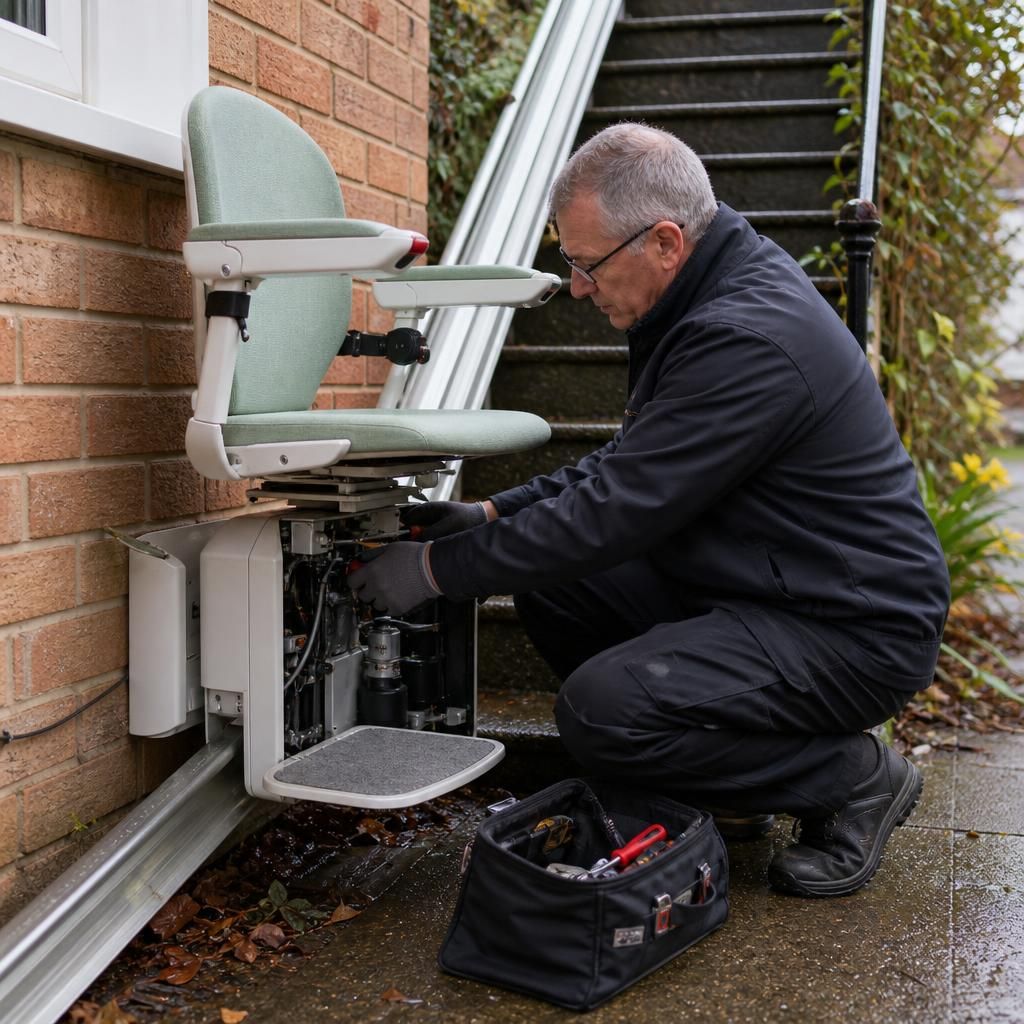
Arrange outdoor stairlift maintenance and support
Contact Independent Stairlifts to arrange outdoor stairlift servicing, safety checks, repairs or advice on replacement parts. We can help keep your lift reliable and suitable for continued use.