
How do outdoor stairlifts accommodate different staircase designs, such as curved or straight layouts, for optimal functionality?
Outdoor stairlifts are designed to match the shape, length and landing layout of your staircase. Straight flights generally use a standard straight rail, while curved or multi-level stairs require a bespoke rail made to follow each bend, with weather-resistant components and safety features selected for the installation.
Outdoor stairlifts are configured to follow the physical shape of the staircase, whether it is a straight flight, a curved run, or a set of stairs with intermediate landings. A straight staircase usually uses a standard rail cut to the required length, whereas a curved, multi-level or changing-direction staircase needs a bespoke rail manufactured to follow its bends, gradients and landing positions. In both cases, the installation is assessed around the user, the available space and the conditions outside the property.
How straight outdoor stairlifts are fitted
A straight outdoor stairlift is suitable where the steps run continuously between two points without a change of direction. The rail is normally installed alongside the steps and secured to the treads or another suitable supporting structure, rather than relying on the wall. This allows the lift to travel in a consistent line while leaving the handrail and access areas usable where the staircase permits.
The rail length is selected to provide safe access at the top and bottom of the flight. Depending on the layout, the stairlift may finish at the edge of the landing, extend beyond the final step, or incorporate a suitable parking position. A powered or manual swivel seat, folding footrest and hinged or retractable rail may be considered where a doorway, pathway or narrow landing could otherwise obstruct movement.
Outdoor versions use weather-resistant materials and protective covers for the chair, controls and charging equipment. The installation still needs to account for rainwater, drainage, exposure to sunlight and the position of nearby doors or gates. A straight rail is simpler than a curved one, but it must be measured accurately to avoid leaving an awkward gap or creating an obstruction at either end.
How curved and multi-level stairlifts are fitted
Curved outdoor stairlifts are made for staircases that turn, include a bend, change gradient or connect more than one flight. A bespoke rail is shaped to the staircase after a detailed survey. It can be designed to follow curves, corners and transitions between flights, allowing the seat to travel smoothly through the available route rather than stopping at each section.
The survey considers the width of every part of the staircase, the position of landings, the height of the steps, the direction of travel and the space needed for the user’s feet and arms. It also checks whether the rail could affect a door, pathway, handrail or access route. Where space is restricted, the rail and parking position may be planned so the chair is kept clear of the main walking area when it is not in use.
Curved systems generally require more detailed design and installation than straight systems because the rail must be accurate at every change in direction. The lift may use a continuous rail through several sections, with the controls and seat movement configured to keep the user stable while travelling around the staircase. A suitable parking position at the top or bottom can also reduce the need to turn or transfer in a confined area.
Layouts that need particular planning
- Stairs with a landing: The lift can be designed to continue around the landing or stop at a planned transfer point, depending on the available space and the user’s ability to move between sections.
- Staircases with several flights: A bespoke design can link the flights where the layout and safety clearances allow it. In some homes, separate lifts may be more practical if the flights are widely separated or have different access requirements.
- Narrow or winding stairs: The rail position, seat width, footrest and parking location are reviewed together to maintain clearance for the user and other people using the stairs.
- External steps with a turn: The design must allow for uneven surfaces, exposed corners, drainage and changes in level as well as the curve itself.
- Stairs leading to a gate or path: The lift may need an extended rail, a safe swivel position or a different parking arrangement so the user can leave the chair without blocking the route.
Features that support safe operation on different designs
The chair should be positioned so that the user can sit down and stand up on a stable, level area where possible. Swivel seats, adjustable armrests, folding footrests and seat belts can make transfers easier, particularly at the top or bottom of a staircase. Obstacle sensors help stop the lift if an object is detected on the rail or steps, while controls on the armrest and remote controls can provide convenient operation from either end.
On a curved staircase, speed control and smooth transitions are particularly important because the lift changes direction or gradient. On a straight staircase, the main considerations are usually the rail length, end clearances, parking position and access around the chair. Weatherproof controls, sealed electrical components and a protective cover are relevant to both designs, although the level of exposure varies between installations.
Why an assessment is important
Outdoor staircases often differ from indoor stairs in ways that affect the design. They may have open sides, irregular treads, retaining walls, gravel or paving nearby, limited shelter, or surfaces that become slippery in wet or icy conditions. An assessment checks the structure supporting the rail, the electrical supply, drainage, clearances and the safest points for boarding and leaving the lift.
The assessment also considers the user’s mobility, posture, weight, transfer ability and likely clothing or footwear. These details can influence the choice of seat, controls and parking position. Measurements should be taken at every part of a curved staircase rather than estimating from a simple floor plan. For a straight flight, accurate measurements are still needed to confirm that the chosen rail will reach the required landing without compromising access.
Once the layout has been assessed, the proposed rail route and parking positions should be explained clearly before installation. This helps confirm how the stairlift will work in everyday use, where it will charge, how it will be protected when parked and whether other people can continue to use the stairs safely.
In practical terms, a straight outdoor stairlift is normally the most straightforward solution for a single, uninterrupted flight. A curved or multi-level staircase calls for a tailored rail and more detailed planning, but the same principles apply: the lift must follow the route accurately, provide stable boarding and exit positions, withstand outdoor exposure and leave the surrounding access usable. A site-specific assessment is the reliable way to determine which configuration will provide safe, functional access around your home.
Outdoor stairlifts accommodate different staircase designs by using either a straight rail for an uninterrupted flight or a bespoke curved rail for bends, landings and changes in direction. The rail is measured and positioned to follow the staircase accurately while preserving safe space for boarding, leaving the seat and using the surrounding path.
A site assessment is particularly important outdoors because the design must also allow for drainage, uneven surfaces, doors, gates, handrails and exposure to the weather. On a curved staircase, the assessment determines how the rail transitions between sections and where the chair can park safely. On a straight flight, it confirms the correct rail length, end clearances and charging position. Weather-resistant controls, protected electrical components and a suitable cover can then be selected for the specific installation.
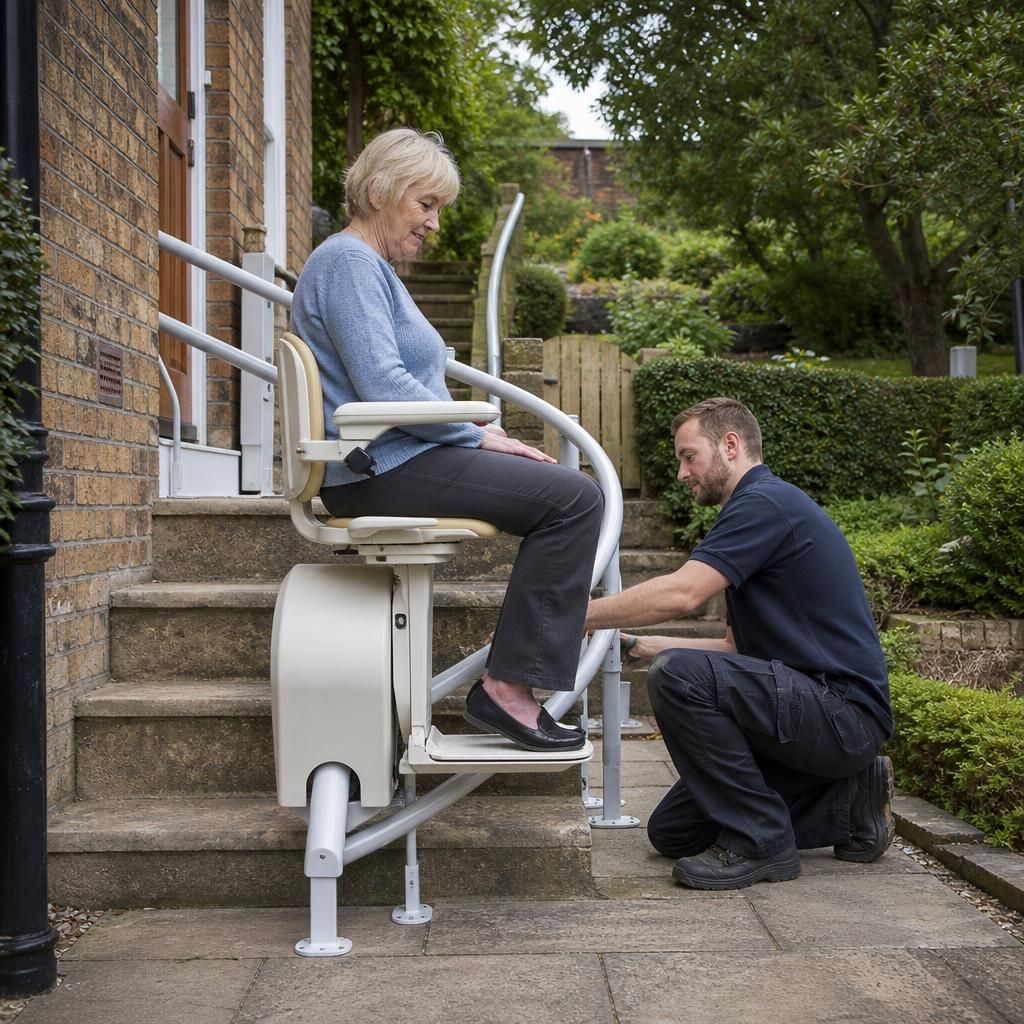
Arrange your outdoor stairlift assessment
Arrange an outdoor stairlift assessment with Independent Stairlifts to confirm the most suitable rail, parking position and weather protection for your straight, curved or multi-level staircase.