
How do I choose the right outdoor stairlift for my specific needs and setting?
Choose an outdoor stairlift by assessing the staircase layout, the user’s mobility and transfer needs, the level of weather protection required, and the available space at the top and bottom of the stairs. A professional home assessment will confirm the safest configuration, suitable features and installation approach for your particular setting.
Choosing the right outdoor stairlift involves matching the equipment to the staircase, the user’s mobility and transfer needs, the available space, and the level of exposure to the weather. A professional assessment is the most reliable way to confirm whether a straight or curved model is suitable, where it can be positioned safely, and which features will make everyday use practical.
Start with the staircase and surrounding space
The shape and construction of the stairs determine the type of outdoor stairlift required. A straight flight will usually suit a straight outdoor stairlift, while a staircase with a bend, landing, intermediate turn or change in direction may require a curved system designed around the individual route. The assessment should consider more than the stairs themselves. The installer will also look at the landing areas, doorways, paths, gates, walls, railings and any obstacles that could affect access or parking.
Space at the top and bottom of the staircase is particularly important. The chair must be able to reach a safe stopping position without obstructing a doorway, pathway or other household access. Depending on the layout, options such as a hinged rail, a powered swivel seat or a different parking position may help manage limited space. The position of the controls and the direction in which the user gets on and off should also be considered rather than assumed.
Consider how the user will transfer on and off the chair
The user’s mobility needs should guide the choice of seat, armrests and controls. Someone who can stand briefly and turn may be comfortable with a conventional seat, whereas a person with reduced balance, joint pain or significant weakness may need features that make transfers more controlled. A powered swivel seat can help turn the user towards the landing, reducing the need to twist while getting off. A perch-style or standing stairlift may be appropriate in some settings, but only after an assessment confirms that the user can use it safely.
Consider whether the user can bend their knees, sit upright, reach the controls, use a seat belt and operate the footrest. Adjustable or supportive armrests, a suitable seat height and a straightforward restraint can all affect confidence and stability. If more than one person will use the stairlift, the configuration should accommodate the needs of the person with the greatest difficulty, while remaining comfortable and simple for other users.
Check the stairlift’s capacity and dimensions
Every stairlift has manufacturer-specified limits for user weight, seat dimensions and stairway clearance. These must be checked against the user’s requirements and the available width of the staircase. A thorough survey will identify whether the lift leaves enough room for other people to use the stairs and whether the chair, footrest or rail could interfere with nearby walls, doors or handrails.
Do not choose a model based on appearance alone. A compact design may be useful on a narrow flight, but it still needs to provide adequate support and a comfortable seating position. Conversely, a larger seat or enhanced support may be preferable where space allows. The installer should explain any compromises between seat size, folding components, stair clearance and parking options before installation.
Match the weather protection to the installation site
Outdoor stairlifts are designed for external use, but different locations expose them to different conditions. A sheltered stairway beneath a canopy may need less protection than an exposed set of steps facing driving rain, strong wind or direct sunlight. Salt air, mud, leaves, frost and standing water can also influence the specification and maintenance requirements.
Look for an outdoor-rated model with suitable protection for its electrical and mechanical components, durable surfaces and a battery system designed for the installation. Covers can help protect the chair when it is parked, although they should be used as advised by the manufacturer and should not trap moisture. The rail and charging points should be positioned so that water does not collect around vulnerable components. Regular cleaning and inspection remain important even when the lift is weather-resistant.
Prioritise controls and safety features that the user can manage
Controls should be easy to see, reach and operate, particularly if the user has limited hand strength, reduced dexterity or visual impairment. A simple control on the armrest is commonly useful, while call-and-send controls at the landings allow the stairlift to be brought to the required level. Remote controls may be helpful where more than one person uses the lift, but they should not replace clear, accessible controls on the chair.
Discuss the features that support safe travel, including a seat belt, armrests, obstruction sensors, a swivel mechanism, a safety edge and a manual or powered footrest where appropriate. Battery backup is also important because it allows the stairlift to continue operating during a power interruption, subject to the model and the condition of the batteries. Ask how the lift stops, what warning indicators mean and what the user should do if it stops unexpectedly.
Think about charging and day-to-day use
The stairlift needs to park in a position where it can charge reliably without blocking access or being exposed unnecessarily to the weather. Some systems can charge at more than one point, which may be useful on a longer route or where the usual parking position is inconvenient. The assessment should confirm that the charging arrangement suits the user’s routine and that the lift will not be left away from its charging point for extended periods.
Ask for a practical demonstration before deciding. The user should be able to approach the seat, operate the controls, fasten the restraint, travel at a comfortable speed and get off safely at the destination. They should also understand how to fold the seat or footrest, park the lift, use the emergency stop if fitted and report a fault.
Compare installation, servicing and future support
A suitable outdoor stairlift is one that can be supported throughout its working life, not simply one that fits the stairs on the day of installation. Confirm what is included in the quotation, such as the survey, preparation, installation, demonstration and removal of any redundant equipment. Ask about the warranty, servicing arrangements, fault reporting process and availability of replacement parts.
Reconditioned equipment may be an option in some installations, provided that its condition, compatibility, safety checks, warranty and ongoing support are clearly explained. The right choice depends on the staircase and the user’s requirements rather than whether the equipment is new or reconditioned.
Use the home assessment to make the final decision
Before the assessment, note where the user currently struggles, whether they need help transferring, how often the stairs are used and which areas must remain accessible. Mention any relevant changes in mobility or medical needs, as these may affect the seat style, controls or positioning. The surveyor can then compare suitable configurations, explain limitations and identify any preparation needed around the staircase.
The best outdoor stairlift is therefore the one that provides a safe transfer, follows the staircase correctly, parks without creating an obstruction, withstands the conditions at the property and can be operated confidently by the intended user. A personalised recommendation from Independent Stairlifts will take these practical factors into account rather than relying on a standard model for every home.
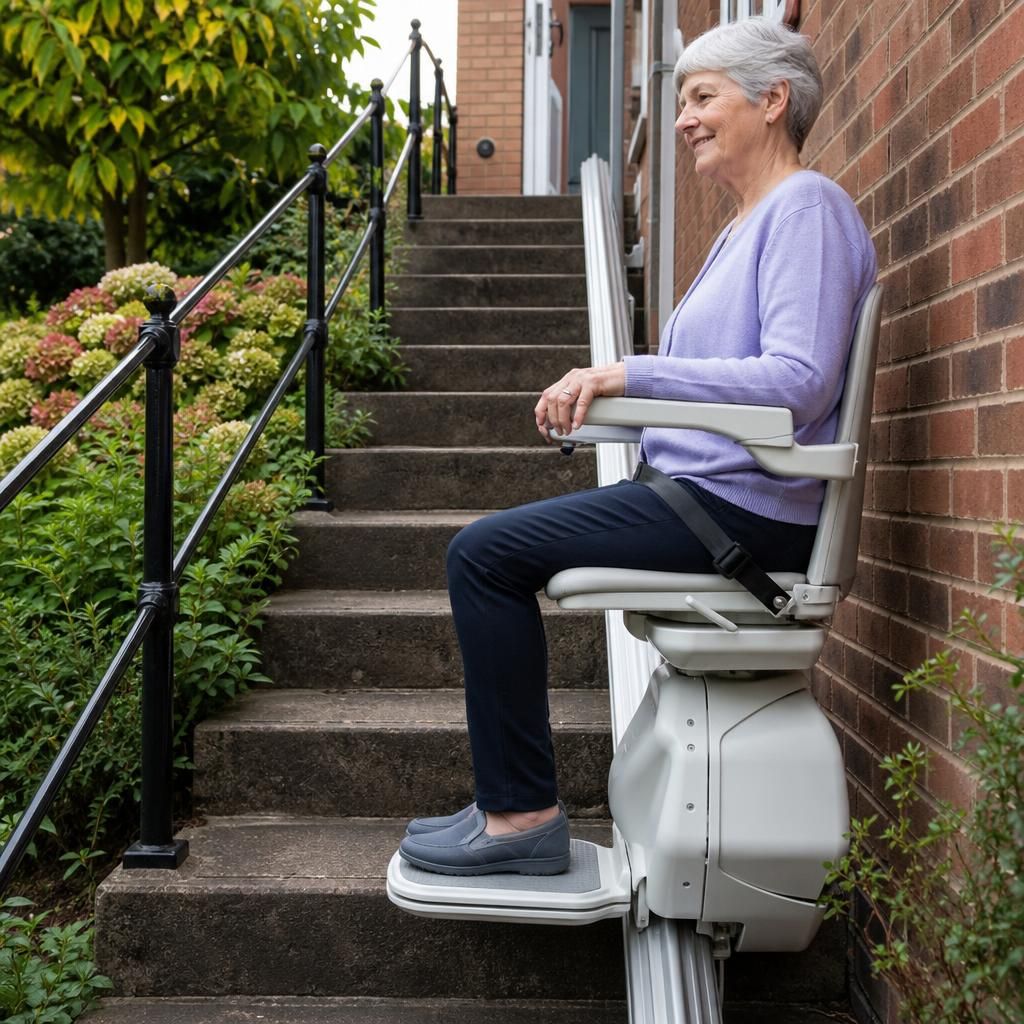
The right outdoor stairlift is determined by the user’s mobility needs and the layout of the staircase, not by the appearance of the equipment alone. A professional assessment should check how the user approaches, sits down, fastens the seat belt, travels and gets off at the destination.
Consider whether the user can bend their knees, maintain an upright position and turn safely at the top or bottom of the stairs. A powered swivel seat may make transfers easier by turning the user towards the landing, while supportive armrests, accessible controls and a suitable seat height can improve stability and confidence. The stairlift must also have enough clearance for the user, chair and footrest without obstructing doors, paths or other household access.
Tell the surveyor about any changes in balance, strength, dexterity or vision, and ask for a practical demonstration before installation. This helps confirm that the chosen controls, restraint and transfer position are manageable for the intended user in everyday conditions.
Book Your Outdoor Stairlift Assessment
Book an outdoor stairlift assessment with Independent Stairlifts to review the staircase layout, available space, weather exposure and the user’s transfer needs. We will recommend a suitable configuration and explain the relevant features, installation requirements and ongoing support.