
Can outdoor stairlifts be customised with additional features to enhance accessibility and user experience?
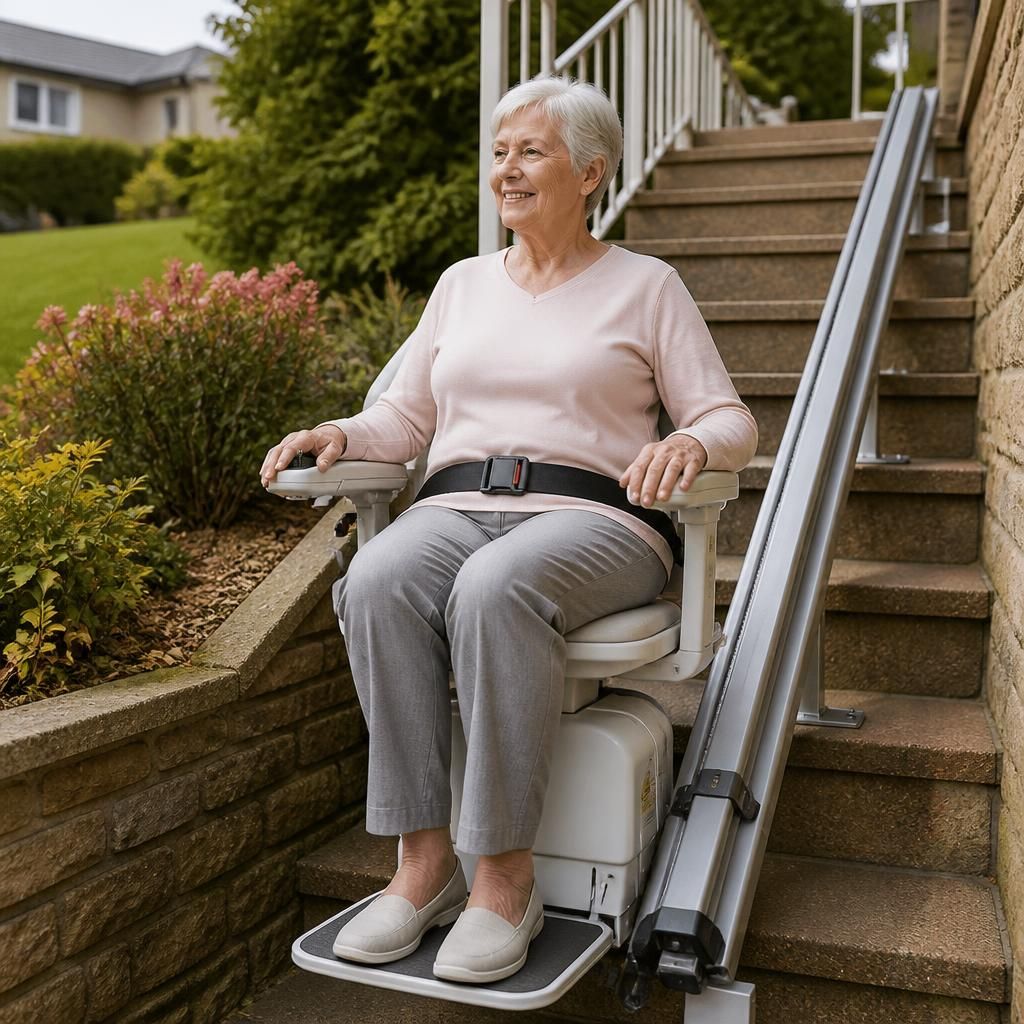
Yes. An outdoor stairlift can often be customised with features such as weather-resistant upholstery and controls, a powered swivel seat, adjustable or foldable footrests, safety belts, armrests and remote controls, subject to the staircase and user’s needs.
A professional assessment will identify suitable options for the slope, access points and outdoor conditions, helping ensure the finished installation is safe, practical and comfortable to use.
Yes. Outdoor stairlifts can usually be customised with additional features to improve safety, comfort and ease of use, provided the staircase, landing areas and user’s needs are suitable. Options may include weather-resistant materials, powered swivel seating, adjustable armrests, different control arrangements, folding components, safety belts and remote controls. A professional assessment is essential because not every feature is appropriate for every staircase or user.
Customisation starts with the outdoor environment rather than the stairlift model alone. The assessment should consider whether the stairs are straight or curved, the available space at the top and bottom, the position of gates or pathways, exposure to rain and sunlight, drainage, electrical access and the way the user approaches the seat. These details affect the type of rail, seat position, parking location and controls that can be installed safely.
Seating and transfer features can make getting on and off the stairlift more manageable:
- A powered swivel seat can rotate towards the landing, reducing the need to twist while sitting down or standing up.
- Manual or powered folding footrests can help keep access routes clear when the lift is parked.
- Adjustable armrests may provide better support and help accommodate different body sizes.
- A choice of seat height or seating configuration may make transfers easier where the user has restricted movement in the hips, knees or back.
- A safety belt or harness helps keep the user securely positioned during travel. The most suitable restraint depends on the person’s posture, balance and ability to use the release mechanism.
Powered options can be helpful when hand strength or dexterity is limited, but they also add controls and moving parts. The user must be able to operate them reliably, or have suitable assistance. During an assessment, it is useful to consider whether the person can release the belt, use the joystick or switches, and respond if the stairlift stops between its parking points.
Controls can be adapted to suit the way the user accesses the stairs. A control can often be positioned on the armrest, and remote controls may allow the stairlift to be called to the required end of the staircase. This can be useful when more than one person uses the stairs or when the lift has been left at the opposite end. Controls should be easy to identify and operate, particularly for someone with reduced grip, vision or coordination. Two-way controls should be positioned so they do not obstruct the stairway or create a trip hazard.
Outdoor protection is an important part of customisation. Outdoor stairlifts are designed for external use, but exposed equipment still needs suitable protection and care. Weather-resistant upholstery, sealed controls and protective finishes can help the stairlift cope with rain, damp, sunlight and temperature changes. A cover may also be appropriate when the lift is parked, especially where it is not protected by a porch or canopy. Covers should be used in accordance with the manufacturer’s instructions and should not trap moisture against the equipment.
The installation can also be planned around the way the staircase is used. For example, the stairlift may be parked in a position that leaves a gate, doorway or path usable, where the layout allows. A hinged rail or other space-saving arrangement may be considered if the lower or upper end of the rail would otherwise interfere with an entrance. On curved stairs, the rail is made to follow the staircase, while straight outdoor stairs generally allow a simpler rail arrangement. In both cases, clearances and safe access at the landings remain the deciding factors.
Additional safety features may include obstruction sensors, swivel or interlock sensors, diagnostic indicators and charging points at suitable parking locations. Obstruction sensors are designed to stop the lift if an object is detected in its path, but they do not replace keeping the stairs clear. A charging arrangement should be positioned where the stairlift can be left safely when not in use. If the property is vulnerable to power interruptions, the assessment should also cover the available battery backup and the procedure for dealing with a lift that stops away from a charging point.
Not every requested feature will be suitable. A larger seat, extra padding, a particular footrest or a chosen parking position may reduce clearance on a narrow staircase. A powered swivel mechanism may not be appropriate if there is insufficient space at the landing, and a control may need to be changed if the user cannot operate it safely. The assessment should balance comfort and convenience with transfer safety, stairway access, emergency considerations and the ability to maintain the equipment outdoors.
Custom features also need to be included in the ongoing care plan. Keep the rail, charging contacts, sensors and footrest area free from leaves, mud and other debris, and report unusual noises, reduced battery performance or control problems promptly. Do not modify covers, wiring or safety components yourself. When arranging an assessment, explain the user’s mobility limitations, how the stairs are approached, who else uses the route and the level of weather exposure. This allows the recommended configuration to be based on the actual setting rather than on a standard list of options.
For most installations, the best result is a combination of practical features rather than the maximum number of additions. A correctly positioned seat, simple controls, appropriate restraint, suitable weather protection and a safe parking arrangement can significantly improve everyday use. Independent Stairlifts can review these requirements during a home assessment and confirm which customisations are compatible with the outdoor staircase and the user’s needs.
Custom features can make an outdoor stairlift easier and safer to use, particularly when they support the user’s transfers on and off the seat. A powered swivel seat can turn towards the landing, while adjustable armrests, a suitable safety belt and a folding footrest can provide better support without obstructing the stairs.
These options must be matched to the available space and the user’s abilities. For example, a swivel mechanism needs sufficient room at the landing, and powered controls are only helpful if the user can operate them reliably. During an assessment, Independent Stairlifts can check the staircase, approach routes and outdoor exposure before confirming which features will improve everyday use without reducing clearance or creating additional risks.
Discuss Your Outdoor Stairlift Customisation Options
Contact Independent Stairlifts to discuss which outdoor stairlift features suit your staircase, access requirements and mobility needs. We can arrange an assessment to confirm the safest, most practical customisation options.