
Can outdoor stairlifts accommodate varying stair configurations and lengths?
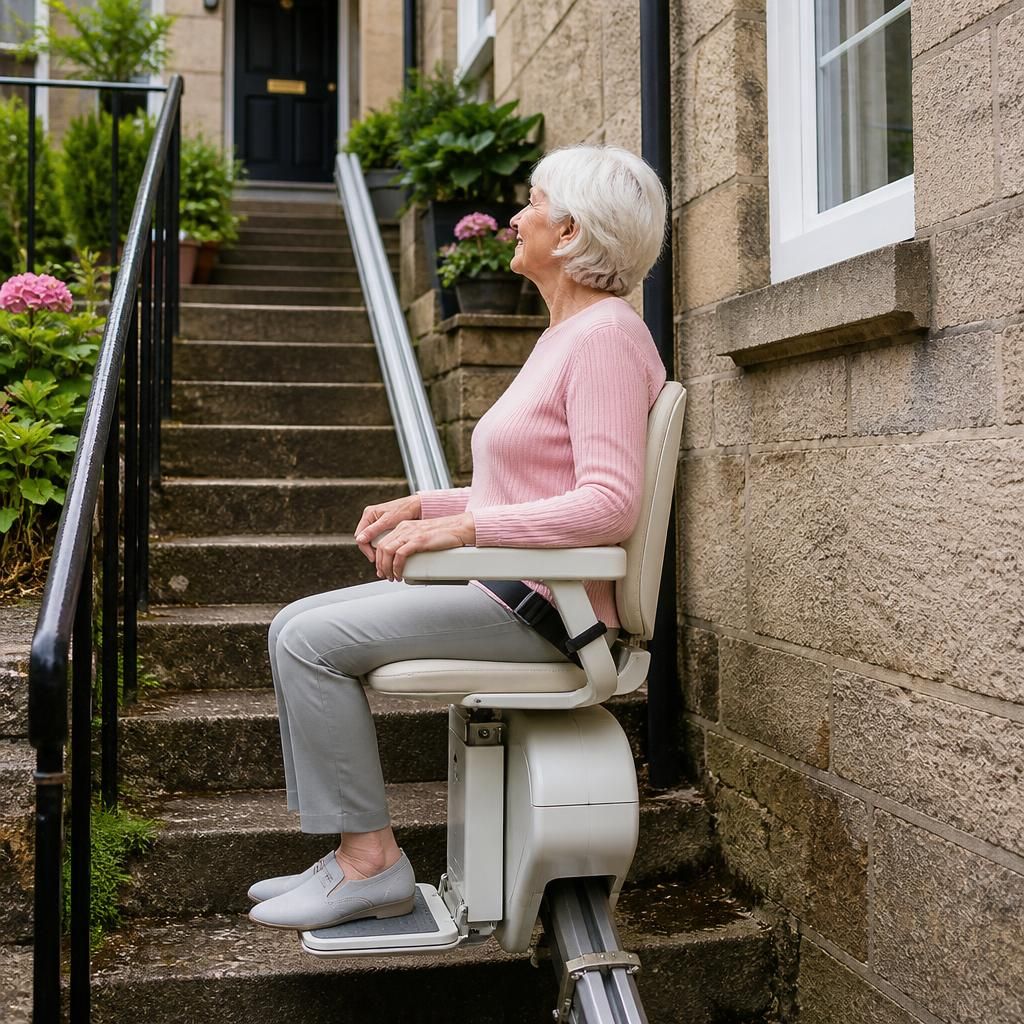
Yes. Outdoor stairlifts can be designed for different staircase configurations and lengths, including straight, curved, narrow or stepped routes, with a bespoke rail manufactured to follow the available space.
An assessment determines the most suitable stairlift, rail layout, charging points and weather-resistant features for your staircase and access requirements.
Yes. Outdoor stairlifts can accommodate many different staircase configurations and lengths, provided the route is assessed properly and there is sufficient space for the lift, rail and safe access at the top and bottom. Straight outdoor staircases usually use a standard rail, while curved, changing-direction or unusually shaped stairs require a bespoke rail designed to follow the route.
The length of the stairs is not assessed in isolation. The installation survey considers the full journey, including the first step, intermediate landings, bends, gates, paths and the area where the user needs to get on or off the seat. This helps determine the most suitable rail arrangement, charging position, parking point and control method.
- Straight staircases: A straight outdoor stairlift is suitable where the steps run in one continuous direction without a change in angle. The rail is measured to the staircase and may extend beyond the first or last step to provide a safer and more convenient transfer position.
- Curved or multi-flight stairs: A curved stairlift uses a made-to-measure rail that can follow bends, corners and changes in direction. It may be designed to stop on a landing or continue through several sections, depending on the layout and available space.
- Stairs with landings: A landing can sometimes be incorporated into the route, but the available turning space and the position of doors, walls or railings must be checked carefully. In some properties, separate lifts or an alternative access arrangement may be more practical.
- Narrow staircases: Compact equipment and a suitable seat or armrest arrangement can help where space is restricted. The lift must still leave enough clearance for safe use and, where relevant, for other people to pass.
- External steps and stepped paths: Outdoor lifts may be considered for access between different levels in a garden, entrance route or side passage. The surface, gradient, exposure to weather and space at each end all affect whether a stairlift is appropriate.
For longer or more complex routes, the rail may need additional support points to keep it stable. The installation team also checks that the rail does not obstruct doors, gates, handrails or paths and that the stairlift can park without creating a trip or access hazard. Where the route changes significantly, a hinged, swivelling or alternative parking arrangement may be considered if it improves access and keeps the rail clear of an opening.
Outdoor use adds further requirements. Components must be suitable for exposure to rain, frost, sunlight and changing temperatures, while the seat, controls and charging equipment need to be positioned and protected appropriately. A weather-resistant cover can help when the lift is parked, but it does not replace correct installation, cleaning and routine servicing. Water drainage and the condition of the steps are also important, as slippery or damaged surfaces can affect safe transfers even when the stairlift itself is operating correctly.
A bespoke assessment is particularly important where the stairs are very steep, uneven, unusually narrow or exposed to severe weather. The surveyor will normally review the staircase structure, available fixing points, electrical supply, parking areas and the user’s mobility needs. They can then explain whether a straight or curved model is suitable, whether any minor adjustments are needed, and where the user should board and leave the lift.
Not every outdoor route can support a stairlift. A lack of safe space at the top or bottom, unsuitable surfaces, access obstructions or a route that is more like a ramp or open path may require a different mobility solution. If a stairlift is not appropriate, the assessment should identify the limitation clearly and discuss suitable alternatives rather than forcing a standard installation.
Before installation, ask for the proposed rail route and parking position to be explained in practical terms. Confirm how the lift will handle each bend or landing, where it will charge, how it will be protected when not in use, and what maintenance and support are included. This ensures that the finished installation matches both the staircase configuration and the way the outdoor access is actually used.
Outdoor stairlifts can accommodate different staircase lengths because the rail is measured and configured for the route, rather than supplied as a fixed standard size. On a straight flight, it may extend beyond the steps to create a more convenient boarding or dismounting position. On a curved or multi-flight staircase, a bespoke rail can follow bends, landings and changes in direction.
The assessment must consider more than the steps themselves. The surveyor checks the space at the top and bottom, intermediate landings, doors, gates, handrails, fixing points and the position where the lift will park and charge. This confirms that the stairlift can complete the full journey without blocking an access route or creating a transfer hazard.
Where space is restricted or the staircase is unusually long, steep or exposed, the proposed rail route and parking arrangement should be explained before installation. If the route does not provide suitable clearance or safe boarding areas, an alternative access solution may be more appropriate than adapting a standard stairlift.
Arrange your outdoor stairlift assessment
Arrange an outdoor stairlift assessment with Independent Stairlifts to review your staircase configuration, route length, parking space and access requirements. We can explain the most suitable bespoke solution and whether any alternative access arrangement should be considered.