
What safety features are integrated into outdoor stairlifts to ensure user protection during operation?
Outdoor stairlifts protect users through weather-resistant construction, secure seating with a safety belt and swivel mechanism, and controls designed for straightforward operation. Safety sensors detect obstacles on the steps, while braking systems, emergency stop controls and battery backup help the lift stop safely and remain usable during a power interruption.
Outdoor stairlifts use a combination of physical restraints, obstacle detection, controlled movement, weather-resistant components and backup systems to protect the user during operation. The exact specification varies between models, but a properly selected and installed lift should help prevent falls, stop when an obstruction is detected, control movement on the stairs and provide a safe way to stop in an emergency.
Outdoor conditions make these protections particularly important. Rain, frost, dust, temperature changes and organic debris can affect the stairway and equipment, so an outdoor model must be designed for external use rather than simply being an indoor lift placed outside. A site assessment also helps identify risks such as uneven steps, poor lighting, overhanging branches, exposed landings and drainage problems.
Weather-resistant construction
Outdoor stairlifts are built with materials and finishes intended to withstand regular exposure to changing weather. Components such as the rail, seat structure, armrests and covers are selected to resist corrosion, moisture and ultraviolet exposure. Electrical parts are enclosed to help prevent water ingress, subject to the protection level specified by the manufacturer.
Many outdoor models have a weatherproof seat cover or protective enclosure. This helps keep the seat, controls and upholstery dry when the lift is not being used. The cover should be used correctly and kept secured, but it is not a substitute for routine checks. Standing water, ice, leaves and mud should be removed from the steps and the lift before use. Weather resistance also does not mean that every component can be submerged or safely operated in severe conditions, so the manufacturer’s instructions should always be followed.
Seat belt and secure seating position
A safety belt helps keep the user seated while the lift is moving. It should be fastened before starting and adjusted so that it is comfortable but secure. Armrests provide additional support and help maintain the correct position, while a shaped seat and suitable footrest reduce the risk of the user slipping forwards or sideways.
On many seated stairlifts, the seat swivels at the top or bottom landing. This allows the user to turn towards the landing before standing up, rather than stepping off while facing the stairs. A swivel mechanism may include a safety interlock that prevents the lift from travelling unless the seat is in its correct riding position. Where a powered swivel is fitted, its controls should be used as instructed and the landing should be kept clear.
Obstacle sensors and movement control
Sensors around the footrest and other parts of the carriage detect objects on or near the track. If the system senses an obstruction, it is designed to stop the lift so the object can be removed. This can help protect feet, pets, loose items and the equipment itself. Sensors do not remove the need to check the staircase before travelling: small, soft or poorly positioned objects may not always be detected reliably.
The drive system is designed to move at a controlled speed and stop smoothly at the programmed points. Braking components hold the carriage securely when it stops and help prevent uncontrolled movement. Limit switches and position controls help the lift recognise where it is on the rail, including the designated stopping areas at the top and bottom of the stairs.
Controls and emergency stopping
Controls are normally provided on the armrest and may also be available through a remote control. They are intended to operate the lift in a straightforward way, with the user able to start, stop and control the direction of travel. Controls may be lockable or removable so that the lift cannot be operated accidentally by children or unauthorised users.
An emergency stop control allows the lift to be stopped if the user notices a problem. Once stopped, the user should follow the operating instructions and contact the service team if the cause is not clear. The emergency stop should not be used as a replacement for normal controls, and the lift should not be restarted if there is visible damage, an unusual noise, burning smell or evidence of water reaching electrical parts.
Battery backup and power protection
Most modern stairlifts use rechargeable batteries so that the lift can complete a journey during a mains power interruption. The charger maintains the batteries when the lift is parked at its charging point. Depending on the model and the remaining charge, the system may allow the user to travel to a suitable landing or another safe position when the power is off.
Battery backup is only effective when the batteries are healthy and the lift is regularly returned to its charging point. If the lift is left away from the charger for long periods, or if warning tones are ignored, the available backup may be reduced. Battery condition is checked as part of servicing, and replacement is advised when the batteries no longer hold sufficient charge.
Safety interlocks and fault monitoring
Interlocks help ensure that key parts are in the correct position before travel begins. Depending on the design, these may check the seat, swivel, arms, footrest or carriage position. If a condition is not met, the lift may refuse to move until it has been corrected.
Electronic monitoring can identify certain faults, low battery conditions or charging problems and communicate them through an audible warning or display. These warnings should not be ignored. A lift that repeatedly stops, gives a fault indication or behaves differently from normal should be taken out of use until it has been assessed by a qualified engineer.
Safety features on outdoor platform lifts
Platform models use a different arrangement because the user remains standing or travels in a wheelchair or mobility scooter. A platform may have a non-slip surface, protective side panels, a safety barrier, a restraint belt and powered or manual ramps at the entrance and exit. These features help prevent wheels or feet from rolling off the platform during travel.
Platform lifts may also include under-platform obstruction sensors, emergency stop controls, a controlled descent or braking system and controls positioned on the platform and at the landings. The safe working load, platform dimensions and wheelchair position must be suitable for the individual user and equipment. Doors, gates or barriers should be fully closed before movement where the design includes them.
Safe use after installation
Safety systems work best when the lift is used as intended. Keep the rail, steps, landings and charging areas clear; remove snow, ice, leaves and standing water; fasten the belt; and remain seated or positioned within the marked area while travelling. Do not exceed the stated load, carry loose items that could interfere with the controls or sensors, or allow another person to operate the lift at the same time unless the model is specifically designed for that purpose.
Regular servicing is important for outdoor equipment because moisture and corrosion can affect mechanical and electrical parts over time. Checks should include the rail and fixings, safety belt, sensors, brakes, controls, batteries, charger, covers and emergency systems. If the staircase or surrounding area changes, arrange a further assessment so that the installation remains appropriate. Independent Stairlifts can advise on the safety specification for the outdoor stairlift or platform model and explain the checks needed for the particular installation.
Outdoor stairlifts use safety sensors and interlocks to prevent movement when an obstruction or unsafe condition is detected. Sensors positioned around the footrest and carriage can stop the lift if they encounter an object on the stairs, while interlocks check that the seat, swivel, arms and footrest are correctly positioned before travel begins.
These systems support safe operation but do not replace basic checks. Keep steps and landings clear of leaves, ice, mud and loose items, and contact a qualified engineer if the lift stops repeatedly, displays a fault or makes an unusual noise.
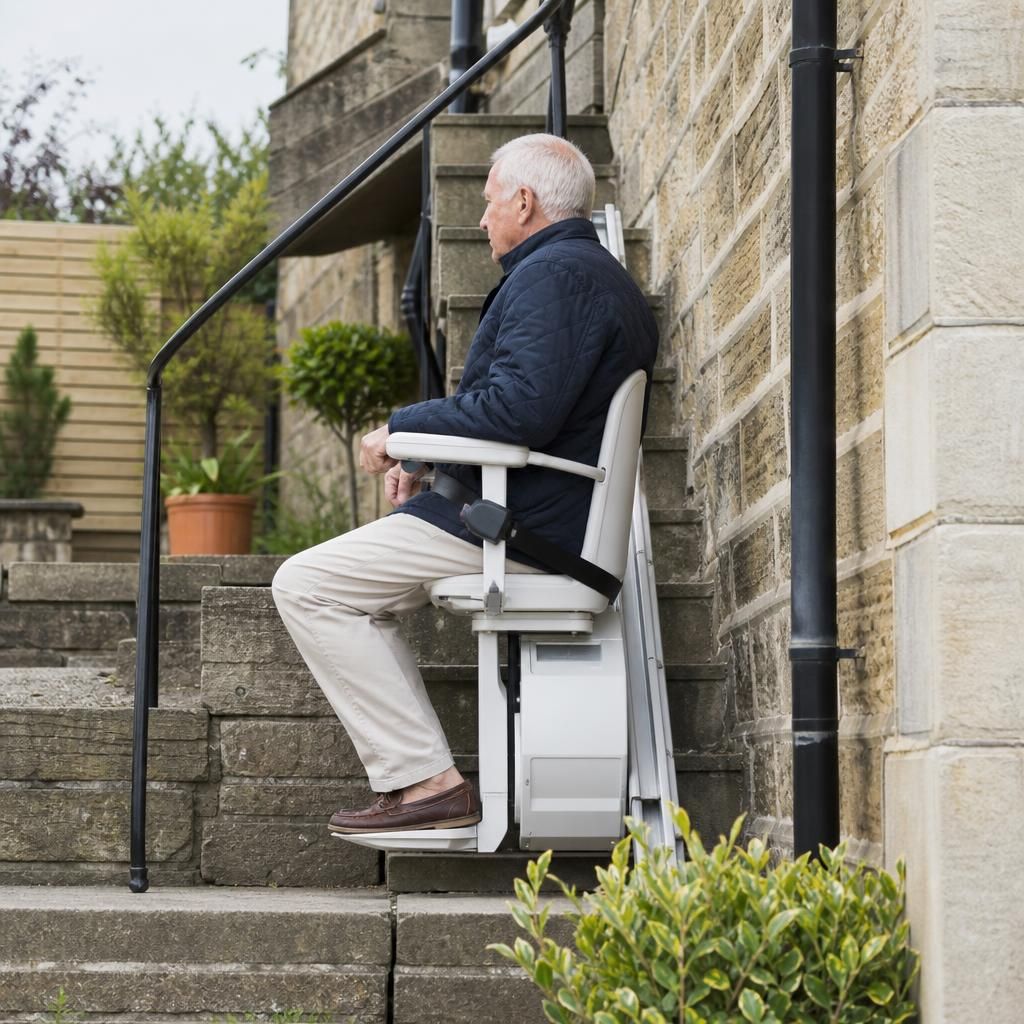
Discuss the right safety features for your outdoor stairlift
Speak to Independent Stairlifts to discuss the safety features suited to your outdoor stairlift or platform installation. We can help assess your staircase, access needs and preferred safety controls.