
What maintenance is required for outdoor stairlifts to ensure optimal performance?
Outdoor stairlifts require regular cleaning, visual checks and battery charging, together with servicing by a qualified technician at the intervals recommended for the model. Keep the seat, controls, sensors, rails and charging points free from dirt and moisture, and report unusual noises, movement or warning lights promptly.
Outdoor stairlifts need routine cleaning, visual checks, battery care and professional servicing to maintain safe, reliable performance. Because they are exposed to rain, frost, sunlight, dirt and temperature changes, an outdoor model generally needs more frequent attention than an equivalent indoor stairlift. Always follow the maintenance instructions for your specific lift and arrange servicing at the intervals recommended by the manufacturer or installer.
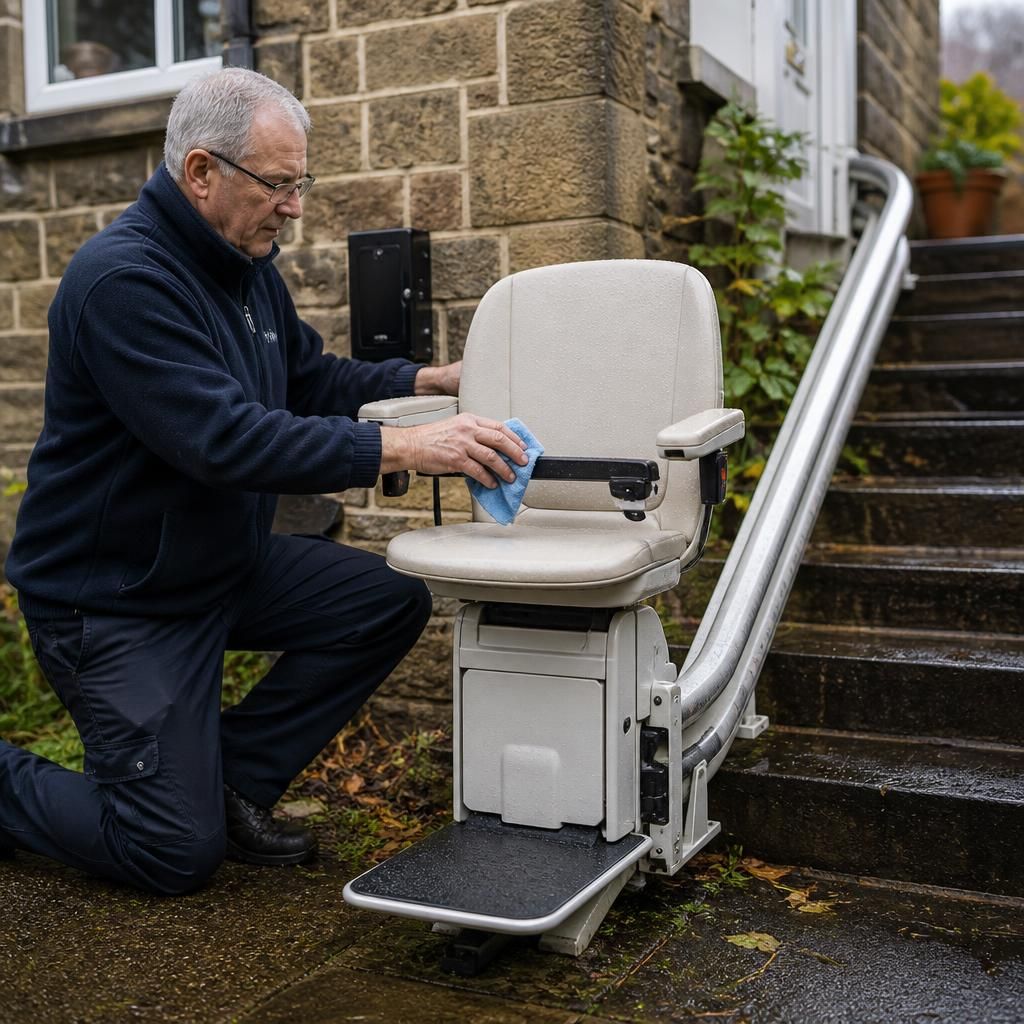
Keep the lift clean and dry. Remove leaves, mud, grit and other debris from the seat, footrest, armrests, controls, sensors and accessible parts of the rail. Use a soft, slightly damp cloth and a mild cleaning solution where appropriate. Do not hose the stairlift down, use a pressure washer or allow water to enter the motor, control box, joystick, charging points or other electrical components. After cleaning, dry exposed surfaces and check that no debris is trapped around moving parts.
Inspect the rail and staircase regularly. Look for dirt, moss, ice, standing water, fallen leaves or objects that could obstruct the carriage. Check that the rail appears secure and has not been damaged, bent or affected by nearby building work. Outdoor stairs can become slippery or uneven, so keep the steps and landing clear as well as the lift itself. Do not attempt to adjust, lubricate or realign the rail unless this is specifically permitted in the manufacturer’s instructions.
Check the seat, footrest and safety components. Before use, confirm that the seat swivels and locks correctly, the armrests are secure and the footrest is free from damage. Test the seat belt or harness as instructed and report fraying, looseness or a faulty buckle. Sensors, safety edges and obstruction controls should be clean and unobstructed. Never bypass a safety switch or continue using the stairlift if a safety feature does not operate correctly.
Look after the batteries and charging points. Outdoor stairlifts normally recharge through dedicated charging contacts or a charging station. Keep these contacts clean and dry, and make sure the stairlift is parked in its designated charging position when not in use. If the lift gives a low-battery warning, moves more slowly than usual or fails to complete its journey, check that it is charging correctly and contact a qualified technician if the problem continues. Battery performance can reduce in cold weather, so do not ignore repeated charging warnings.
Pay attention to changes in operation. Unusual grinding, clicking, juddering, hesitation, an unexplained stop, warning lights or a burning smell should be reported promptly. Do not continue making journeys to see whether a fault clears, particularly if the lift is stopping between charging points or the carriage is not moving smoothly. Switch off the lift only in accordance with the operating instructions and keep the stairway clear until professional advice has been obtained.
Arrange professional servicing. A qualified stairlift technician can inspect the drive system, batteries, charging equipment, carriage, rail fixings, safety circuits and controls. They can also identify wear or corrosion that may not be visible during routine cleaning. The correct service interval depends on the model, how often it is used and the conditions at the property, so use the service schedule supplied with the lift rather than relying on a general interval. Platform models may require additional checks on the platform deck, ramps, restraints, access controls and guard features.
Give extra attention to seasonal conditions. Before periods of frost or severe weather, check that the rail, steps and charging area are clear and that water cannot collect around electrical parts. Remove snow and ice with suitable methods rather than forcing the lift through an obstruction. In hot, bright weather, inspect exposed covers and controls for cracking, fading or deterioration. Coastal properties may also need closer inspection for corrosion because of salt in the air.
- Carry out a brief visual check before use, particularly after heavy rain, frost or strong winds.
- Clean the accessible surfaces and charging contacts as described in the user manual.
- Keep the stairway, rail and landing free from leaves, mud, ice and stored items.
- Park the stairlift correctly so that its batteries can charge.
- Keep the manual and service information available for anyone who operates the lift.
- Record faults and report recurring warning lights, noises or movement problems rather than repeatedly resetting the lift.
Do not use household oils, solvents or unapproved cleaning products on the stairlift, and do not remove covers or work on batteries and electrical components yourself. If the lift has been exposed to flooding, impact, vandalism or significant corrosion, arrange an inspection before using it again. Proper routine care will reduce avoidable wear, while scheduled professional servicing ensures that safety-critical parts are assessed and maintained correctly.
Keeping the charging contacts clean and parking the outdoor stairlift correctly are essential for dependable battery performance. Dirt, moisture or an incorrectly positioned carriage can prevent the batteries from charging fully, while cold weather may reduce battery efficiency.
Wipe the charging contacts with a clean, dry cloth as instructed in the user manual, keep the charging area clear and leave the lift in its designated charging position when it is not in use. Report repeated low-battery warnings, slower movement or a lift that fails to complete its journey to a qualified technician rather than repeatedly resetting it.
Arrange Your Outdoor Stairlift Service
If your outdoor stairlift is due for a service or showing signs of reduced performance, contact Independent Stairlifts to arrange an inspection by a qualified technician. Please report any unusual noises, warning lights or charging problems when booking.