
What factors should I consider when choosing an outdoor stairlift for my home?
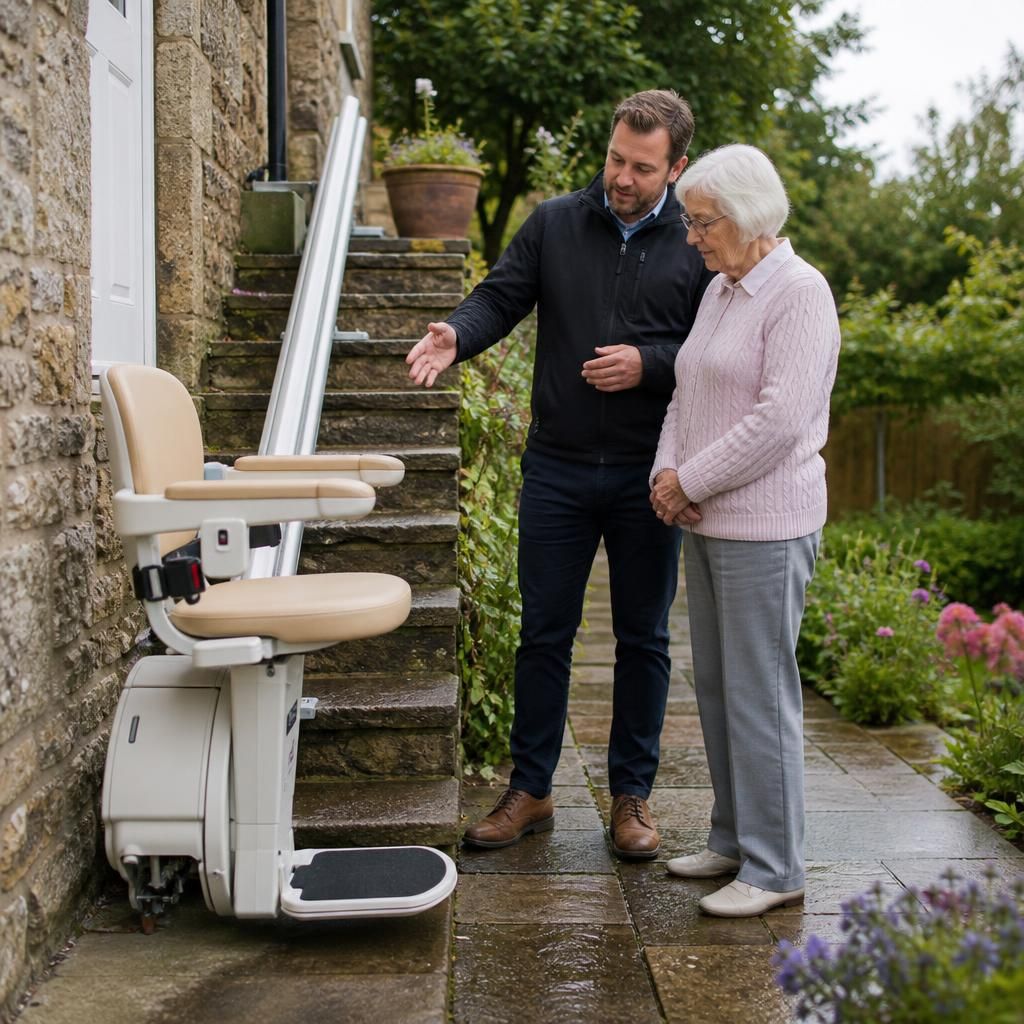
When choosing an outdoor stairlift, consider the staircase layout, exposure to weather, user’s mobility needs, safety features, access to charging, installation requirements and ongoing maintenance. A professional assessment will help confirm whether a weather-resistant stairlift or platform model is most suitable for your home and outdoor access route.
The right outdoor stairlift depends on the staircase, the user’s mobility needs, exposure to weather, available power and the way the route is used. A professional survey should assess these factors together rather than selecting a model based on the stairlift alone. This confirms whether a seated outdoor stairlift or a platform model will provide the safest and most practical access.
Start with the shape and condition of the staircase. Outdoor staircases can be straight, curved, steep, narrow or irregular, and the design of the track must suit the route. The survey should consider landings, sharp turns, changes in gradient, the position of gates and doors, available clearance at the top and bottom, and whether the stairlift will obstruct other users. Steps and handrails also need to be checked for stability, as the installation must be fixed securely to a suitable structure.
A straight outdoor stairlift may be suitable where the staircase follows one continuous line. If the route includes bends, intermediate landings or more complex changes of direction, a made-to-measure curved system may be required. In some locations, a platform lift could be more appropriate, particularly where the user needs to remain in a wheelchair or where the route is intended to carry a wheelchair or mobility scooter. The available turning space at each landing is important for both types of equipment.
Consider how the stairlift will be used. A seated stairlift is generally considered where the user can transfer from a wheelchair or standing position onto a seat. Check whether the seat height, swivel mechanism, armrests and footrest support a safe transfer. The user should be able to operate the controls without stretching or twisting, and should have enough stability to remain seated throughout the journey.
If transferring is difficult or the wheelchair needs to travel with the user, a platform model may be more suitable. Platform lifts require sufficient space for the platform to fold, unfold and move safely, as well as clear areas for entering and leaving. The size and weight of the wheelchair or mobility scooter must be checked against the equipment’s rated capacity. A platform model can also affect access for pedestrians, so the route should be considered for everyone who uses it.
Assess exposure to outdoor conditions. The stairlift should be designed for external use and protected against rain, moisture, dust, frost, sunlight and temperature changes. This includes weather-resistant controls, sealed electrical components, corrosion-resistant materials and a track and drive system suitable for the location. Weather resistance does not mean that every component can be left exposed without care, so ask how the particular model should be protected when it is not being used.
The position of the staircase makes a difference. A lift beneath an overhang may have different protection requirements from one on an exposed garden path or beside the coast, where salt-laden air can accelerate corrosion. Water should be able to drain away from the steps, track and charging points. Avoid placing covers where they can trap condensation, and follow the manufacturer’s instructions for protective covers and cleaning products.
Check the power supply and charging arrangements. An outdoor stairlift needs a reliable electrical supply and a practical charging position. Charging points may be located at one or both ends of the track, depending on the model and how the lift is used. The survey should confirm that the lift can be parked where it will charge correctly without blocking a doorway, path or gate.
Consider what will happen during a power cut. Battery-powered systems are designed to retain enough charge for use when the mains supply is temporarily unavailable, but the battery must be maintained and the lift must normally be returned to its charging point. Ask about the charging indicator, battery replacement, emergency lowering or manual release procedures, and who to contact if the lift stops away from its charging position.
Review the safety features. Important features can include a seat belt, swivelling seat, safety sensors, obstruction detection, controlled starting and stopping, lockable controls and emergency stop controls. Platform models may also include access barriers, ramps, non-slip surfaces and sensors that prevent movement unless the platform is correctly positioned.
Safety features should be matched to the user rather than treated as a standard checklist. For example, someone with reduced grip may need simple, clearly positioned controls, while a person who is unsteady when transferring may benefit from powered or manually operated swivel and safety mechanisms. Check that controls can be used with the hand that has the best movement and that a carer or family member can operate the system if required.
Lighting and visibility should also be considered. Outdoor steps can become slippery or difficult to see in poor weather and low light. Non-slip surfaces, suitable handrails and adequate lighting around the boarding and exit areas can reduce risk, but they do not replace safe use of the stairlift. Keep the route free of leaves, ice, plant growth and other obstructions.
Look at installation requirements and access around the property. The installer should establish whether fixing the track to the steps, wall or another supporting surface is appropriate. Drainage, nearby electrical equipment, exposed pipework and the condition of the masonry may affect the installation. Where the staircase is unusual, the track may need to be measured and manufactured specifically for the route.
Consider how the stairlift will affect deliveries, gardening, refuse collection, visitors and emergency access. The lift should not create a trip hazard when folded or parked, and gates and doors should remain usable. If the property is rented, listed or subject to local restrictions, check whether the owner or relevant authority needs to approve the installation before work begins.
Plan for maintenance and everyday care. Outdoor equipment needs more attention than an equivalent indoor installation because it is exposed to dirt and changing weather. Ask what routine checks are required, how often servicing is recommended, how to clean the track and seat or platform, and which parts are likely to wear. Keep charging contacts clean, report unusual noises or movement, and do not use unsuitable lubricants or pressure washers unless the manufacturer specifically permits them.
Find out what support is available if the lift develops a fault, including how faults are reported and whether servicing can be arranged at the property. A clear maintenance plan is particularly important if the outdoor route is the main access to the home, garden or parking area. Battery condition, corrosion, sensors and the operation of safety mechanisms should be checked as part of ongoing care.
Compare the total practical cost, not just the initial quotation. The price can be affected by the staircase shape, track length, electrical work, weather protection, structural preparation and any alterations needed around landings or gates. Ongoing costs may include servicing, replacement batteries, repairs and, for a platform model, additional space or building work. A reconditioned outdoor stairlift may be suitable in some straightforward situations, but its condition, weather protection, warranty and continued availability of parts should be confirmed carefully.
The most reliable choice is the model that fits the staircase, supports the user’s transfer or wheelchair needs, remains protected in its specific location and can be used safely every day. During the assessment, demonstrate how the user will approach, board, travel, leave the lift and deal with a power interruption. This practical check, together with advice on installation and maintenance, will show whether a seated outdoor stairlift or platform model is the better solution for the home.
Weather exposure is a key factor when choosing an outdoor stairlift because rain, frost, sunlight, dust and salt-laden air can affect electrical components, batteries, fixings and moving parts. The lift must be designed for external use and suitable for the conditions at your property.
During the assessment, consider whether the staircase is sheltered by an overhang or fully exposed, how well water drains away, and whether the installation is close to the coast. Ask how the controls, charging points, track and drive system are protected, and whether a manufacturer-approved cover is recommended when the lift is not in use.
- Keep steps, charging contacts and the track clear of leaves, ice and standing water.
- Follow the recommended cleaning and maintenance instructions.
- Report corrosion, unusual noises or changes in movement promptly.
Arrange your outdoor stairlift assessment
Arrange an outdoor stairlift assessment with Independent Stairlifts to review your staircase, access requirements, weather exposure and the most suitable lift type for your home.