
What are the key features to consider when selecting an outdoor stairlift or platform model?
When selecting an outdoor stairlift or platform model, consider weather resistance, staircase compatibility, weight capacity, safety controls, charging arrangements and ease of use. Platform models also require sufficient space for the platform, wheelchair and safe entry and exit at each level.
The key features to assess when choosing an outdoor stairlift or platform model are weather resistance, compatibility with the route, safe weight capacity, controls, charging arrangements, access at the top and bottom, and the space available for boarding or leaving the lift. A stairlift with a seat is usually suited to someone who can transfer from a wheelchair or stand briefly, while a platform model is designed to carry a wheelchair and needs enough clear space for the platform, chair and safe manoeuvring.
Weather protection and materials
An outdoor model should be specifically designed for external use rather than adapted from an indoor lift. Look for weather-resistant finishes and components that can withstand rain, damp, sunlight, temperature changes and airborne dirt. The seat, armrests, controls and platform surface should be suitable for the conditions in which they will be used. A weatherproof cover is also important when the lift is parked, particularly for a seat model.
Weather resistance does not mean that the lift can be left unprotected in every situation. The parking position should shield the equipment as far as the installation allows, and covers should be used as instructed. Ask how exposed electrical parts, charging points and moving mechanisms are protected and whether the proposed model is appropriate for a coastal or particularly exposed location.
Compatibility with the staircase or access route
The track or guide rail must follow the shape of the outdoor staircase without obstructing steps, gates, paths or doors. For a straight staircase, this may be relatively simple, but a curved, steep, narrow or irregular route requires careful measurement and design. Check the available headroom, landing space, step width, gradients and any turns before choosing a model.
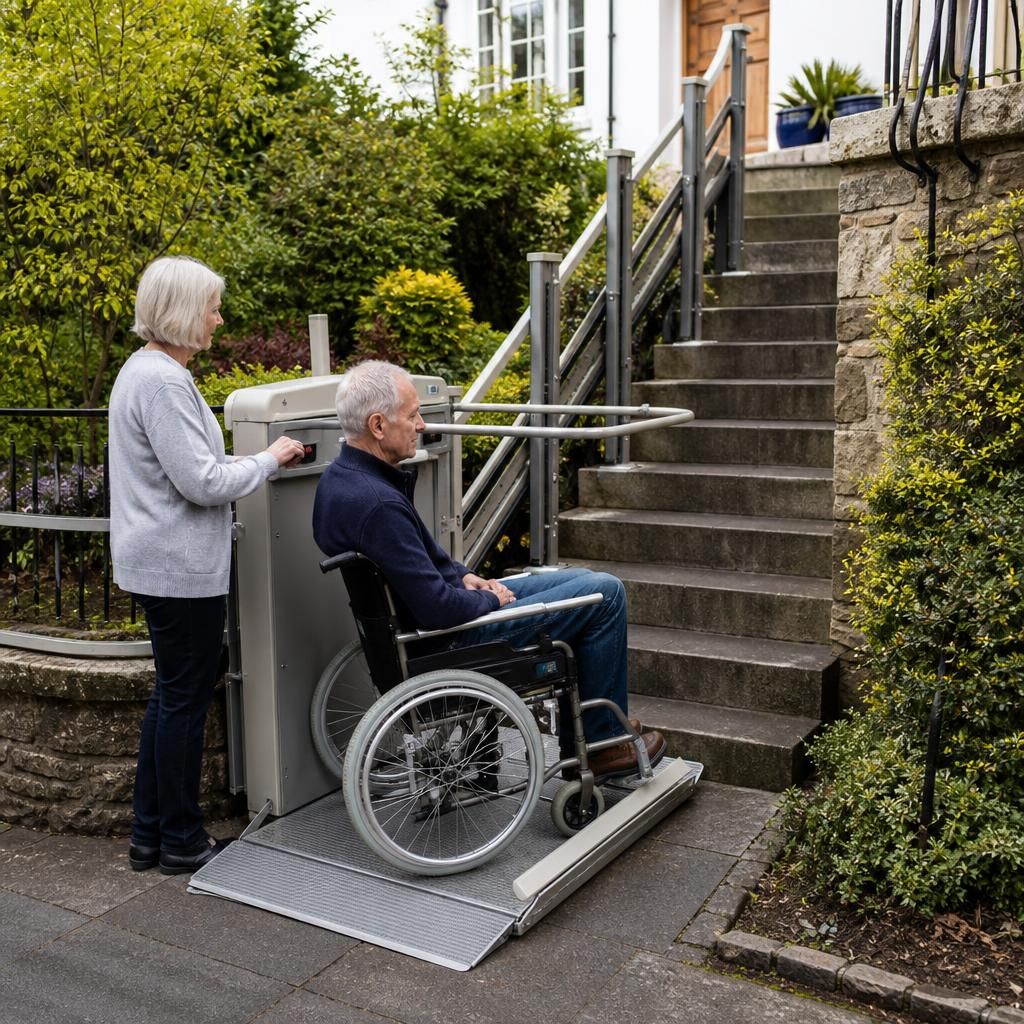
For a platform model, assess the full route rather than only the stairs. The platform needs room to travel safely, and the user must be able to approach it without awkward reversing or crossing an unprotected edge. The upper and lower landings should provide sufficient space to enter, leave and turn a wheelchair. Gates, doors, handrails, walls and garden features may affect the layout.
Seat, platform and wheelchair arrangements
Choose the lifting format according to how the person will use it. A seated stairlift should have a comfortable, supportive seat and enough room for the user to sit securely. Consider the seat height, swivel or powered swivel options, armrest position and whether the user can transfer safely at both ends.
A platform model should accommodate the wheelchair without forcing the user to leave it. Consider the platform dimensions, the position of the controls, the loading direction, the ramp or access flap, and whether the wheelchair can be secured during travel. The platform should not make the staircase unusable for other people when parked, unless the layout has been specifically designed for shared access.
Weight capacity and stability
Confirm the manufacturer’s stated maximum load and ensure it covers the user and, for a platform model, the wheelchair and any essential equipment carried during travel. Weight should not be estimated casually, as different wheelchairs and accessories can substantially alter the total load. The lift must also remain stable on the particular staircase, surface and gradient where it will be installed.
Safety features and controls
Useful safety features include a seat belt or harness, armrests or side protection, obstruction sensors, a safe braking system, emergency stop controls and controls that prevent movement when the seat or platform is not correctly positioned. Platform models should also have suitable barriers, ramps or safety edges to help prevent the wheelchair from rolling off during travel.
Controls should be easy to identify and operate, including when the user is wearing gloves or has limited hand strength. Consider whether the lift can be called from either end, whether remote controls are supplied, and how it can be stopped safely if an obstruction or problem occurs. Ask how the lift behaves if the power supply fails and whether there is a suitable manual lowering or emergency procedure.
Charging and power supply
Battery-powered outdoor stairlifts can usually travel when the mains supply is unavailable, provided the batteries are adequately charged. The lift should charge at a reliable parking point, and the charging contacts or connection should be protected from the weather. Check whether the lift charges at one or both ends of the track and whether the user must leave it in a particular position after use.
Ask about battery replacement, expected charging behaviour and what happens during a power cut. A suitable electrical supply and safe cable routing are part of the installation assessment, especially where the staircase is separate from the house or exposed to rain.
Parking, folding and access around the lift
When the stairlift is not being used, the seat or platform should be capable of parking without creating an unnecessary trip or access hazard. A folding seat, footrest or platform can be valuable on a narrow staircase, but the folded dimensions still need to be checked against the available width. Consider whether the lift will interfere with a gate, pathway, driveway or emergency exit.
For a platform model, the folded or parked position is particularly important because the equipment is larger than a seated stairlift. Confirm how much of the route remains available to other users and whether the platform can be moved or parked without blocking a landing.
Ease of use and user suitability
The best model is one the intended user can operate consistently and confidently. Consider dexterity, balance, vision, hearing, memory and the ability to transfer. A simple control layout may be more suitable than additional features that complicate operation. If more than one person will use the lift, assess whether the controls and seating arrangement work for everyone.
Ask for a practical demonstration of boarding, fastening the belt, operating the controls, parking the lift and dealing with a stopped lift. This can identify difficulties that are not obvious from measurements alone.
Installation, servicing and aftercare
Outdoor installation should include checks of the staircase structure, drainage, electrical supply, fixing points and the condition of surrounding surfaces. On unusual or exposed staircases, the survey should also consider how installers will access the route and how future servicing can be carried out safely.
Before selecting a model, confirm what routine cleaning is required, how often servicing is recommended, how faults are reported and whether replacement batteries or weather covers are readily available. Keeping the track, charging contacts and safety sensors clean and following the manufacturer’s instructions will help maintain reliable operation. Do not use the lift if a safety component is damaged or if its movement has changed noticeably; arrange an inspection instead.
A site assessment is the most reliable way to compare these features. It should consider the user’s abilities, the wheelchair or transfer method, the dimensions and condition of the route, exposure to weather, parking requirements and the intended pattern of use. The result should be a model that fits both the outdoor space and the person’s day-to-day needs, rather than one selected on specifications alone.
A platform stairlift needs enough clear space at the top and bottom of the route for the wheelchair user to approach, board, leave and turn safely. The platform dimensions alone do not confirm that an installation will work.
During the assessment, check the position of gates, doors, handrails, walls and garden features, as these can restrict access or create an awkward reversing manoeuvre. Also consider where the platform will park when not in use and whether it will obstruct other users of the stairs or pathway. A site survey should assess the complete route so the chosen model supports safe, practical day-to-day access.
Book your outdoor stairlift or platform assessment
Arrange an outdoor stairlift or platform assessment to check the route, access space, weather exposure and user requirements. Our team can help you identify the most suitable model for your home.