
Are outdoor stairlifts difficult to install on unconventional staircases, such as those with sharp turns or irregular steps?
Outdoor stairlifts can usually be installed on staircases with sharp turns or irregular steps, but they require a bespoke rail and a detailed on-site assessment. Installation may be more complex than on a straight staircase, as the rail must follow the exact shape of the steps while maintaining safe clearance, reliable operation and protection from the weather.
Outdoor stairlifts can usually be installed on unconventional staircases, including routes with sharp turns, multiple changes of direction or irregular steps. They are more involved than straight-stair installations because the rail must be designed to follow the staircase accurately while allowing safe clearance, smooth travel and reliable protection from outdoor conditions. A detailed site assessment is essential before confirming whether a stairlift is suitable.
For a staircase with sharp turns, the rail is normally made to measure rather than selected from a standard straight section. Its route may include curves, corners, changes in gradient and transitions between flights. The design must account for the position of walls, handrails, gates, doorways and nearby obstacles, as well as the space available for the user to get on and off safely. Where the staircase has a landing, the rail may be designed to bring the seat or platform into a more convenient parking position.
Irregular steps require particular attention. Steps may vary in depth or height, have uneven edges, include winders or have surfaces that slope slightly for drainage. These features do not automatically prevent installation, but they affect the rail position and the available clearance. The installer will assess whether the stairlift can travel without fouling the steps, walls or surrounding structures and whether the user can approach the lift safely at the top and bottom.
An outdoor assessment also considers conditions that would not usually apply indoors. The survey may examine:
- the width and shape of every part of the staircase;
- the position of sharp corners, landings and changes in direction;
- the condition, gradient and drainage of the steps;
- exposure to rain, frost, sunlight, wind and falling leaves;
- available electrical supply and the most suitable location for charging equipment;
- clearance from walls, fences, doors, gates and garden features;
- safe parking positions that do not obstruct access routes; and
- how the user will transfer on and off the stairlift at each end.
Outdoor stairlifts are designed with weather-resistant components, but the rail and equipment still need to be positioned carefully. Water should be able to drain away rather than collect around the drive unit or charging points. The design may also need to reduce exposure to persistent spray, overhanging vegetation and direct sunlight. A suitable cover or sheltered parking position can help protect the seat and controls when the stairlift is not in use, although this does not replace routine maintenance.
Installation on an unusual staircase generally takes more planning than installation on a simple straight flight. The surveyor may take detailed measurements and record the route so that a bespoke rail can be manufactured or configured accurately. Once the equipment is ready, the installation team secures the rail to suitable points, fits the drive system and controls, connects the charging equipment and tests the stairlift along the complete route. They should also check starting and stopping positions, clearances, safety sensors and the operation of the swivel seat, armrests, footrest or other relevant features.
Some staircases may need minor preparation before work begins. This could include clearing vegetation, improving lighting, repairing damaged steps or addressing a drainage problem. Structural alterations are not always necessary, but the installer should explain any proposed work and why it is required. If the staircase is particularly narrow, unstable or exposed, a different access solution may be more appropriate.
A platform model may be considered where the user travels in a wheelchair or needs to transport a mobility aid without transferring to a seat. However, platform lifts usually require more room for the platform, entry and exit areas, and turning space. On a complex outdoor route, the suitability of a platform model depends on the layout of the landings and the ability to keep the route clear. It should not be assumed that a platform model will solve restrictions that make a seated stairlift unsuitable.
The most useful way to establish feasibility is to arrange an in-person assessment rather than relying on photographs or general measurements. During the assessment, discuss how the staircase is used, where the user needs to enter and leave the lift, whether other people use the route and any concerns about weather or security. The final recommendation should reflect the user’s mobility, the physical staircase and the practical demands of outdoor operation.
In summary, sharp turns and irregular steps can make installation more complex, but they do not necessarily rule out an outdoor stairlift. A bespoke rail, accurate measurements, appropriate weather protection and careful testing are the key requirements. If the route cannot provide safe clearance, stable fixing points or suitable boarding space, the installer should explain the limitation and assess whether another accessibility solution would provide safer access.
Outdoor stairlifts on staircases with sharp turns or irregular steps usually require a bespoke rail and an in-person survey. The installer assesses the exact route, available clearance, step condition, drainage and suitable boarding positions before confirming whether the stairlift can be installed safely.
Uneven steps do not automatically prevent installation, but they can affect rail positioning and the space available around the lift. The completed system must travel smoothly without contacting walls, fences or steps, while allowing the user to board and leave safely. Weather exposure, charging equipment and a suitable parking position are also considered during the assessment.
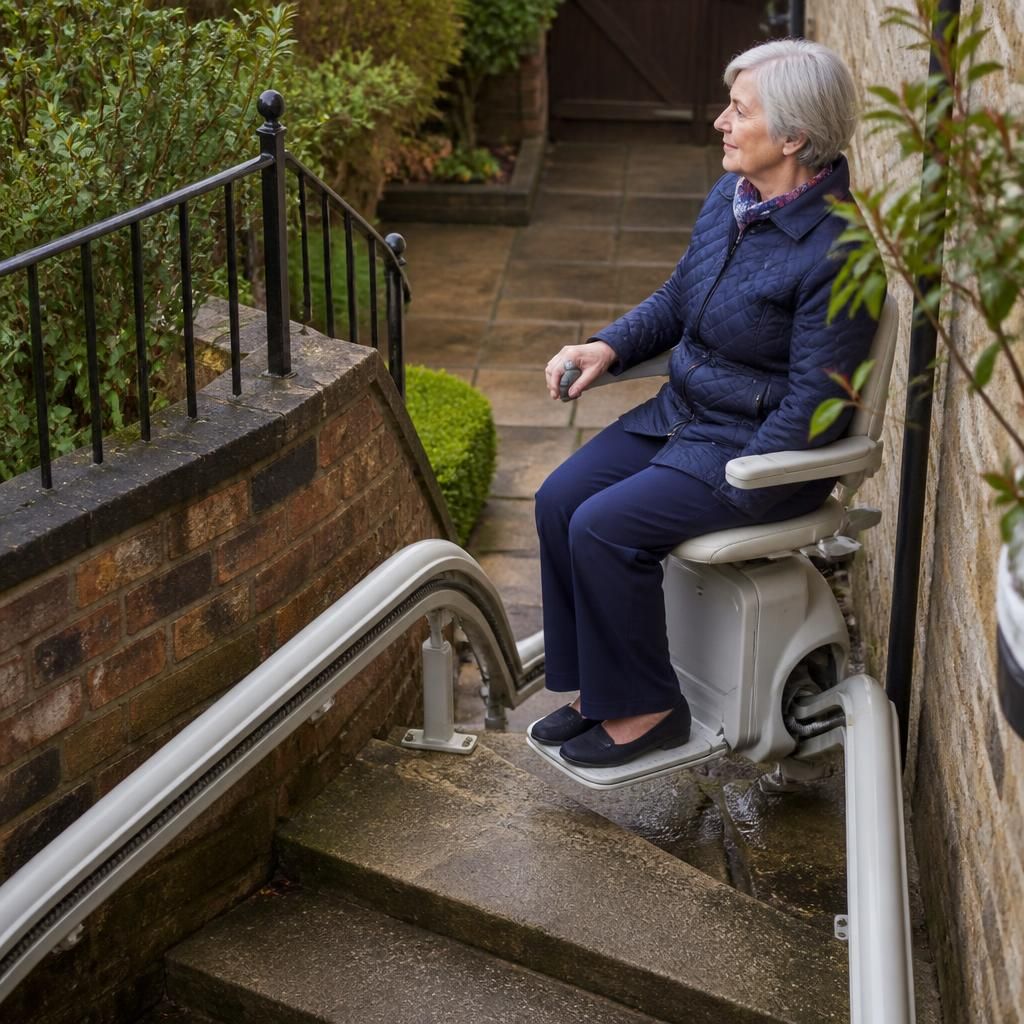
Arrange an assessment for your outdoor staircase
Arrange an in-person assessment of your outdoor staircase so we can check sharp turns, irregular steps, available clearance and suitable boarding positions. We can then confirm whether a bespoke outdoor stairlift or another access solution is appropriate.