
What should I consider when comparing outdoor stairlift models for different weather conditions?
When comparing outdoor stairlift models, assess their weather resistance, drainage, battery performance, safety features and suitability for your staircase in conditions such as rain, frost, snow, wind and strong sunlight. A reliable choice should be designed for outdoor use, protected when parked and supported by an installation and maintenance plan suited to your local exposure.
When comparing outdoor stairlift models, prioritise proven weather resistance, reliable operation in cold and wet conditions, safe use on your particular staircase, and practical protection when the lift is parked. A suitable outdoor stairlift should be specifically designed for external use, rather than being an indoor model with minimal additional protection. Compare the complete installation, including the seat, controls, rail, charging arrangement, protective cover and ongoing maintenance requirements.
Check the level of weather protection
Outdoor stairlifts are exposed to rain, frost, snow, wind, dirt and sunlight, so the materials and electrical protection are important. Look for a model with corrosion-resistant components, sealed electrical parts and upholstery intended for outdoor use. Ask what environmental protection rating applies to the controls, motor and other electrical components. An IP rating can help indicate resistance to dust and water, but it must be considered alongside the manufacturer’s instructions and the actual location of the equipment.
Protection should cover more than the main unit. Check whether the hand control, charging points, sensors, armrests, footrest and exposed fixings are suitable for outdoor conditions. Some parts may need to be kept under a cover or positioned away from direct water even when the stairlift itself is weather-resistant.
Consider how the model will cope with different UK weather
- Rain: The stairlift should have effective drainage and components that will not retain water unnecessarily. The seat and footrest should be easy to dry, and the parked position should provide some shelter where possible.
- Frost and freezing temperatures: Cold weather can affect battery performance, lubricants and moving parts. Ask how the model behaves in freezing conditions and whether the batteries remain charged when the lift is parked at either end of the rail.
- Snow and ice: Snow should not be allowed to build up on the seat, footrest, rail or charging contacts. Compare models for ease of clearing and confirm whether the lift has safeguards against being used when the steps or landing are slippery.
- Wind: A stairlift on an exposed staircase may be affected by strong gusts, particularly when the seat is raised or when a cover is being used. The installation must be secure, and the parked position should not leave the lift unnecessarily exposed.
- Strong sunlight: Ultraviolet light can fade or weaken some plastics and upholstery over time. Choose durable outdoor materials and consider whether the lift can be parked beneath a canopy or covered when not in use.
- Leaves, grit and dirt: Outdoor debris can collect around the rail, footrest and sensors. A model with accessible surfaces and straightforward cleaning requirements will generally be easier to keep safe and reliable.
Compare battery performance and charging
Most outdoor stairlifts use batteries so that the lift can continue to operate during a power cut. Compare the battery type, expected charging process, replacement arrangements and performance in low temperatures. Confirm that the lift charges at one or both ends of the rail, particularly if the staircase is long or the user normally leaves the lift at the less sheltered end.
Ask how the charging contacts are protected from rain and dirt and whether the system gives a clear warning when the battery is low. A model may be weather-resistant but still become unreliable if it is routinely left away from its charging point. The charging locations should be included in the installation assessment rather than treated as an afterthought.
Assess safety features for wet and slippery conditions
Outdoor conditions can make both the stairlift and the staircase more hazardous. Compare models for secure armrests, a stable footrest, a seatbelt, obstruction sensors and controls that can be operated accurately when the user is wearing gloves or has limited dexterity. A swivel seat can help the user get on and off at the landing, but the available space and the user’s transfer method must also be assessed.
Check whether the footrest and seat have surfaces that remain practical when damp, and whether water can drain away rather than pooling. The stairlift should not be used on steps covered with ice, snow, standing water or other hazards unless the manufacturer’s instructions specifically allow it. The staircase itself may need additional handrails, lighting, non-slip treatment or improved drainage.
Compare the protective cover and parked position
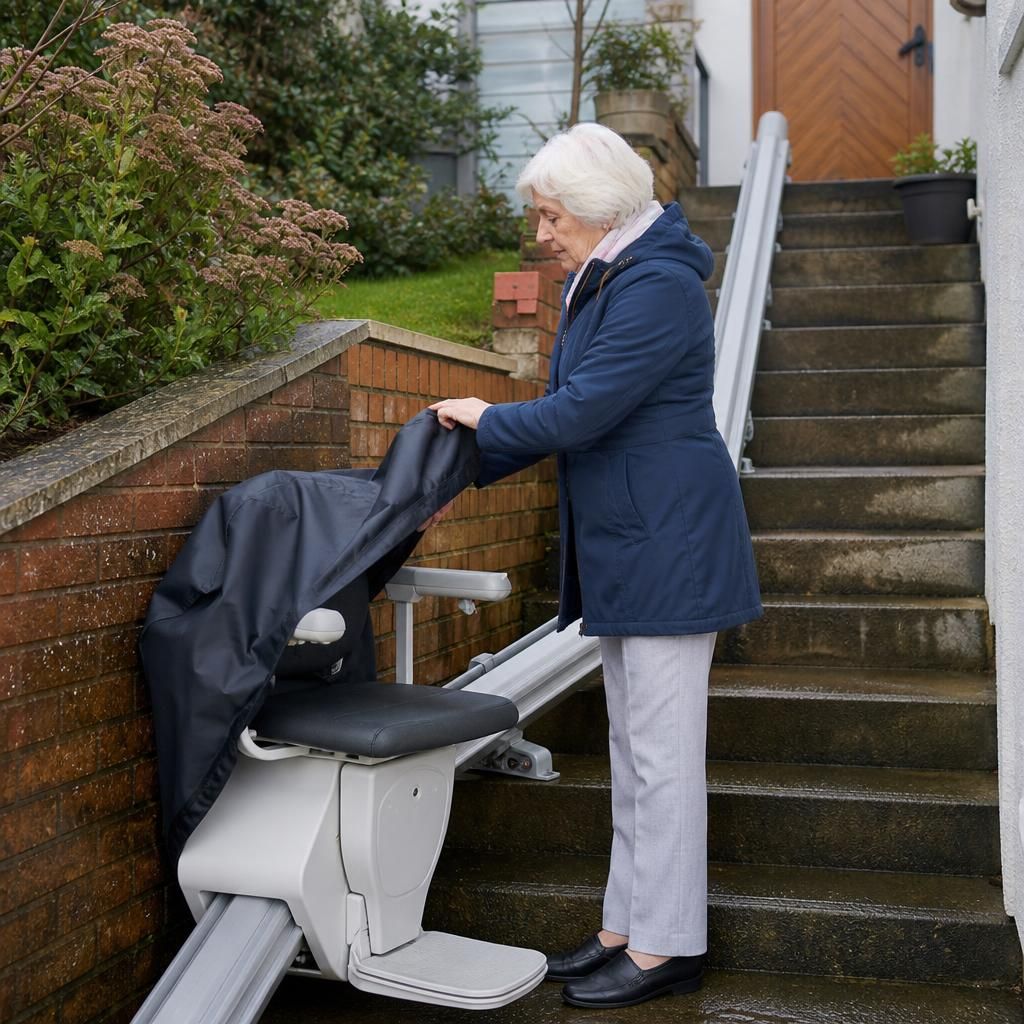
A properly fitted cover can reduce exposure to rain, frost, bird residue, dust and sunlight, but it should not trap moisture against the equipment. Compare how quickly the cover can be fitted and removed, whether it is secured against wind, and whether the user can manage it safely without stretching across the stairs. A cover is not a substitute for an outdoor-rated stairlift or appropriate servicing.
Where the layout allows, parking the stairlift beneath a porch, canopy or sheltered landing can reduce weather exposure. However, the shelter must not obstruct doors, paths, emergency exits or the travel route. The installer should confirm that the parked position leaves enough room for safe access and does not create a trip hazard.
Match the model to the staircase and its exposure
A sheltered, straight staircase may have different requirements from an exposed, winding staircase beside a garden or driveway. Compare the available straight and curved configurations according to the rail route, landings, changes in direction and the amount of space at the top and bottom. A curved outdoor stairlift may follow the staircase more closely, while a straight model may be suitable where the flight is genuinely straight; the correct choice depends on the survey rather than the model name alone.
Ask the installer to examine the surface supporting the rail, the condition of the steps, wall or balustrade clearances, drainage, nearby vegetation and access for installation. Coastal locations, elevated sites and staircases exposed to prevailing wind may require particular attention to corrosion protection and fixing points. If water runs across the steps or collects at the bottom, drainage improvements may be needed before installation.
Review maintenance requirements before deciding
Outdoor stairlifts usually need more frequent visual checks than indoor models because dirt and weather can affect moving and electrical parts. Compare the recommended cleaning routine, servicing interval, battery replacement process and availability of support. The instructions should state which surfaces can be cleaned, which products are safe, and which components must not be sprayed or washed directly.
- Keep the rail, steps, footrest, seat and controls free from leaves, grit, ice and standing water.
- Check that the cover is dry before fitting it, where the manufacturer’s instructions require this.
- Look for corrosion, loose fixings, damaged cables, cracked covers or changes in movement.
- Keep charging contacts clean and make sure the lift is returned to its charging position.
- Report unusual noises, slower movement, repeated battery warnings or sensor faults rather than continuing to use the lift.
Do not use household lubricants, pressure washers or unapproved cleaning chemicals unless the manufacturer or servicing team confirms that they are suitable. Regular servicing is particularly important where the lift is exposed to salt air, persistent damp, heavy debris or temperature changes.
Compare the whole cost, not just the purchase price
The quoted price should be considered alongside the outdoor specification, rail design, electrical work, protective cover, weather shelter, drainage changes, difficult access and future servicing. A lower initial price may not represent better value if the model needs additional protection or is unsuitable for the exposure at your property. Ask for a clear explanation of what is included and which items are optional or likely to be required after the site assessment.
Also confirm the warranty conditions. Some warranties require servicing, correct use of the cover or compliance with cleaning and charging instructions. Check how weather-related damage is treated and who to contact if the stairlift stops working during cold or wet weather.
The most suitable outdoor stairlift is therefore the one that combines appropriate weather protection with safe operation, dependable charging, accessible controls and a realistic maintenance plan for the location. A detailed assessment of the staircase and the user’s needs will allow the model, rail route, parking position and protective measures to be compared accurately before installation.
When comparing outdoor stairlift models, assess the complete weather-protection system rather than relying on a protective cover alone. The stairlift should have outdoor-suitable materials, protected electrical components, effective drainage and a parking position that limits exposure to rain, frost, snow, wind and strong sunlight.
Check whether the controls, charging contacts, seat, footrest and exposed fixings are designed for the conditions at your property. An environmental protection or IP rating can provide useful information, but it should be considered alongside the manufacturer’s instructions and the actual position of the lift. A cover should be breathable, secure in windy conditions and easy to fit without stretching across the stairs; it must not be fitted over wet equipment if this could trap moisture.
During the site assessment, ask how the model will be protected when parked and how easily you can clear leaves, grit, ice and standing water. These practical details can be just as important as the stairlift’s headline specification when choosing a reliable outdoor solution.
Compare Outdoor Stairlift Models With an Expert Assessment
Arrange an expert assessment with Independent Stairlifts to compare outdoor stairlift models against your staircase, local weather exposure and charging requirements. We can explain the installation, protection and maintenance considerations before you decide.