
What installation considerations should I be aware of before purchasing an outdoor stairlift?
Before purchasing an outdoor stairlift, check that the staircase, landing and access points can accommodate the equipment, and that there is a suitable power supply. You should also consider weather protection, drainage, surface condition, charging access, safe transfer space and the installation requirements for your specific outdoor environment.
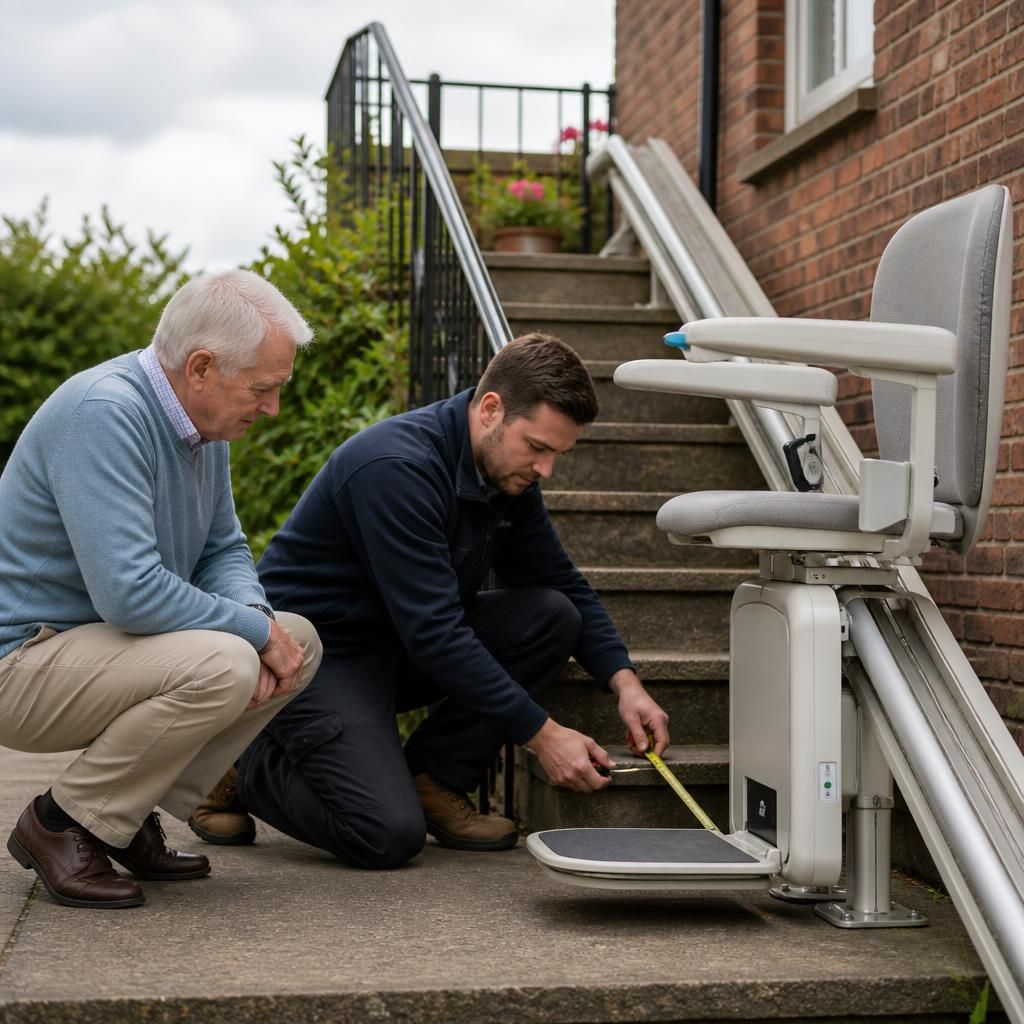
Before purchasing an outdoor stairlift, arrange a site assessment to confirm that the staircase, landing areas, power supply and surrounding environment can safely accommodate the equipment. Outdoor installations need more than a suitable set of steps: the installer must also assess exposure to weather, drainage, surface condition, access, charging and safe transfer at the top and bottom of the stairs.
Have the complete route assessed. The assessment should cover the full staircase and both ends of the journey, not just the steps themselves. The installer will need to check the width and shape of the stairs, the available space beside or beyond the rail, the position of handrails, gates, walls, doors and paths, and whether the seat can be parked without obstructing access. Any bends, intermediate landings or changes in level may affect the type of outdoor stairlift and the amount of track required.
For a straight staircase, the track generally follows one uninterrupted flight. A staircase with bends, multiple flights or a landing may require a bespoke curved solution. The position of the stairlift when parked is also important. It may need to be folded away from a doorway, positioned clear of a narrow path or left in a sheltered charging area. These practical details can influence both the installation method and the overall price.
Check the condition and construction of the stairs. Outdoor steps should be stable, even and capable of supporting the fixings used for the track. Loose paving, cracked concrete, worn timber, rusting metalwork or damaged edges may need repair before installation. Uneven surfaces can affect safe boarding and disembarking, while inadequate foundations or deteriorating retaining walls may require attention before a stairlift can be fitted.
Drainage should be considered at the same time. Water must not collect around the track, footplate, motor or charging points, particularly at the bottom of the stairs. Sloping surfaces, blocked drains, moss and slippery algae can create risks independently of the stairlift. In some cases, improving drainage, repairing steps or treating the surrounding surface is an essential part of preparing the installation area.
Plan for weather exposure. An outdoor stairlift is designed for external use, but it still needs suitable protection from rain, snow, frost, strong sunlight, wind-blown debris and coastal or corrosive conditions. Check whether the stairlift can be parked under a canopy or within another sheltered area, while ensuring that the shelter does not restrict movement or access. A weatherproof cover may be appropriate when the lift is not in use, but it should be used in accordance with the manufacturer’s instructions and should not trap moisture around the equipment.
Consider nearby trees, walls and fences as well. Falling leaves, branches, grit and salt can enter moving parts or build up on the track. Strong winds may affect a lift on an exposed staircase, especially where the seat or controls are left raised. Tell the installer about local conditions such as heavy rainfall, sea air or regular frost so that the proposed equipment and protective measures are appropriate for the site.
Confirm the electrical supply and charging position. The installation will need a suitable source of power, with the location and protection of the supply assessed for external use. The charging points must be positioned where the stairlift can park reliably, even when it is not used frequently. If the staircase is away from the property, the installer may need to consider the route for the electrical supply, outdoor protection and whether existing wiring is suitable. Any electrical work should be completed by a suitably qualified professional and in line with applicable requirements.
Ask how the batteries are charged and what happens during a power cut. Battery-operated outdoor stairlifts normally require the lift to be left at a charging point when parked. If the user may stop part-way along the stairs, or if access to the charging position could be blocked, this should be discussed before choosing a model. Regular use and correct parking help maintain battery availability.
Allow enough room for safe transfers. The user should be able to approach the seat securely, sit down without twisting unnecessarily and leave the lift on a stable, level surface. Check the space at the top and bottom of the stairs for doors, gates, kerbs, steps, loose gravel and other trip hazards. A swivel seat, powered footrest, hinged track or other option may help where the landing is restricted, but these features must be assessed against the actual space available.
Handrails and other support equipment also need to be considered. The stairlift should not remove a useful handhold or prevent another person from using the stairs safely. If the route is shared with visitors or household members, there should be enough clearance for them to pass where necessary. The installer can advise whether the existing handrail should be moved, retained or supplemented.
Discuss controls and the intended user. Outdoor controls must be accessible and protected from the conditions at the site. Consider whether the user will be able to operate the armrest controls, call points and remote controls while wearing outdoor clothing or gloves. If more than one person uses the staircase, remote controls should be positioned so the lift can be sent to the required end without creating an obstruction.
Tell the installer about any mobility, balance, strength or visual difficulties that could affect boarding, operating the controls or using the seat belt. The correct seat position, armrest arrangement, swivel mechanism and footrest can be as important as the track itself. If the user transfers from a wheelchair or walking aid, plan where that equipment will be left without obstructing the staircase or landing.
Check permissions and access requirements. A stairlift installed on a private domestic staircase may not require the same approvals as a structural alteration, but local planning, building control, leasehold or conservation requirements can vary. This is particularly relevant for listed properties, shared entrances, communal paths and installations close to a boundary. Confirm responsibility for any permissions before work begins. The installer may also need access to an internal electrical point, an external wall or a route through a gate.
Ask how the installation will affect existing paving, walls, railings, doors and drainage. Fixings should be suitable for the substrate and weather conditions, and any penetrations through walls or external surfaces should be sealed correctly. Agree how the area will be left after installation, including the removal of packaging and any making-good that has been included in the quotation.
Compare the proposed specification, not just the stairlift price. A written quotation should identify the type of lift, track arrangement, charging points, weather protection, electrical work, preparation of the stairs, delivery, installation and any follow-up adjustments. It should also state whether repairs, drainage work, additional handrails, canopies or access alterations are excluded. This helps avoid unexpected costs when the site requires more preparation than originally expected.
Before proceeding, ask about warranty conditions, servicing, battery replacement, cleaning and the availability of assistance if the lift stops working in poor weather. Outdoor equipment usually needs more regular attention than an indoor installation because dirt and moisture can affect exposed surfaces and moving parts. Keep the operating and maintenance instructions available, and make sure everyone who may use the lift understands the safe operating procedure.
A proper assessment should leave you with a clear installation plan and an explanation of any work needed before fitting. If the staircase is unsuitable for a conventional outdoor stairlift, alternatives such as a different track arrangement or an external wheelchair lift may be considered, depending on the available space, the user’s mobility and the structure of the property.
A site assessment is essential before installing an outdoor stairlift because the staircase, landings, power supply and surrounding conditions all affect whether the equipment can be fitted safely. The installer should inspect the complete route, including the parking positions at the top and bottom, rather than assessing the steps alone.
Particular attention should be given to:
- the width, shape and condition of the stairs;
- available transfer space beside the seat;
- doors, gates, handrails, paths and other obstructions;
- drainage and surfaces that may become slippery;
- exposure to rain, frost, wind, sunlight, leaves or coastal air; and
- the location of a suitable, weather-protected charging point.
Any damaged paving, unstable steps, inadequate drainage or unsuitable electrical wiring may need attention before installation. Ask for these requirements to be recorded in the quotation, along with any excluded preparation work, weather protection and electrical alterations.
Arrange Your Outdoor Stairlift Assessment
Arrange an outdoor stairlift assessment with Independent Stairlifts to check your staircase, landing areas, power supply, drainage and weather exposure before choosing a solution.