
What are the primary benefits of investing in an external wheelchair lift for outdoor staircases?
An external wheelchair lift provides safer, step-free access between different outdoor levels, allowing a wheelchair user to travel without transferring to a stairlift seat. It can improve independence, make entrances and gardens easier to use, and reduce the physical strain and risk associated with navigating outdoor stairs.
An external wheelchair lift provides step-free movement between different outdoor levels without requiring the user to leave their wheelchair. Depending on the property and staircase, this may be a vertical platform lift or an inclined platform lift that travels alongside the stairs. Its main benefits are safer access, greater independence, easier movement for carers and improved usability of entrances, gardens, patios and other external areas.
Safer, transfer-free access
The most important benefit is that a wheelchair user can remain seated in their own chair while using the lift. This avoids the potentially difficult transfer between a wheelchair and a stairlift seat, which may be unsuitable for people with limited balance, strength or mobility. A correctly specified lift normally includes features such as a platform with edge protection, safety gates, controls and sensors designed to stop movement if an obstruction is detected.
Using a lift can also reduce the risk associated with wet, icy, uneven or steep outdoor steps. It does not remove every hazard, however. The surrounding route must still be well lit, kept clear and provided with a suitable surface, particularly during poor weather.
Greater independence at home
An external wheelchair lift can allow someone to enter and leave their property without waiting for assistance. This may make it easier to reach a driveway, pavement, garage, garden or lower patio, depending on the layout. Maintaining access to these areas can help a person continue with everyday activities and use more of their home on their own terms.
The lift may be operated by controls on the platform, at the landings or by a remote control, subject to the model and installation. Controls should be positioned where the user can reach them comfortably and should be straightforward to use.
Suitable for users who cannot use a conventional stairlift
A stairlift is designed for a person who can transfer safely into a seat and remain seated during the journey. An external wheelchair lift is often more appropriate when the user needs to stay in their wheelchair, uses a larger specialist chair or needs to travel with particular postural support. It can also be useful where a carer needs to accompany the wheelchair user, provided the lift’s platform size and rated capacity allow this.
The exact suitability depends on the wheelchair, the user and the proposed route. A powered wheelchair, for example, may need more platform space and a suitable turning area at the top or bottom. The lift must never be used beyond its stated load or dimensions.
Improved access for more than one person
Unlike a personal stairlift seat, a platform lift may accommodate different wheelchair users without requiring them to leave their own equipment. This can make access more practical in a household where mobility needs may change over time. Some installations can also be used by a standing person or someone using a walking aid, but this depends on the equipment and its operating instructions.
More flexible solutions for outdoor layouts
External wheelchair lifts can sometimes be installed where a conventional ramp would require too much space or would be too steep to use safely. A lift may connect split-level entrances, raised terraces or garden areas while preserving more of the existing layout. Vertical models can be appropriate where there is a suitable landing or open area beside the building. Inclined platform lifts may be considered where the route follows an existing staircase.
Neither option is suitable for every property. Available space, the width and gradient of the stairs, landing dimensions, surface condition, drainage, power supply and the position of doors all affect the design. A site assessment is therefore essential before choosing the type of lift.
Reduced physical strain for carers and family members
A wheelchair lift removes the need for another person to push a wheelchair up or down stairs, which can involve considerable effort and create a risk of losing control. It can also reduce the need for carers to support transfers in exposed outdoor areas. This does not mean assistance is always unnecessary: some users will still need help with positioning, opening gates or operating the equipment.
Greater use of the property throughout the year
Many external wheelchair lifts are designed with weather-resistant materials, protective covers or sealed components to cope with outdoor exposure. This can make an entrance or garden route usable in conditions where steps may be difficult to manage. Weather protection and regular servicing remain important, since rain, frost, dirt and coastal air can affect moving parts, controls and electrical connections over time.
Potential for longer-term accessibility
Installing a wheelchair lift can provide a more adaptable access solution if mobility needs are likely to change. It may be particularly helpful when a person expects to use a wheelchair more frequently in the future or wants to keep an existing external route available without relying on temporary assistance. The equipment should still be selected around current needs, the available space and the likely type of wheelchair rather than on future assumptions alone.
Before investing, compare a wheelchair lift with alternatives such as a ramp, step-free entrance alterations or an outdoor stairlift. A ramp may offer simple, continuous access but need substantial space and suitable gradients. An outdoor stairlift may occupy less room but requires a transfer into a seat. A platform lift can provide direct wheelchair access, although it may involve more structural work, planning considerations and ongoing maintenance.
A professional assessment should confirm the lift’s platform size, weight capacity, travel distance, controls, weather protection and emergency operation. It should also consider planning or building-control requirements, safe landing areas and how the lift will be maintained. When correctly matched to the user and property, an external wheelchair lift can provide a safer and more practical route between outdoor levels while preserving independence and reducing the strain of negotiating stairs.
An external wheelchair lift provides step-free access over an outdoor staircase while allowing the user to remain in their own wheelchair. This avoids transferring to a stairlift seat, which can be difficult or unsafe for people with limited balance, strength or movement.
Platform edge protection, safety gates, controls and obstruction sensors help support safer operation, although the surrounding route must still be kept clear, well lit and maintained in wet or icy weather. The lift’s platform size and weight capacity must also be suitable for the wheelchair and user, so a professional site assessment is essential before installation.
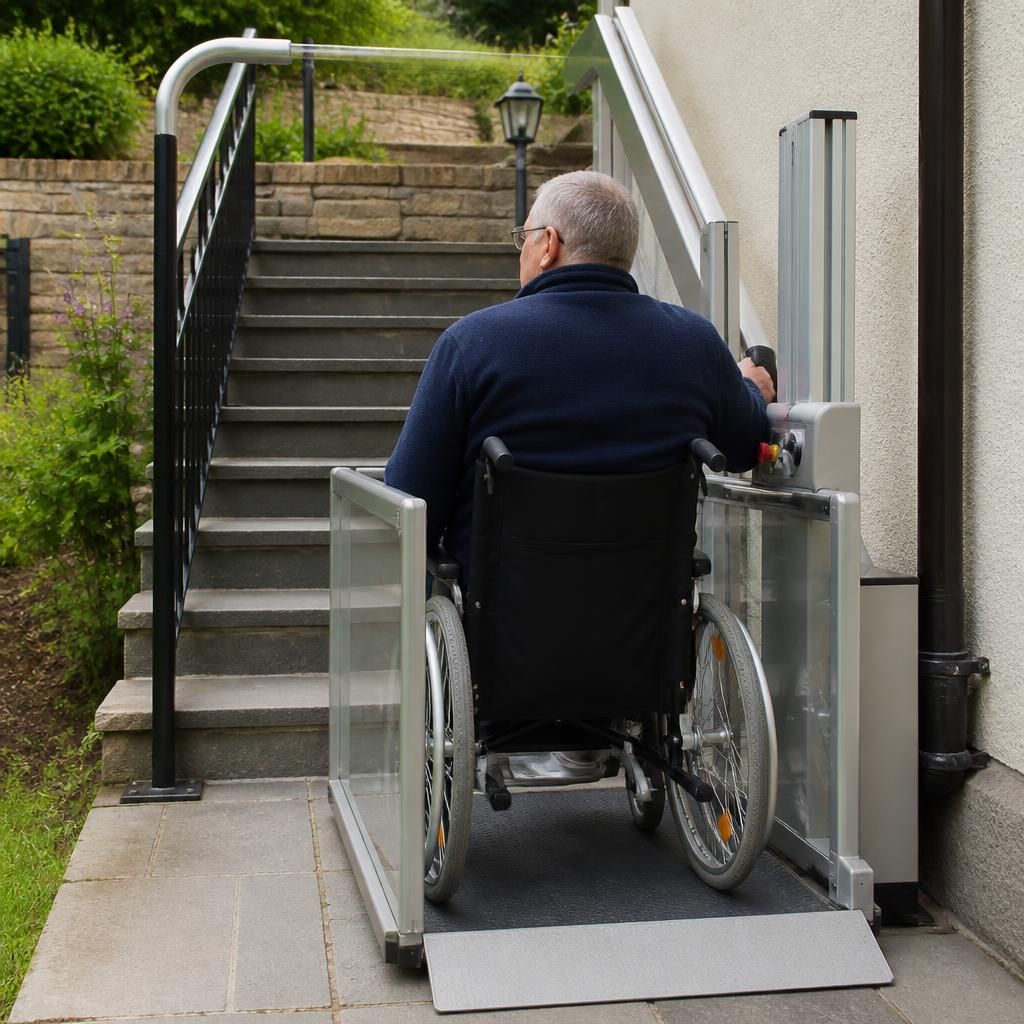
Arrange an assessment for your external wheelchair lift
Arrange an assessment with Independent Stairlifts to confirm whether an external wheelchair lift is suitable for your staircase, wheelchair and outdoor access requirements. We can discuss the available options and any installation considerations for your property.