
What are the differences between straight and curved outdoor stairlifts in terms of cost and installation?
Straight outdoor stairlifts generally cost less and can be installed more quickly because they use a standard rail on an uninterrupted flight of steps. Curved outdoor stairlifts require a bespoke rail shaped to the staircase, so they usually cost more and involve a more detailed survey, manufacture and installation process.
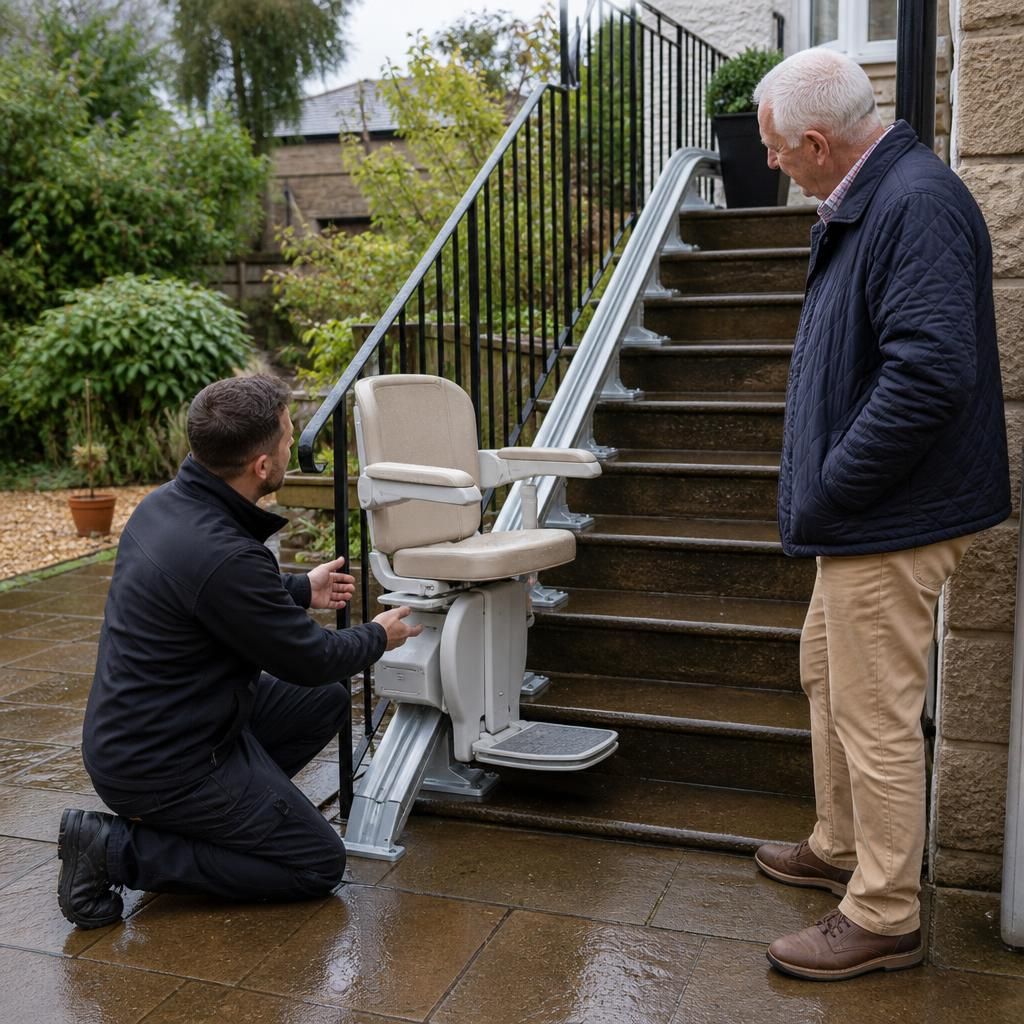
Straight outdoor stairlifts generally cost less and can be installed more quickly than curved outdoor stairlifts. A straight model uses a standard rail fitted along one uninterrupted flight of steps, whereas a curved model requires a bespoke rail made to follow bends, landings, changes of direction or more complex stair layouts. The final price for either option depends on the staircase, access, electrical work and the level of outdoor protection required.
Cost comparison
A straight outdoor stairlift is usually the more economical option because its rail is based on a standard design and can often be supplied without extensive modification. The installation process is also more predictable when the staircase is straight, has consistent steps and provides suitable space at the top and bottom.
A curved outdoor stairlift normally costs more because the rail must be measured and manufactured specifically for the staircase. The price can increase where the route includes a bend, intermediate landing, tight turn, multiple flights or a change in gradient. A curved system may also require more detailed planning to ensure that the seat, footrest and controls clear walls, gates, doorways and other obstructions.
Outdoor use can add to the cost of either type. Components must be suitable for exposure to rain, sunlight, temperature changes and, in some locations, salt or airborne debris. Weather-resistant upholstery, protective covers, sealed electrical components and suitable charging arrangements may be included in the specification or priced separately, depending on the model and installation requirements.
How installation differs
- Straight stairlift: The rail is normally installed directly to the stair treads rather than the wall. Once the survey confirms that the staircase is suitable and the required power supply is available, fitting is generally a relatively straightforward process.
- Curved stairlift: The staircase must be surveyed in greater detail so that the rail can be designed accurately. Measurements may include the position of each bend, landing dimensions, available headroom, the clearance from surrounding walls and the locations where the lift will park or charge.
A straight outdoor installation may be completed in a shorter timeframe when the lift is readily available and no substantial preparation is needed. A curved installation usually takes longer overall because the rail is manufactured after the survey. The fitting itself may also be more involved, particularly where the stairlift has several sections or needs carefully positioned parking points.
What the survey should assess
An outdoor survey is important for both designs, even when the staircase appears simple. The installer should check the width and condition of the steps, the fixing points, drainage, nearby doors and gates, the position of handrails and the space available for safe transfers at the top and bottom. The survey should also identify whether the stairlift could obstruct a walkway or reduce access for other people using the stairs.
For a curved stairlift, the survey must establish the exact route of the rail and how the seat will move around each corner. For a straight stairlift, the main considerations are usually whether the rail can follow the flight safely and whether the lift can park without obstructing the entrance, path or landing.
Electrical and structural considerations
Both types normally require a suitable charging point. Outdoor power supplies should be installed in accordance with current electrical requirements and protected appropriately for their location. If there is no convenient supply, additional electrical work may be needed, which can affect the total cost. The installer should also check that the steps and supporting structure are sound enough for the proposed fixings. Repairs, resurfacing or other building work may be necessary before installation.
Curved rails can require more fixing positions because they follow a more complex route. This does not necessarily mean major structural work, but the installer must ensure that every fixing is secure and that the rail remains stable along the full staircase. Straight rails are often simpler to position, although unusual step surfaces, uneven construction or limited edge clearance can still require additional preparation.
Which option is suitable?
A straight outdoor stairlift is generally suitable where the steps form one direct flight and there is enough room for safe boarding and parking. It is normally the practical choice when keeping the purchase and installation cost as low as reasonably possible is important.
A curved outdoor stairlift is more appropriate where the staircase changes direction or includes a landing that cannot be covered safely by one straight rail. It can provide continuous access over a complex route, but the bespoke design means that the assessment, manufacture and installation require more planning.
It is not always possible to compare prices accurately before a survey. Two straight staircases may have very different requirements if one has difficult access, poor drainage or a longer route. Similarly, the cost of a curved stairlift depends on the shape of the staircase and the specification rather than simply the number of bends.
For an accurate recommendation, the assessment should confirm the staircase layout, outdoor exposure, electrical arrangements and the safest parking positions. A clear quotation should distinguish the stairlift, bespoke rail where applicable, installation, weather protection and any additional electrical or building work. This makes it easier to compare a straight and curved solution on suitability as well as initial cost.
The key installation difference is that a straight outdoor stairlift follows a single, uninterrupted flight, while a curved model is designed around the exact shape of the staircase. This means a curved lift needs a more detailed survey before its rail can be manufactured and fitted.
For either option, the assessment should check the condition and width of the steps, available space for boarding and parking, nearby doors or gates, drainage, handrails and the position of a suitable power supply. Outdoor exposure must also be considered, including rain, sunlight, temperature changes and any airborne salt or debris.
- A straight lift is usually quicker to plan and install where the route is clear and the steps are structurally sound.
- A curved lift may need additional planning to ensure the seat and footrest clear walls, landings and other obstructions safely.
- Repairs, electrical work or improved drainage can add to the cost of either installation.
A home assessment is therefore the most reliable way to confirm which design is suitable and provide a meaningful comparison of the total installation cost.
Arrange Your Outdoor Stairlift Assessment
Arrange an outdoor stairlift assessment with Independent Stairlifts to compare the most suitable straight or curved option for your staircase and receive a clear installation quotation.