
What steps are involved in the installation process for a bespoke stairlift?
A bespoke stairlift installation involves a detailed home assessment, accurate measuring and track design, manufacture of the stairlift, professional fitting, and thorough safety testing. The installer then demonstrates the controls and confirms that the stairlift operates correctly for your staircase and mobility needs.
A bespoke stairlift installation involves several linked stages: assessing your staircase and mobility needs, measuring and designing the track, confirming the specification, manufacturing the lift, fitting it professionally, and completing safety checks before handover. Each stage is important because a bespoke lift must follow the exact shape of your staircase and be straightforward and safe for you to use.
- Home assessment and discussion
An experienced adviser visits your home to assess the staircase, surrounding space and access points. They discuss how you use the stairs, any difficulties you experience, who will use the lift, and features that may help now or in the future. The assessment also considers practical details such as where you can sit and stand safely, whether doors or hallways could affect access, and where the stairlift will park at the top or bottom. - Detailed measurements and design
The staircase is measured carefully, including bends, landings, changes in gradient, narrow sections and the available clearance. The proposed track is then designed to follow the stair profile while maintaining suitable space for walking and safe entry and exit. For a particularly unusual staircase, further checks may be needed to confirm how the track, charging points, controls and parking positions will work within the home. - Agreeing the specification
The design is reviewed with you before manufacture. This is the stage to confirm the seat style, upholstery, controls, armrests, footrest, safety belt, swivel mechanism and any other appropriate options. The position of the controls and the way the lift is operated should reflect your reach, dexterity, balance and confidence. If other people use the staircase, the design must also take their access needs into account. - Manufacture and preparation
Once the design has been approved, the track and stairlift are prepared to the agreed specification. Components are checked against the measurements and selected options before the installation visit. Bespoke work may require more preparation than a standard straight stairlift because the track is made to suit the individual staircase rather than supplied as a simple off-the-shelf length. - Preparing the installation area
Before fitting begins, the installer confirms the agreed route and checks that the staircase is ready. You may need to move ornaments, furniture or other items near the stairs to provide safe working access. The installation is normally designed to use the stair structure appropriately and to minimise disruption, without requiring major building work in most domestic settings. Any specific preparation identified during the assessment should be completed beforehand. - Fitting the track and stairlift
The track is installed securely and the stairlift carriage, seat, footrest and controls are fitted. The installer checks clearances around steps, walls, doors and landings as the components are assembled. On a curved staircase, the track is aligned through each turn and transition so that the lift travels smoothly and parks in the planned positions. The installer also confirms that charging points and any remote controls are placed correctly. - Testing and safety checks
After fitting, the stairlift is operated repeatedly along the full route. Checks include smooth travel, stopping and starting, the swivel seat, armrests, safety belt, footrest sensors, obstruction sensors, controls, charging and the operation of any emergency or manual lowering features. The installer also checks that the lift stops in the correct locations and that the user can get on and off safely at the top and bottom of the stairs. Any adjustment required is completed before handover. - Demonstration and handover
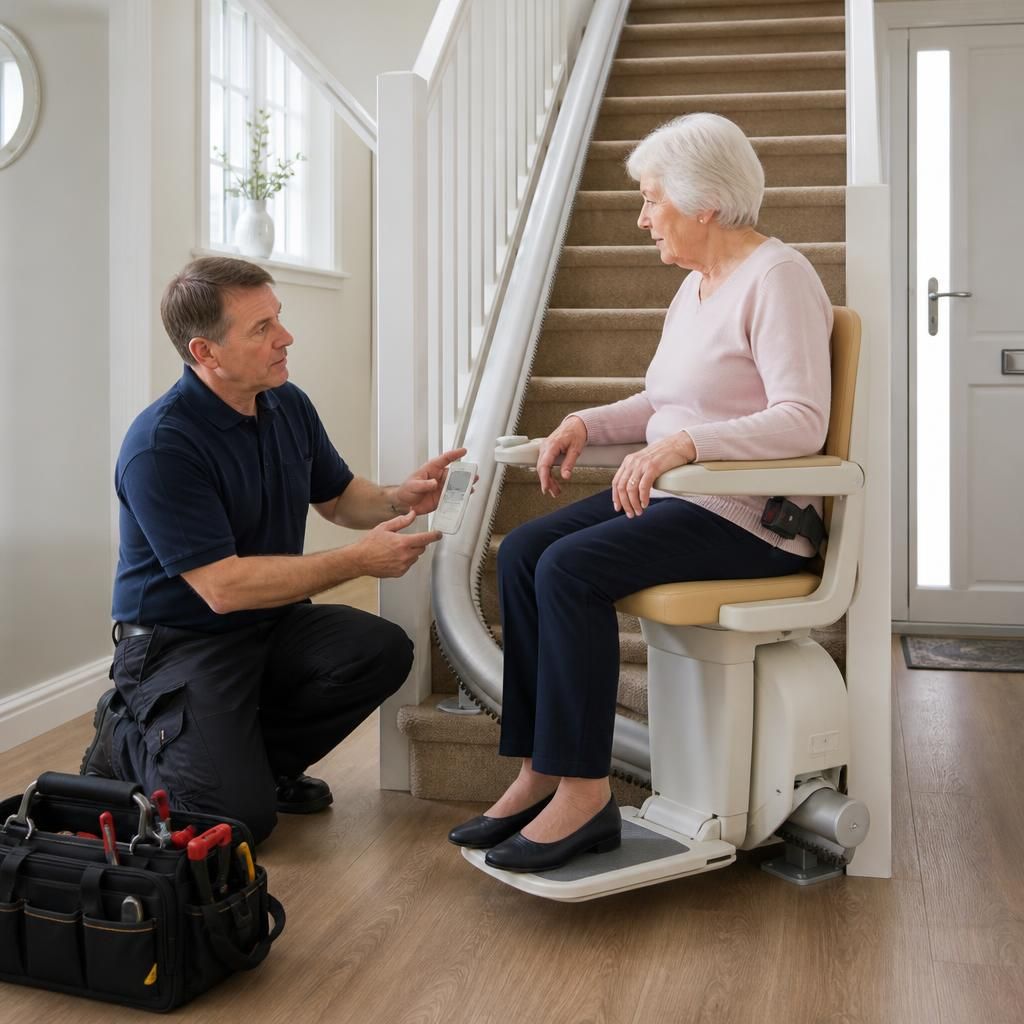
The installer explains how to call and operate the stairlift, use the seat and safety belt, position the armrests and footrest, and charge the batteries. You should have the opportunity to operate it yourself and ask questions. Instructions for routine care, what to do if the lift stops, and how to contact the support team are also covered. If more than one person will use the stairlift, each user should receive a practical demonstration.
Installation does not finish until the lift has been tested and you are comfortable using it. If your mobility or confidence changes later, contact Independent Stairlifts for advice rather than adapting or repairing the equipment yourself. Keep the controls, track and charging area clear, follow the operating guidance, and report unusual noises, repeated stopping or changes in performance promptly.
The exact installation arrangements depend on the staircase, the chosen specification and any preparation needed in the home. A clear assessment and accurate design reduce the risk of adjustments during fitting, while the final demonstration ensures that the bespoke stairlift is not only physically fitted but also suited to the way you use your stairs.
The final stage of a bespoke stairlift installation is thorough testing and a practical handover. After the track, carriage, seat and controls have been fitted, the installer runs the lift along its complete route to confirm that it travels smoothly, stops correctly and clears the stairs, walls, doors and landings.
The safety checks include the seat swivel, safety belt, armrests, footrest, obstruction sensors, controls, charging points and any emergency features. The installer also confirms that you can board and leave the stairlift safely at the planned parking positions. You will then be shown how to operate the lift, use the call controls, charge the batteries and respond if it stops. You should have the opportunity to use it yourself and ask questions before the installation is considered complete.
Arrange your bespoke stairlift assessment
Arrange your bespoke stairlift assessment with Independent Stairlifts to review your staircase, mobility needs and suitable design options. Contact our team to arrange a convenient home visit.