
What considerations should be made for bespoke stairlifts to ensure optimal safety and ease of use within a multi-user household?
In a multi-user household, a bespoke stairlift should be planned around each person’s mobility, balance, height and preferred method of access, while maintaining safe clearance for people using the stairs on foot. Key considerations include easy-to-operate controls, suitable seat and armrest positioning, safe boarding points, reliable safety sensors, secure parking, and clearly agreed arrangements for shared use.
A bespoke stairlift for a multi-user household should be designed around the needs of every intended passenger, while preserving safe access for people who continue to use the stairs on foot. The assessment should consider each user’s mobility, balance, height, weight, transfer ability, preferred hand, vision and confidence, as well as the staircase layout, landing space and household routines. Controls, seating, boarding positions, safety features and parking locations must then be selected so that the lift is straightforward and safe for all approved users.
Assess each user individually
People who share a stairlift may have very different abilities. One person may be able to stand and turn easily, while another may need more support when transferring from a wheelchair or walking aid. The assessment should record:
- Whether each user can safely approach, sit down, stand up and turn at the top or bottom of the stairs.
- The level of support required for balance, including whether a powered swivel seat or additional seat support would be appropriate.
- Each person’s height, leg length and sitting position, so the seat, armrests, footrest and controls can be positioned safely.
- Whether a user has reduced grip, limited movement in one arm, visual impairment, tremors, memory difficulties or difficulty understanding controls.
- Whether the user needs to travel with a walking stick, frame or other mobility aid, and where that aid can be placed without obstructing the lift or staircase.
- Any condition that may change over time, so the design remains practical as support needs develop.
A stairlift should not simply be set up for the most able passenger and expected to suit everyone else. If users have substantially different requirements, the assessor may recommend adjustable features, alternative operating positions or a different seating arrangement. Where a single configuration cannot safely meet everyone’s needs, that limitation should be discussed before installation.
Make the controls accessible to every user
Controls should be reachable without leaning across the seat or twisting awkwardly. A control on the armrest is commonly useful, but its position and operation should be checked with each passenger. A user with limited strength or movement may need a simple, clearly marked control that can be operated with minimal pressure. If the lift has a directional control, the intended movement should be obvious and consistent.
Remote controls at the top and bottom of the stairs can allow one household member to send the lift to the required landing. They should be positioned where they can be reached safely and kept out of the way of children or accidental operation. If more than one person uses the lift, agree who is responsible for moving it when it is parked and avoid leaving it in a position that blocks a landing or creates a trip hazard.
Key switches or other access controls may be useful where unsupervised use by children, visitors or people who may not understand the controls is a concern. They should be considered alongside the needs of every authorised user, rather than introduced in a way that prevents a passenger from operating the lift independently.
Choose seating and transfer features carefully
Seat height is particularly important in a shared household. A seat that is comfortable for a taller user may be difficult for someone shorter to access, while a low seat may make standing harder for another passenger. The seat should allow each user to sit securely with their back supported and feet positioned correctly on the footrest.
Consider the following features during the design assessment:
- Swivel seat: This can help a user turn towards the landing before standing, reducing the need to twist on the stairs. The locking action should be understood and manageable by every user.
- Powered swivel or powered controls: These may reduce the physical effort required, but the user must still be able to wait until the seat is in the correct position before transferring.
- Seat belt: Each user should be able to fasten, release and position the belt correctly, or have appropriate assistance available. The belt should not be treated as a substitute for good seating posture.
- Armrests and footrest: These should provide stable support without preventing a safe transfer. The footrest must accommodate the user’s feet and avoid contact with the stairs or surrounding structure.
- Seat width and support: The seat should accommodate the largest intended passenger comfortably while allowing the lift to maintain safe clearances on the staircase.
If users require different seat positions, ask whether the proposed model provides sufficient adjustment or whether one user would need assistance each time. A safe transfer is more important than making the lift look compact.
Protect users from different types of risk
Safety sensors should be checked as part of the design and installation, particularly where the staircase has unusual edges, narrow sections, tight bends or doors close to the track. Sensors should stop the lift if an obstruction is detected, but users must still be shown how to keep clothing, feet, walking aids and household items clear of the moving parts.
Additional points to consider include:
- Whether the user can sit fully back in the seat before travelling.
- Whether loose clothing, blankets, footwear or bags could become caught.
- Whether children or pets may approach the stairs while the lift is moving.
- Whether a landing door, cupboard, radiator or furniture could interfere with boarding, parking or the track.
- Whether lighting is adequate at the bottom, top and any intermediate landing.
- Whether the handrail remains useful and accessible to people who continue to walk up or down the stairs.
Users should be shown how to stop the lift, what to do if it stops unexpectedly and how to report a fault. Demonstrations should be repeated for anyone who may need assistance with the controls or safety belt.
Plan boarding, parking and shared use
In a multi-user home, the boarding points need to work for the least mobile passenger, not just the person who can make the tightest turn. At the lower landing, there should be enough room to approach the seat with the required walking aid. At the upper landing, the user should be able to swivel and transfer without being forced towards an open edge or obstructed by a doorway.
Parking positions should be agreed around the household’s normal movements. The lift should not be left across a narrow passage, in front of a door, at the foot of the stairs where it creates an obstruction, or in a position that prevents another user from boarding. If the track design allows the seat to be parked away from the main staircase, that may improve access for other household members. The final arrangement must still leave suitable clearance and comply with the installation requirements for the property.
It is helpful to establish a simple household routine: users should park the lift in the agreed location, keep the staircase clear, and avoid trying to pass a moving or poorly positioned lift. Where one person needs the lift urgently or cannot move it independently, the household should agree how assistance will be provided.
Consider the needs of people who do not use the stairlift
A stairlift is installed on a staircase that may still be used by other residents. The track, seat and footrest should leave practical clearance for people walking on the stairs, particularly at bends and narrow points. The assessment should also consider whether the lift reduces access to a handrail, creates a projection at the landing or changes how a person carrying laundry or other items can use the stairs.
Children and visitors may not understand the risks associated with a stairlift. Keep the staircase free from toys, bags and loose objects, and ensure that controls, keys and charging points are not placed where they invite unsupervised play. Pets should not be allowed near the lift while it is travelling or boarding.
Account for changing requirements
A shared stairlift should be suitable for current users without preventing sensible future adjustments. Ask whether the seat, controls, belt and transfer method could remain appropriate if a user becomes less steady or needs more assistance. It is also important to confirm the permitted passenger and equipment limits for the selected lift rather than assuming that every household member can use it in the same way.
If a user’s mobility changes, the lift should be reassessed rather than modified informally. A new walking aid, reduced ability to transfer, increased need for supervision or a change in weight may affect safe use. Do not allow a passenger to travel while standing, carry another person, or transport a mobility aid in a way that obstructs the controls, sensors or footrest.
Provide clear instruction and ongoing checks
Every intended user should receive a practical demonstration tailored to their ability. This should cover approaching the lift, operating the controls, using the belt, positioning the feet, swivelling the seat, stopping safely and parking the lift. If a carer or family member assists, they should also understand how to support the passenger without standing on the stairs in an unsafe position.
Keep the operating information available to the household and arrange servicing in line with the manufacturer’s guidance. Regular checks can identify changes in the seat, belt, controls, sensors, batteries or track before they affect daily use. Report unusual noises, hesitation, repeated stopping or damage promptly, and do not continue using the stairlift if a safety feature is not working as intended.
The most suitable bespoke arrangement is therefore the one that combines individual assessment with a clear shared-use plan. Independent Stairlifts can review the staircase, observe how each person approaches and transfers, and specify the seating, controls, safety features and parking positions that provide safe, practical use for the whole household.
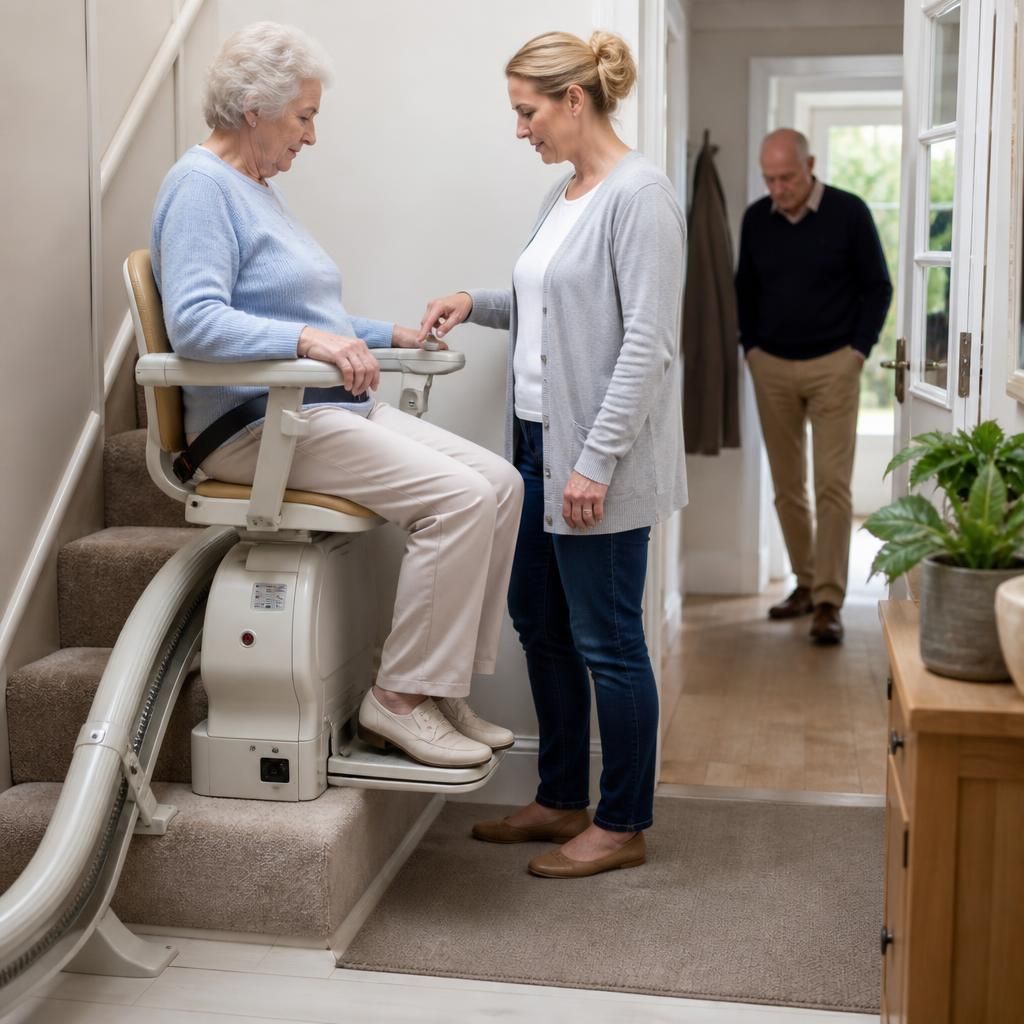
In a multi-user household, the stairlift’s boarding and parking positions should be planned around the person who needs the most space and support. Each passenger must be able to approach the seat, transfer safely, use the controls and leave the lift without twisting towards the stairs, an open landing or a nearby doorway.
The assessment should also consider where the lift is left when not in use. An agreed parking position can keep landings, doors and the staircase clear for other residents, while remote controls may allow the lift to be moved without anyone reaching across the stairs. Every user should be shown the same safe routine, including how to position their feet, fasten the belt, swivel the seat and report a fault.
Arrange a bespoke multi-user stairlift assessment
Arrange a bespoke multi-user stairlift assessment with Independent Stairlifts to review each passenger’s needs, the staircase layout and the safest shared-use arrangements.