
What are the benefits of choosing a bespoke stairlift over a standard model?
A bespoke stairlift is designed around your staircase, home layout and mobility needs rather than fitted as a standard, one-size-fits-all model. This can provide a more precise fit, smoother operation, greater comfort and improved safety, particularly on curved, narrow, steep or unusually configured stairs.
A bespoke stairlift is designed and configured around the user, the staircase and the available space, whereas a standard model is usually built to a more typical specification. The main benefits of choosing a bespoke stairlift are a more accurate fit, better suitability for unusual staircases, improved comfort and control, and greater flexibility when safety, access or future mobility needs are important.
“Bespoke” does not necessarily mean that every component is made from scratch. It usually means that the stairlift is selected, measured and configured to suit the individual installation. This may include a purpose-designed curved rail, a choice of seat and controls, adjustments to the track position, and features that address the user’s posture, strength and ability to transfer on and off the stairlift.
A more precise fit for the staircase
Standard stairlifts are generally most suitable for straightforward staircases with a consistent gradient and adequate space at the top and bottom. A bespoke design is more appropriate where the staircase includes bends, intermediate landings, multiple flights, narrow sections, unusual angles or limited clearance. The rail can be planned to follow the staircase more closely, helping the stairlift operate within the available space rather than requiring the home to accommodate a fixed standard layout.
A carefully planned track can also help preserve access to doorways, hallways and landings. For example, the rail may be positioned or finished with a parking arrangement that reduces obstruction at the bottom or top of the stairs. The precise solution depends on the measurements and the surrounding architecture, so an in-home assessment is essential.
Improved safety on difficult or restricted staircases
A bespoke assessment considers more than whether the stairlift can travel from one floor to another. It examines the width of the stairs, the position of handrails, doorways, radiators and furniture, as well as the space available for safe transfers. This helps identify potential hazards before installation and allows the design to address them.
Depending on the individual’s needs and the staircase, useful safety features may include powered swivel or folding seats, adjustable armrests, retractable or powered footrests, a suitable seat belt, obstruction sensors and controls that are easy to operate. A bespoke approach helps ensure that these features are selected for a reason rather than added without considering how the user will actually use the stairlift.
Greater comfort and easier transfers
Comfort is particularly important when a stairlift will be used frequently or when the user experiences stiffness, reduced balance, joint pain or limited strength. A bespoke model can offer choices relating to seat size, seat height, back support, armrest position and controls. These details can make it easier to sit down, remain stable during travel and stand safely at the destination.
Some users need a seat that supports a particular posture, while others may benefit from a design that makes transfers less demanding. The best arrangement will depend on the person’s height, weight, flexibility, balance and the position from which they approach the stairs. A professional assessment should consider these practical movements, not just the dimensions of the staircase.
A smoother and more controlled journey
On a curved or irregular staircase, a rail designed for the route can provide a more consistent journey than attempting to adapt a standard arrangement to an unsuitable layout. The travel path, speed changes and stopping positions can be planned around the shape of the stairs and the available landing space.
Even on a straight staircase, a tailored installation may improve the overall experience if the track position, seat orientation or parking point needs to work around other household activities. A smooth journey also depends on correct installation, regular servicing and using the stairlift within its specified operating limits.
More flexibility for the home
A bespoke stairlift can be planned to work with the way the household uses its stairs. This may be important where more than one person uses the staircase, where the stairlift needs to be parked clear of a passageway, or where doors and landings must remain accessible. Folding components and considered parking positions can help retain usable space when the stairlift is not moving.
For a multi-user household, the design may need to balance different heights, transfer abilities and preferences. Controls can be positioned for the principal user, while remote controls or other arrangements may help family members move the stairlift when necessary. Any shared-use solution should still prioritise safe operation for the person with the greatest mobility limitations.
Options that can support changing needs
Mobility can change over time. A person who can currently stand and transfer easily may later require more support, or may find that a different seating position is more comfortable. During the design process, it is sensible to discuss foreseeable changes without selecting features that are unnecessary or difficult to use.
Possible considerations include a powered swivel seat, powered folding functions, simple controls, suitable support from the arms and back, and a charging or parking arrangement that is convenient for daily use. A bespoke stairlift cannot predict every future need, but choosing adaptable features can reduce the likelihood that the equipment becomes unsuitable as mobility changes.
Better integration with the property
Because the rail and equipment are planned around the staircase, a bespoke stairlift can often be integrated more neatly into the home than a standard installation that does not account for unusual architectural features. The assessment may consider the position of bannisters, skirting boards, newel posts, architraves and nearby furniture.
This does not mean that the stairlift will be invisible, but careful planning can reduce unnecessary interference with the home’s layout and appearance. Colour, upholstery, finishes and compact or folding components may also be available, subject to the equipment selected and the installation requirements.
When a standard stairlift may be the right choice
A bespoke stairlift is not automatically the best option for every property. A standard straight stairlift may provide a practical and cost-effective solution where the stairs are uncomplicated, there is sufficient clearance and the user’s requirements are well served by the standard seat and controls. It can also involve a simpler installation.
The important comparison is not whether bespoke equipment sounds more advanced, but whether it solves a specific problem. A detailed assessment should establish whether the staircase, the user and the household require custom design, or whether a standard model will provide safe, comfortable and reliable access.
How to decide
Discuss the full range of daily requirements during the assessment, including how the user approaches the stairs, transfers to the seat, operates the controls and leaves the stairlift at the other end. Mention pain, balance issues, reduced grip, visual difficulties, fatigue and any anticipated changes in mobility. It is also useful to explain how other household members use the staircase and which doors or walkways must remain clear.
The resulting recommendation should explain why a particular rail design, seat configuration and set of features has been chosen. In practical terms, the benefit of a bespoke stairlift is that the equipment is matched to the real conditions of the home and the person using it, rather than relying on a standard arrangement that may be acceptable but not ideal.
A bespoke stairlift is configured to match the staircase and the user’s way of transferring, which can improve safety where space is restricted or the stairs are unusually shaped. The assessment considers the available room at the top and bottom, nearby doors and handrails, and how the user approaches, sits on and leaves the stairlift.
This may allow the track, seat position and parking point to be planned around the home rather than imposed on it. Features such as a powered swivel seat, folding footrest, supportive armrests or easy-to-operate controls can then be selected because they address a specific mobility need. The result should be a stairlift that supports safer, more manageable daily use while keeping important walkways and access points as clear as possible.
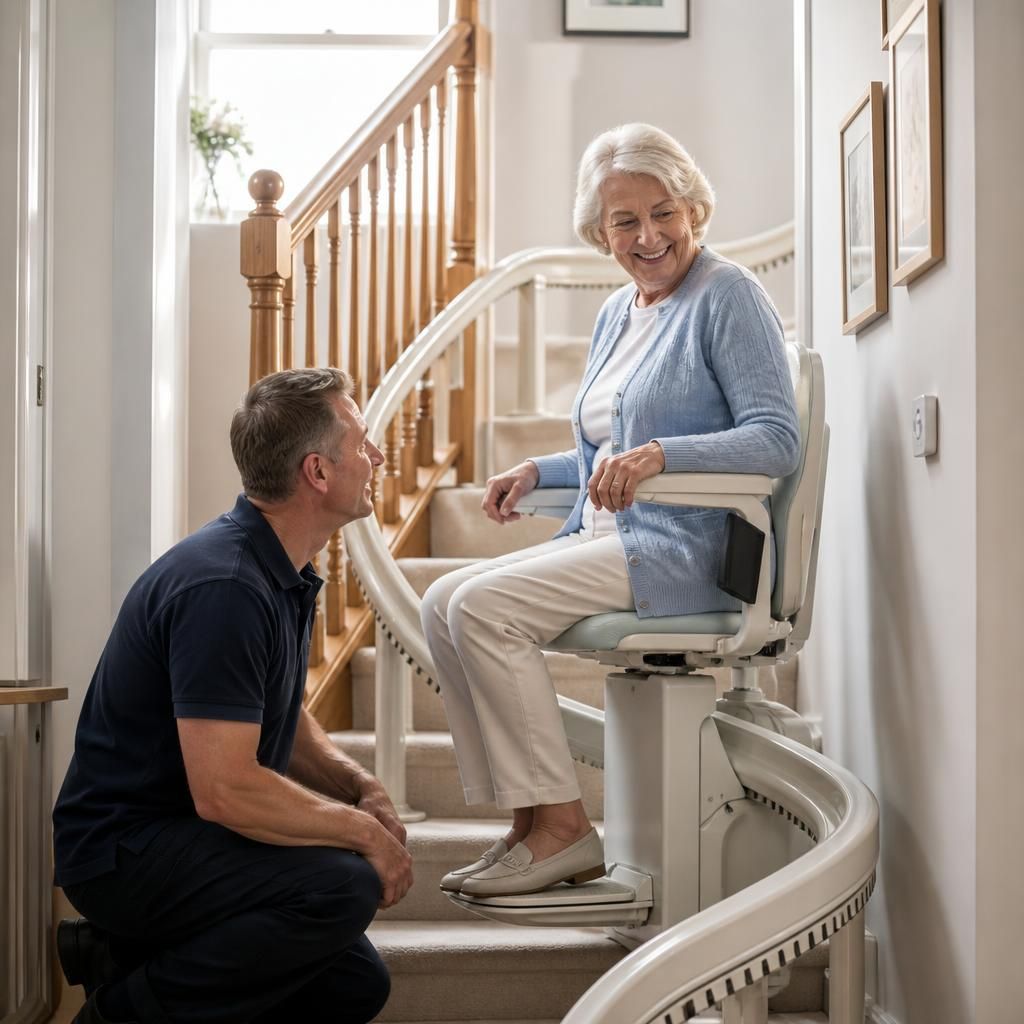
Discuss Your Bespoke Stairlift Requirements
Discuss your bespoke stairlift requirements with Independent Stairlifts so we can review your staircase, home layout and mobility needs. Our assessment will help determine whether a bespoke model or standard stairlift is the most suitable option.