
What should I consider when choosing between a straight and curved stairlift?
Choose a straight stairlift for a single, uninterrupted flight; choose a curved stairlift when the stairs include bends, landings, multiple flights or unusual angles. Your decision should also consider the staircase layout, available space, seating and safety features, visual impact, installation requirements and budget, with a home assessment confirming the most suitable option.
A straight stairlift is usually suitable for one uninterrupted flight of stairs, while a curved stairlift is designed for stairs with bends, landings, multiple flights or unusual angles. The correct choice depends primarily on the staircase layout, but available space, how you use the stairs, seating and safety requirements, appearance, installation practicalities and budget should also be considered. A home assessment will confirm which track design can be installed safely and comfortably.
Start with the shape of the staircase. A straight stairlift runs along a single, straight rail from one level to another. It is generally the simpler option where there are no intermediate landings, changes of direction or obstructions that require the rail to follow the staircase. A curved stairlift uses a made-to-measure rail that follows the exact path of the stairs. It can be suitable for an L-shaped or U-shaped staircase, a spiral or winding section, a split-level arrangement, or a staircase with one or more landings.
A bend is not always obvious from the bottom of the stairs. Changes in angle, narrow turns, open stair edges and differences in tread depth can all affect the rail design. If the staircase has more than one flight, a curved system may allow you to travel between floors without transferring at a landing. In some homes, separate straight stairlifts may be considered instead, but this would require you to leave one lift and transfer to another. Whether that is practical depends on your balance, strength, confidence and the space available at each landing.
Consider how you will use the stairs. Think about where you need to get on and off the stairlift, whether you will carry shopping or laundry, and whether other household members need to use the staircase normally. A lift can be configured with different start and finish positions, including options that help you dismount away from the edge of a landing. This can be particularly useful where the top or bottom of the stairs opens directly into a hallway, doorway or narrow passage.
At the bottom of the stairs, check whether there is enough room to park the chair without obstructing a doorway or route through the home. At the top, consider whether the seat needs to swivel to make getting off safer and easier. On a curved stairlift, the rail may be designed to continue beyond the first or last step so the chair can park in a more convenient position. The available parking space, rather than the staircase alone, can therefore influence the most suitable design.
Assess comfort, transfers and safety. Both straight and curved stairlifts can include features such as a swivelling seat, armrests, a seat belt, obstruction sensors and controls on the armrest or handset. The right specification depends on your mobility and the way you approach the stairs. For example, a powered swivel or powered footrest may reduce the effort needed to prepare for a transfer, while a hinged or retractable rail may help where a doorway or walkway is close to the bottom of the stairs.
Seat shape and dimensions also matter. A standard seat may be suitable for many users, but a perch seat can be considered where bending the knees or sitting fully is difficult. The track and seat must still provide adequate clearance from walls, banisters and the stair edge. If more than one person will use the stairlift, their height, weight, mobility and preferred controls should be discussed before the specification is finalised.
Compare the likely cost and installation requirements. A straight stairlift normally has a simpler rail and installation process, so it is commonly the more economical choice when the staircase allows it. A curved stairlift generally costs more because its rail is surveyed, designed and manufactured to follow the individual staircase. The final price can also be affected by the number of levels, parking positions, powered options, rail configuration, access requirements and any alterations needed around the stairs.
Installation may be relatively straightforward for a suitable straight staircase, whereas a curved system requires more detailed measuring and rail fitting. The stairlift is normally fixed to the treads rather than the wall, but the installer will check the condition of the stairs, the available headroom, landing clearance, electrical supply and any features that could affect safe use. Items such as radiators, doors, low ceilings, decorative newel posts and unusual bannisters should be identified during the assessment.
Think about appearance and the rest of the household. A straight rail has a simpler visual line, while a curved rail is designed to follow the staircase and can be more integrated with a complex layout. In either case, the folded seat and rail occupy space, particularly when parked. Discuss finishes, upholstery, rail position and parking locations if keeping the staircase usable for other people is important. A well-planned installation should balance your access needs with circulation through the hallway and between floors.
Consider future needs as well as current mobility. The best choice is not necessarily the least expensive option today. If using the stairs is becoming progressively more difficult, avoiding transfers at a landing may make a continuous curved stairlift more practical. If the difficulty is limited to one straight flight and you can safely manage any other stairs, a straight lift may meet your needs with less equipment. Your likely use of the home should be discussed honestly, including whether you expect to remain on one floor, need regular access to upper rooms or share the property with other people.
Do not assume that a staircase must be altered to accommodate a stairlift, or that a curved lift is required simply because the stairs are narrow. The appropriate solution depends on measurements and the proposed rail path. A survey should check stair width, tread and landing dimensions, headroom, fixing points, turning areas and the position of doors and other obstructions. It should also establish where you can transfer safely and where the chair can be parked without creating a hazard.
In practical terms, choose a straight stairlift when the route is a single, uninterrupted flight and the available parking positions work for you. Choose a curved stairlift when the rail needs to follow a bend, landing, multiple flights or other unusual geometry, or when avoiding a transfer between flights is important. If the layout is borderline, a detailed assessment is the safest way to compare the options, confirm the available features and receive a specification based on your home rather than a standard assumption.
The main difference between a straight and curved stairlift is the route its rail follows. A straight stairlift is intended for one uninterrupted flight, while a curved stairlift is made to follow bends, landings, multiple flights or unusual angles.
Where a staircase changes direction, a curved stairlift can provide continuous travel between levels, avoiding the need to transfer from one lift to another at a landing. This may be particularly important if balance, strength or confidence makes transfers difficult. However, a straight stairlift may remain suitable where the flights are separate and you can safely move between them.
Parking space is also important. The rail may need to extend beyond the first or last step so that the chair stops in a safer, more convenient position, away from a doorway or the edge of the stairs. During the assessment, the installer will consider the staircase shape, landing clearance, headroom, doors and normal household access before confirming which option is appropriate.
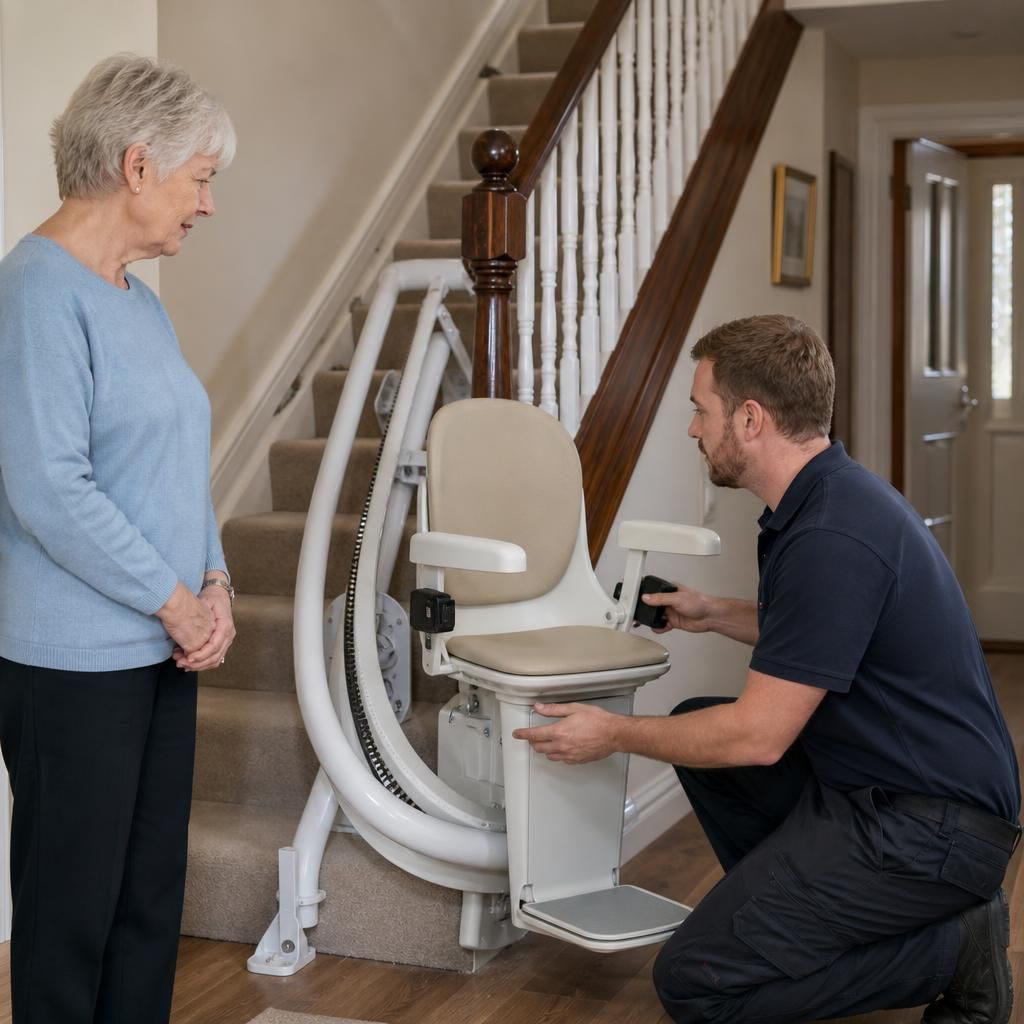
Arrange your straight or curved stairlift assessment
Arrange a home assessment to confirm whether a straight or curved stairlift is suitable for your staircase, including the safest parking and transfer positions. Independent Stairlifts can discuss your needs and provide a tailored recommendation.