
What is the cost difference between new and reconditioned stairlifts?
Reconditioned stairlifts usually cost less than new stairlifts because the main equipment has been previously used, professionally checked and refurbished. The final price depends on the stairlift type, track requirements, installation work, warranty and any extra features, so a home assessment is needed for an accurate comparison.
A reconditioned stairlift generally costs less than a new stairlift because the lift unit has been previously used, professionally inspected and refurbished. The saving can be significant, but the final new versus reconditioned stairlift cost depends on the staircase, track design, installation requirements, warranty and features included in the quotation.
For a straight staircase, the main price difference is usually between the new or reconditioned lift unit. A reconditioned model may use a previously installed seat, motor and controls, with worn or unsuitable parts replaced before installation. The existing stairlift rail may sometimes be suitable for the staircase, but this must be checked carefully rather than assumed.
For a curved staircase, the comparison is more complex. Curved stairlifts require a track made to follow the bends, landings and changes in direction of the individual staircase. A new curved stairlift normally includes a newly manufactured bespoke track. A reconditioned option may still need a new or modified track, so the saving may be smaller than it would be with a straight stairlift. The condition and compatibility of any available track are also important.
The main cost elements to compare are:
- The stairlift unit: This includes the seat, motor, controls, batteries and safety equipment. Reconditioned units cost less because the core equipment has already been used.
- The track: A straight track may be standard or adaptable, while a curved track is made for the staircase. Track manufacture, alterations and fitting can have a major effect on the total.
- Installation: The quotation should make clear whether fitting, testing and commissioning are included. Extra work may be needed where access is restricted or the staircase has unusual features.
- Removal of an existing stairlift: If an old lift needs to be removed before installation, check whether this is included or charged separately.
- Features and accessories: Swivel or powered seats, hinged rails, alternative controls, folding footplates and upgraded upholstery can affect the price of either option.
- Warranty and aftercare: A new stairlift will commonly be supplied with manufacturer-backed warranty cover. A reconditioned stairlift should also have clearly stated warranty terms, including what is covered, for how long and who provides repairs.
A lower purchase price does not automatically make a reconditioned stairlift the better value. Ask what refurbishment has been carried out, whether batteries and safety components have been replaced or tested, and whether the lift has been inspected under load after installation. It is also sensible to check the availability of replacement parts and ongoing servicing for the model offered.
A new stairlift may be preferable where you want the latest specification, a wider choice of upholstery and controls, or a longer expected period of use. It can also be the more practical option for a complex curved staircase when a new track is required regardless of the age of the lift unit. A reconditioned stairlift may be suitable when the priority is reducing the initial cost and a compatible, fully tested model is available for the staircase.
When comparing quotations, request a like-for-like breakdown rather than comparing the headline price alone. Confirm whether each quotation includes the same seat type, track, safety features, installation, removal, warranty and follow-up support. A quotation for a basic reconditioned straight stairlift is not directly comparable with a new curved stairlift with powered options.
The condition of the home can affect the overall cost as well. Narrow stairs, intermediate landings, doors close to the rail, limited parking or difficult access may influence the installation process. In a multi-storey home, separate lifts or a linked solution may be considered, and the cost should be assessed for the complete route rather than one staircase in isolation.
VAT treatment may also affect the amount payable. Some customers with a qualifying disability or long-term condition may be eligible for VAT relief on mobility equipment and installation, subject to the relevant rules. The supplier should confirm whether the proposed work qualifies and what information is required; eligibility should not be assumed from the stairlift type alone.
The most reliable way to establish the difference between a new and reconditioned stairlift is to arrange a home assessment. Independent Stairlifts can assess the staircase, discuss how long and how often the lift is likely to be used, and provide options with the equipment, track, installation and warranty shown clearly. This allows you to compare the total cost and expected support rather than choosing solely on the initial price.
The cost difference between a new and reconditioned stairlift depends on more than the age of the lift unit. A fair comparison should include the track, installation, safety features, warranty and aftercare for both options.
Reconditioned stairlifts can offer a lower initial price, particularly on a straight staircase where a compatible track may be available. On a curved staircase, the saving may be smaller because the track usually needs to be made or adapted to match the individual bends, landings and changes in direction. The condition and compatibility of any existing track must be confirmed during the assessment.
- Check whether the quotation includes delivery, fitting, testing and removal of an existing lift.
- Ask which parts have been inspected, replaced or tested, including batteries and safety components.
- Compare warranty length, exclusions, repair arrangements and ongoing servicing.
- Make sure both options include equivalent seat functions, controls and safety features.
This like-for-like approach shows whether the lower purchase price represents a genuine saving and whether the proposed stairlift is suitable for your staircase and expected use.
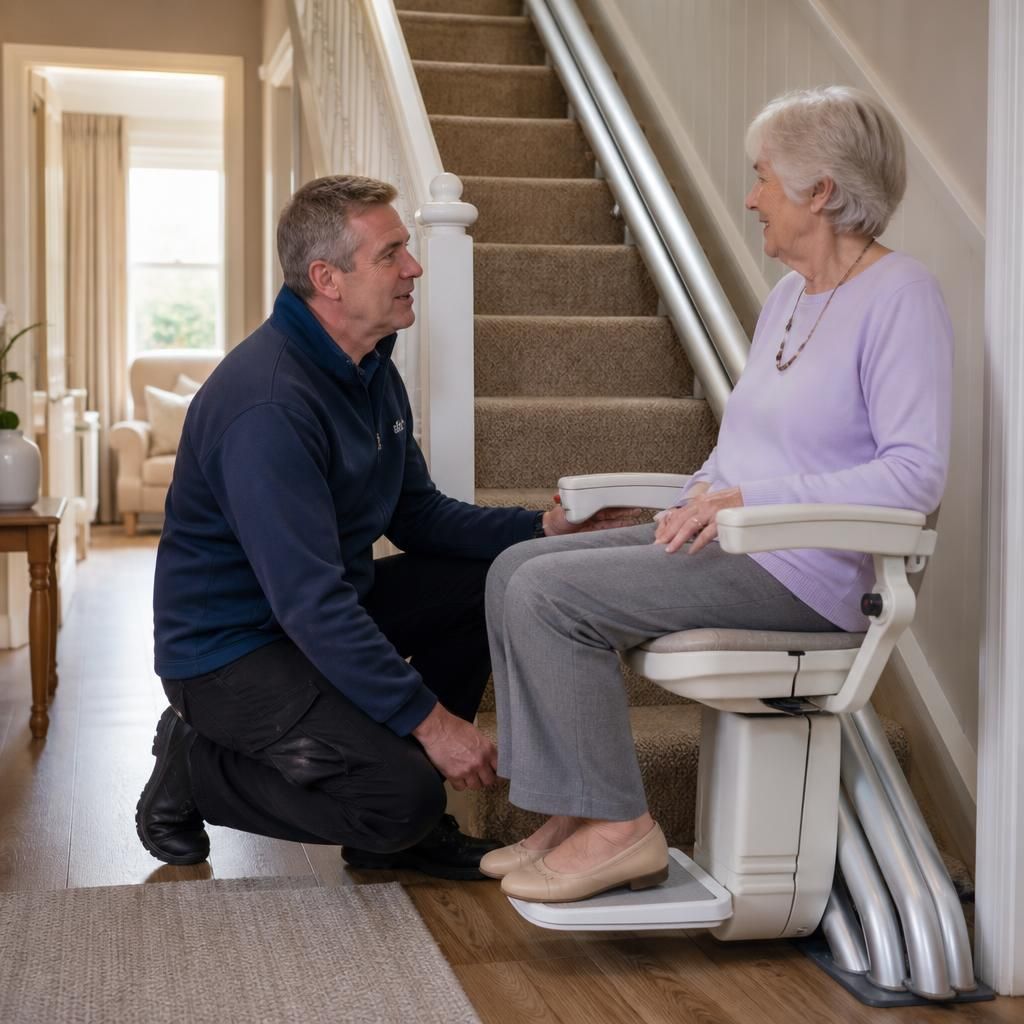
Compare your new and reconditioned stairlift options
Arrange a home assessment to compare new and reconditioned stairlift options, including the track, installation, warranty and aftercare. Independent Stairlifts can explain which solution is suitable for your staircase and provide a clear quotation.