
What factors should I consider when choosing a custom stairlift track?
When choosing a custom stairlift track, consider your staircase layout, available space, user’s mobility needs, safety requirements, comfort, appearance and budget. A professional assessment will establish the most suitable track design, including where it should start and finish, how it follows bends or landings, and whether any access or installation challenges need to be addressed.
The right custom stairlift track is determined by the shape of your staircase, the available space at the top and bottom, and the needs of the person using it. A professional survey should assess the staircase, landing areas, access points and intended route before the track is designed. It should also consider safety, comfort, appearance, installation requirements and the overall cost, rather than treating the track as a separate choice from the stairlift itself.
Staircase layout and track route
The geometry of the staircase is the starting point. A straight flight may need a relatively simple rail, while a staircase with a bend, intermediate landing, return, narrow section or change in direction generally requires a curved track made to follow its individual measurements. The survey should establish how closely the rail can follow the stairs and where it needs to start and finish.
- Assess every flight, landing and turn rather than viewing only the main staircase.
- Identify whether the track needs to pass around a bend, continue across a landing or serve more than one floor.
- Consider whether the stairlift should stop at the top of the stairs, on the landing or beyond the stair edge to make transferring easier.
- Check whether the bottom stopping point leaves enough room to approach the lift without obstructing a doorway, hallway or route through the home.
The end positions can be as important as the bends in the rail. A suitable overrun may improve access and reduce the need to turn on a narrow landing, but it must not create a hazard or block an essential passage. In some homes, a hinged or retractable section may be considered where the rail would otherwise interfere with a doorway or circulation space.
Available space and obstructions
Measure the usable width of the stairs, not just the distance between the walls. Handrails, dado rails, radiators, skirting boards, doors, cupboards, light switches and furniture can all affect the position of the track or seat. The survey should also check headroom at turns and landings, particularly where the staircase passes beneath another flight or a low ceiling.
A narrow staircase does not automatically rule out a stairlift, but it may influence the seat style, rail position, folding clearances and the way the user approaches the lift. The track should allow other household members to use the stairs safely where possible. If the staircase is shared with another access route, this needs to be discussed before the design is agreed.
The user’s mobility and transfer needs
The person using the stairlift should be central to the track decision. Consider whether they can walk to the seat, turn safely, sit down and stand up without overreaching. A track that ends in a more convenient position may be preferable to one that simply follows the shortest route.
- Consider balance, strength, flexibility and the ability to bend the knees when sitting.
- Allow for walking aids, which may need to be left at the top or bottom of the stairs or carried separately.
- Discuss whether a powered swivel seat, adjustable seat position or other seating option would make transfers safer and easier.
- Take account of the user’s height, weight and posture when checking seat clearance and comfort.
- Consider whether more than one person may use the stairlift, and whether the controls and seat settings can accommodate them.
It is also sensible to consider how the user’s mobility may change. A track and seat that are manageable now should not create unnecessary transfer difficulties later. If the user has a condition affecting balance, joints, vision or coordination, mention this during the assessment so that the proposed route and equipment can be reviewed appropriately.
Safety at bends, landings and stopping points
A custom track must provide a stable, predictable ride while keeping the user clear of walls, ceilings, doorways and other obstructions. The design should allow the stairlift to travel smoothly through changes in direction and stop in a position where the user can get on and off securely.
Ask the installer to explain the relevant safety features for the proposed model, including sensors that detect obstacles, a secure seat belt, swivel or folding mechanisms, braking, battery operation and controls. The most suitable features depend on the user and the staircase. For example, a powered swivel may help someone with limited mobility, while a hinged rail may be useful where the bottom of the staircase meets a doorway.
Check how the lift behaves during a power cut and where it is parked when not in use. Battery-powered stairlifts are designed to continue operating for a period during a mains interruption, but the charging points and parking position still need to be planned correctly. The track should not prevent access to switches, doors or other essential household equipment.
Comfort and day-to-day use
The rail route affects more than installation. It influences how the stairlift feels during bends, where the user waits and how easily they can transfer at either end. Ask to discuss the seat height, footrest, armrests, controls, belt position and the amount of space available around the seat. Controls should be within easy reach and simple enough to use reliably.
If the stairlift is likely to be used frequently, small practical details become important. These include whether the seat folds sufficiently to leave space on the stairs, whether the lift can be called from either end, and whether the user can see the landing clearly when approaching the stopping point.
Appearance and impact on the home
The track will be visible, so its position, finish and stopping points should be considered alongside the existing interior. A rail that follows the staircase closely may reduce its visual impact, while the seat colour and upholstery can be selected to suit the surroundings where options are available. The priority remains safe access, but an unobtrusive installation can help the stairlift sit more naturally within the home.
For period properties, listed buildings or homes with unusual woodwork, discuss fixing points and any restrictions before work is scheduled. The proposed installation should respect the building’s structure and any permissions or conservation requirements that apply. A survey can identify whether alternative fixing arrangements or additional planning are needed.
Installation, servicing and future access
Ask how the track will be fixed, where the charging points will be positioned and whether the installation team can work around existing flooring, decoration or household routines. The condition of the stairs and walls may affect the work required. You should also understand how the lift will be accessed for servicing and what happens if a component needs attention in the future.
Maintenance requirements, warranty terms and the availability of ongoing support should form part of the decision. A track that is difficult to access or poorly positioned can make future servicing less convenient, even if the initial installation appears suitable.
Cost and value
The price of a custom track reflects the complexity of the staircase, the amount of rail required, the chosen seat and controls, installation conditions and any additional features. A curved track usually involves more individual design and manufacture than a simple straight rail, but the relevant comparison is the complete solution rather than the rail alone.
Request a clear quotation that separates the stairlift, track, installation, adaptations, warranty and ongoing service arrangements. If a reconditioned stairlift is being considered, confirm whether the available equipment can be safely matched to the proposed track and whether it meets the user’s requirements. The lowest initial price may not represent the best option if it compromises transfers, access or future support.
Use the survey to confirm the final design
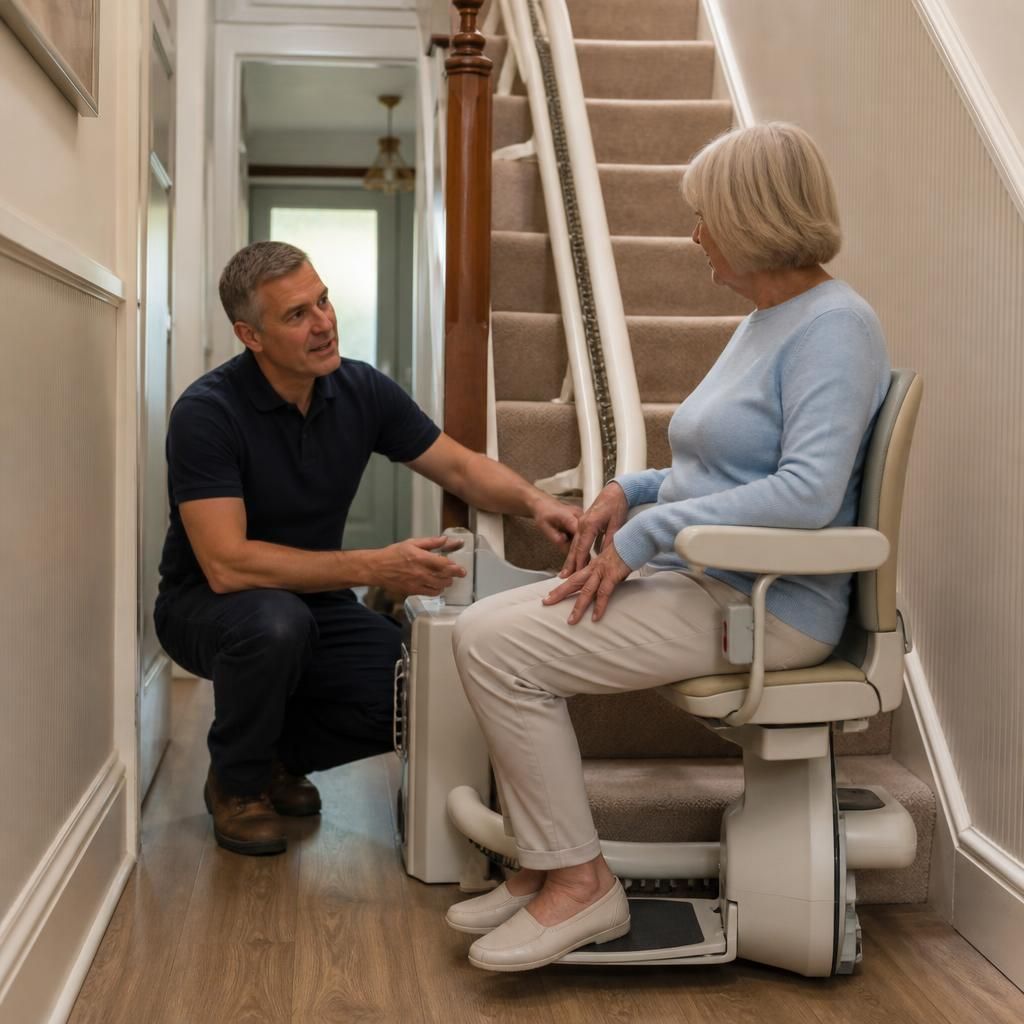
Before agreeing to the installation, ask the surveyor to explain the proposed route in practical terms: where the lift parks, how the user approaches and leaves the seat, what space remains on the stairs, and how doors and landings will be affected. This is the opportunity to raise concerns about other household members, pets, furniture, walking aids or future changes in mobility.
A carefully measured track, selected around the user and the home together, should provide safe movement between floors without creating avoidable obstruction. Independent Stairlifts can assess the staircase and discuss the available custom options so that the final design is based on the actual layout and the user’s everyday needs.
The track route determines where the stairlift travels, parks and allows the user to transfer safely. During the survey, assess every bend, landing and stopping point rather than measuring only the main flight of stairs.
- Check whether the track needs to follow a bend, cross a landing or serve more than one floor.
- Allow enough space at the top and bottom for the user to approach, turn and leave the seat safely.
- Consider an overrun, hinged rail or alternative parking position if a doorway, hallway or narrow landing could be obstructed.
- Confirm that the track will not block handrails, essential routes or access for other people using the stairs.
The best route is not always the shortest one. It should support comfortable transfers and leave the surrounding space practical for everyday use.
Arrange your custom stairlift track assessment
Arrange a custom stairlift track assessment with Independent Stairlifts to review your staircase layout, access requirements and the most suitable track design. Our surveyor can explain the proposed route, stopping points and installation options before you make a decision.