
What considerations are involved in the design and installation of a bespoke stairlift?
Designing and installing a bespoke stairlift involves assessing your staircase layout, available space, structural features, access needs and preferred controls before specifying a suitable rail, seat and safety system. A professional survey then confirms the measurements, installation method and any adjustments needed to provide a secure, practical fit within your home.
A bespoke stairlift is designed around the staircase, the available space and the person using it, rather than selected as a standard unit and adapted afterwards. The main considerations are the stairway’s shape and measurements, access at the top and bottom, the user’s mobility and transfer needs, the strength of the fixing surfaces, electrical arrangements, safety requirements and the practical details of installation within the home.
The staircase and surrounding space. A professional survey examines the full route, including straight sections, landings, intermediate turns, winders, changes in gradient, narrow points and any doors or radiators close to the stairs. Measurements are taken to establish the rail’s route and the clearance needed for the seat, footrest and controls. A curved or particularly compact staircase may require a rail designed to follow its exact geometry, while a straight staircase may still need careful planning where space is restricted at the top or bottom.
The survey should also consider how the stairlift will affect everyday movement. The seat may need to park in a particular position so that it does not obstruct a doorway, hallway or landing. A powered swivel seat, folding footrest or retractable rail can help where space is limited, but these features must be selected for a clear practical reason and checked against the user’s ability to operate them safely.
The user’s mobility and transfer needs. The stairlift must be suitable for the person who will use it now, including their height, weight, balance, flexibility, leg strength, grip and ability to sit down and stand up. The assessment should establish whether they can transfer safely to the seat, operate the controls, release the seat belt and respond to an obstruction or stop control. If more than one person will use the lift, the design needs to accommodate the relevant users without making operation unnecessarily complicated.
Relevant options may include a powered swivel or lifting seat, a different seat height, adjustable armrests, a larger seat, a perch-style arrangement or controls positioned on the more functional side. The user’s preferred hand, eyesight, hearing and any condition that affects coordination should be discussed before the specification is confirmed. A stairlift should support independent use where possible, but it should not be specified on the assumption that the user can manage an action they cannot perform reliably.
Structural fixing and the condition of the staircase. Most stairlifts are fixed to the stair treads or another suitable structural surface rather than attached only to the wall. The installer checks the condition and construction of the stairs, the availability of sound fixing points and whether floor coverings, trims or other features could interfere with the installation. Any weakness, damage or unusual construction needs to be identified before work begins. If alterations or additional building work are required, these should be explained and agreed in advance.
Rail, seat and equipment specification. The rail is made or configured to follow the surveyed staircase and to provide the necessary clearances. Its parking position, travel path and relationship with doors, landings and handrails are confirmed before manufacture or installation. The seat, armrests, footrest, belt, controls and safety sensors are then selected as a complete system. A bespoke design is not simply a matter of making the rail fit; all components must work together without creating new trip hazards or reducing access around the stairs.
Power and control arrangements. The survey identifies the most suitable electrical supply and charging locations. The installer should consider whether the stairlift can charge at its normal parking positions and whether the route of any cable will remain protected and unobtrusive. Controls should be reachable from the seat and, where useful, from the other end of the staircase. Call and send controls can be helpful when the lift needs to be summoned, although they must be positioned so they do not create an obstruction.
Safety and compliance. The finished installation should include appropriate safety features such as a seat belt, obstruction sensors, a reliable stop control, secure armrests and safe braking and charging systems. The equipment and installation should be assessed against the applicable UK safety requirements and relevant standards, including the requirements applying to stairlifts under BS EN 81-40 where applicable. The installer should provide operating instructions, explain safe use and retain the relevant installation and inspection records.
Safety also depends on the home environment. Loose rugs, furniture, trailing cables, poor lighting and items left on the stairs can interfere with use even when the stairlift itself is correctly installed. These issues should be identified during the assessment, with practical recommendations for keeping the route clear. If other household members, pets or visitors use the staircase, their movement should be considered when choosing parking positions and operating procedures.
The installation process. Once the survey is complete, the proposed design should be checked with the customer before the stairlift is built or ordered. This is the opportunity to confirm the rail route, parking positions, seat configuration, controls, finishes and any agreed preparation work. On installation day, the fitting team secures the rail, installs the lift and charging equipment, checks clearances and tests the system through its full travel path. The work should be completed with appropriate care for flooring, walls and household access.
Before handover, the installer should check the safety devices, belt, swivelling mechanism, footrest, controls, charging function, emergency stop and obstruction detection. The user should be shown how to mount and leave the seat, operate the controls, use the belt, charge the lift, respond to a power interruption and report a fault. It is sensible for the user to operate the stairlift themselves during the handover so that any difficulty with reach, balance or understanding can be addressed immediately.
Future access, maintenance and changes. The design should allow routine servicing and access to key components without unnecessary disruption. Details such as the model, rail configuration, battery specification and installation information should be kept for future repairs or adjustments. A bespoke stairlift can often be adapted if the user’s needs or the home’s layout changes, but the feasibility depends on the original design, available space and the equipment involved. Any modification should be assessed and carried out by a suitably qualified stairlift professional rather than improvised at home.
For a reliable result, the important decisions should be based on an in-person survey and a clear written specification. Confirm that the proposed design addresses the staircase layout, the user’s abilities, access around the lift, structural fixing, electrical supply, safety requirements, installation arrangements and ongoing support before proceeding. This approach ensures that the stairlift is not only a correct physical fit, but also practical and safe to use every day.
A professional home survey is the essential first step in designing a bespoke stairlift because it establishes how the lift can fit the staircase and how safely it can be used. The assessment covers the stairway’s shape, landings, available clearances, doors, handrails, radiators and other features that may affect the rail route or parking position.
The survey also considers the user’s ability to transfer onto the seat, operate the controls, use the seat belt and manage features such as a swivel seat or folding footrest. These findings help determine the most suitable seat configuration, control position and charging points. Confirming the design in advance reduces the risk of obstructed access, unsuitable controls or changes being needed during installation.
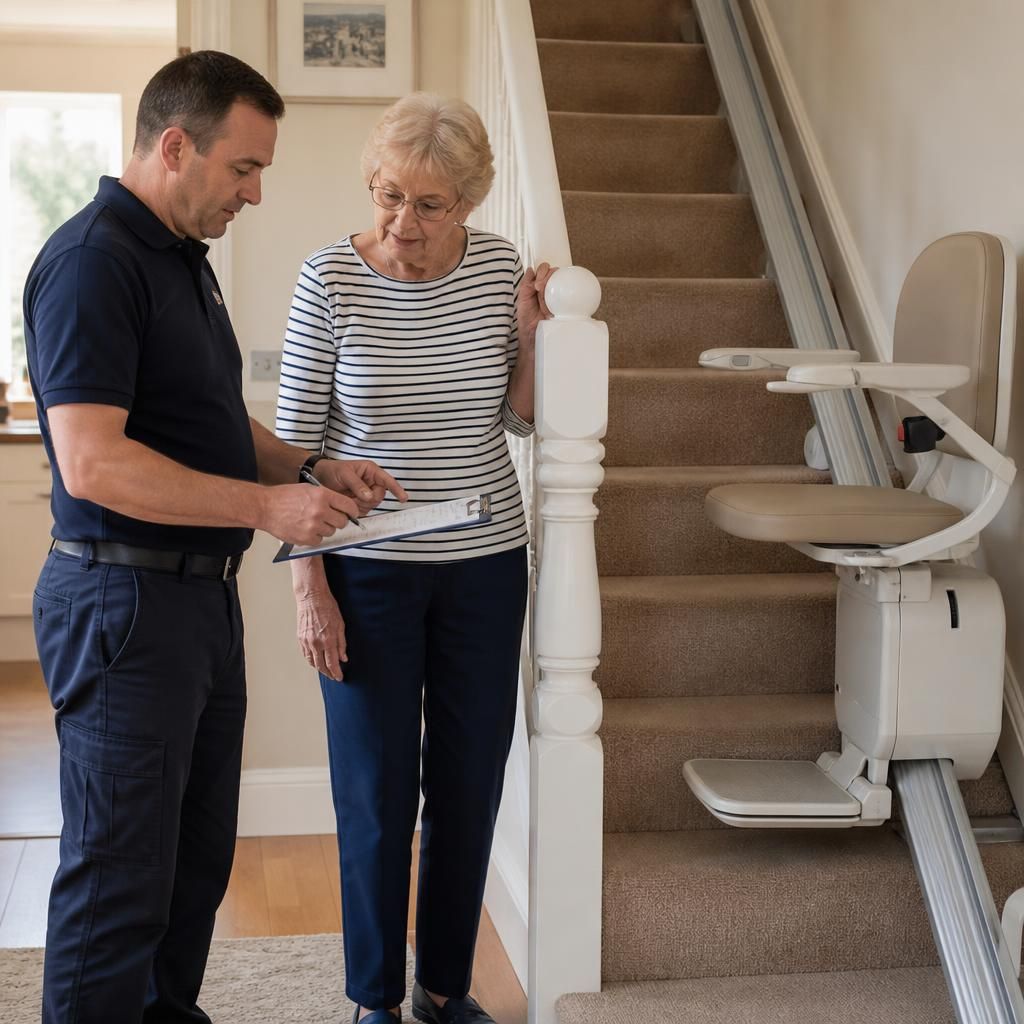
Arrange Your Bespoke Stairlift Assessment
Arrange your bespoke stairlift assessment with Independent Stairlifts to review your staircase, access requirements and preferred features. Our specialist team will recommend a suitable design and explain the installation process for your home.