
Are stairlifts suitable for all types of staircases?
Yes, stairlifts are suitable for most staircases, including straight, curved, narrow, steep, split-level and outdoor stairs, although the model and rail design must match the layout. Very tight spiral staircases, restricted landings or structural limitations may require a bespoke assessment to confirm whether installation is practical and safe.
Stairlifts are suitable for most types of staircase, but not every staircase can accommodate a standard model. Straight, curved, narrow, steep, split-level, spiral and outdoor stairs may all have workable solutions, provided the stairlift, rail and installation method are matched to the building and the user’s needs. A professional survey is needed to confirm whether the available space, staircase structure and landings allow a safe and practical installation.
Straight staircases are usually the simplest to equip. A straight stairlift runs along a continuous rail fixed to the steps, rather than the wall, and can often be configured with different seat heights, armrest widths, footrest options and controls. If the staircase has a doorway, hallway or narrow landing at the top or bottom, the rail may need to finish with a suitable parking position so that it does not obstruct access.
Curved and multi-flight staircases can generally be fitted with a made-to-measure stairlift. The rail follows the bends, corners, intermediate landings and changes in direction of the staircase. Depending on the layout, the stairlift may travel between several levels or stop at selected floors. A curved system is designed around the individual staircase, so the survey must assess clearances around bends, the position of doors and the space available when the seat turns or parks.
Narrow staircases are not automatically unsuitable. Compact stairlift designs, slimline seats, folding arms and folding footrests can help preserve usable space for other people on the stairs. However, the stairlift must still provide enough room for the user to sit securely, operate the controls and keep their feet supported. The survey should consider the width of the staircase at its narrowest point, the position of banisters, radiators and doorways, and whether anyone else needs to use the stairs while the lift is parked or moving.
Steep stairs can often accommodate a stairlift, although the angle of the staircase may affect the model and seat configuration required. The installation team will check that the rail can be fixed securely and that the user can get on and off safely at the top and bottom. If balance, hip movement or strength is limited, a powered swivel seat or other transfer aid may be appropriate. These features should be considered alongside the staircase itself, because a lift that fits physically may not be suitable if the user cannot transfer comfortably.
Spiral, winding and complex staircases require particularly careful assessment. A stairlift may be possible where the staircase has enough tread depth, consistent construction and suitable space at the landings. Very tight spirals, sharply changing steps, restricted headroom or limited access at the top and bottom can make installation impractical. In some homes, a bespoke rail may provide a solution; in others, the safest option may be an alternative access arrangement. The decision should be based on measured clearances and safe use, not on the staircase shape alone.
Split-level homes can often be served with more than one stairlift or with a curved system that follows the full route. The best arrangement depends on the number of flights, whether the user needs to reach every level and whether there is a suitable place to transfer between lifts. Where a person would need to stand, turn or move between separate stairlifts, their mobility and balance must be considered carefully.
Outdoor staircases may also be suitable for a weather-resistant outdoor stairlift. External installations need protection from rain, frost, sunlight and dirt, as well as a secure electrical supply and suitable drainage. The rail, controls, seat and charging arrangements must be selected for outdoor conditions. A sheltered parking position can help protect the lift when it is not being used, but the surrounding paving, steps and handrails must also be checked as part of the assessment.
Unusual stair materials and structures do not necessarily prevent installation. Stairlifts are commonly fixed to the stair treads or a suitable supporting structure, but the fixing method depends on the construction and condition of the stairs. Worn, damaged or unstable steps may need attention before installation. Where there are glass features, floating steps, unusual balustrades, limited tread depth or structural alterations, additional checks may be required to establish where the rail can be secured without compromising the building.
Several practical factors determine whether a stairlift is suitable:
- Staircase geometry: the length, width, gradient, bends, landings and available clearances.
- Access and parking space: room to approach the seat, sit down, stand up and leave the stairs safely.
- Structural condition: whether the steps and supporting surfaces can accept the required fixings.
- Doors and household traffic: whether the lift or rail could restrict door openings, hallways or normal movement.
- User requirements: weight capacity, posture, leg length, transfer ability, grip, balance and control access.
- Power and charging: the location of charging points and the suitability of the electrical installation.
- Emergency considerations: how the user could leave the stairlift and the home if the lift stops or power is interrupted.
A stairlift should not be selected by staircase type alone. Two homes may both have narrow or curved stairs but require different solutions because of their landing layouts, banisters, door positions or the user’s physical abilities. The most suitable seat, rail position and operating features depend on how the lift will be used every day.
What happens during an assessment? An installer measures the staircase and examines each section of the route, including the top and bottom landings. They should discuss who will use the stairlift, how often it will be used, any difficulties with sitting or standing, and whether another person needs to pass on the stairs. They can then explain which type of stairlift is appropriate, where it will park, what adaptations may be needed and whether any limitations remain.
In some cases, installation may not be recommended. Examples include insufficient space to transfer safely, an unstable staircase, obstructions that cannot be removed, inadequate headroom or a layout that would leave the user exposed to a fall risk. If a stairlift cannot provide safe access, other options such as changes to the living arrangement, a through-floor lift or different mobility equipment may need to be considered.
For this reason, a home assessment should take place before committing to a particular model. It confirms compatibility with the staircase and ensures that the equipment is suitable for the person using it. If your stairs are narrow, steep, curved, spiral, split-level or outside the home, provide accurate information about the layout and your mobility needs so the assessment can focus on the right solution.
A professional staircase assessment is the most reliable way to confirm whether a stairlift is suitable for your home. The survey checks the staircase width, gradient, bends, landings, headroom and available space for getting on and off safely. It also identifies obstructions such as doors, radiators, banisters and restricted parking areas.
The assessment should consider your mobility as well as the building. Seat height, swivel options, controls, footrest design and weight capacity may affect whether you can use the stairlift comfortably and transfer safely. This is particularly important on narrow, steep, spiral, split-level or outdoor staircases, where a standard design may not be appropriate.
Following the survey, the installer can explain the suitable stairlift options, required rail design and any practical limitations. If a stairlift cannot provide safe access, alternative arrangements can be discussed before any installation is undertaken.
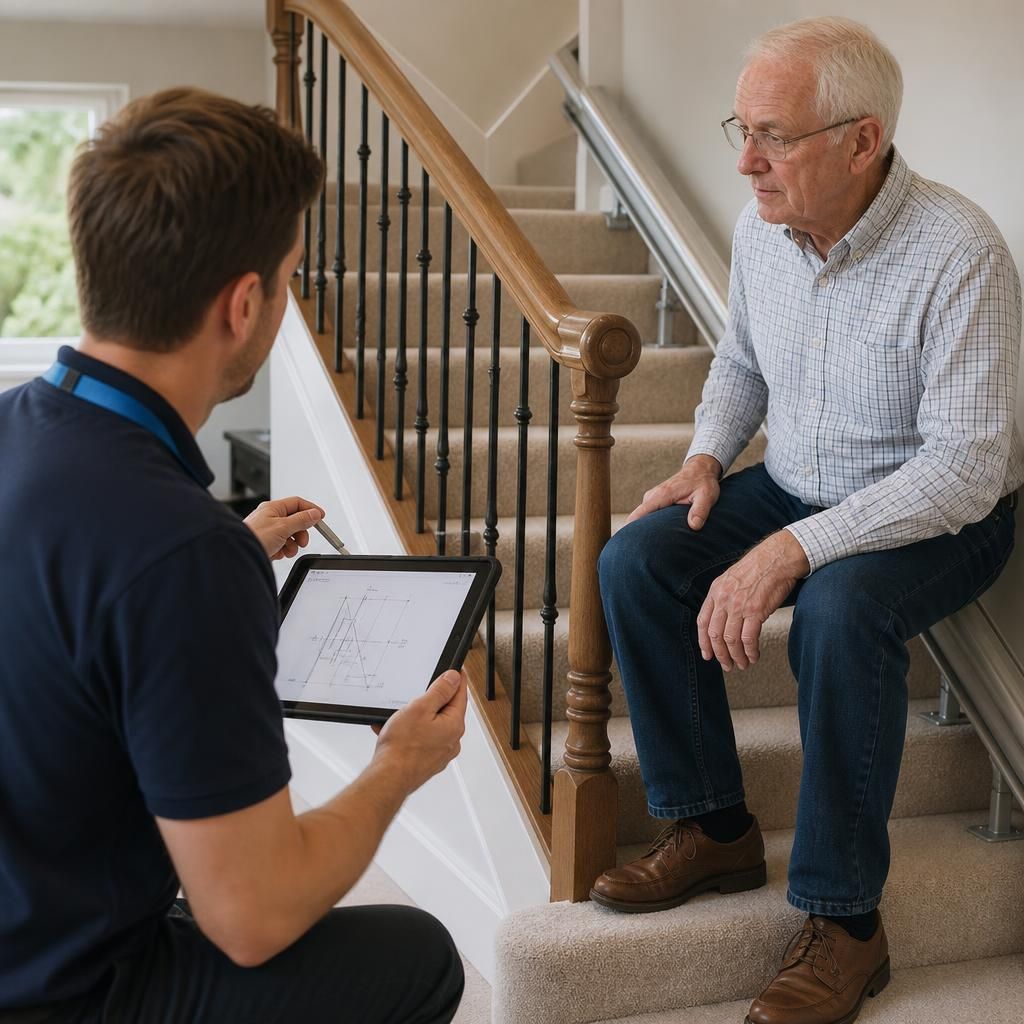
Arrange a Staircase Suitability Assessment
Arrange a professional staircase suitability assessment to confirm which stairlift options are safe and practical for your home. We will assess the staircase, access points and your mobility needs before recommending a suitable solution.