
What should I consider when budgeting for a stairlift, including ongoing maintenance and service costs?
Budget for the stairlift itself, professional installation and any adaptations needed for your staircase, then allow for ongoing servicing, battery replacement and occasional repairs. A suitable budget should reflect the stairlift type, the condition and complexity of your staircase, warranty or maintenance cover, and the likely long-term cost of keeping it safe and reliable.
When budgeting for a stairlift, allow for more than the quoted equipment price. Your overall cost may include the stairlift, survey and installation, staircase adaptations, warranty or service cover, battery replacement, repairs and eventual removal or replacement. The type and condition of the staircase are usually the main factors affecting the initial price, while the warranty and age of the equipment influence ongoing costs.
Start with a complete, itemised quotation. A suitable assessment should establish whether you need a straight, curved, outdoor or reconditioned stairlift and identify any installation requirements. Ask the provider to separate the cost of the equipment from installation and to state clearly whether delivery, VAT, initial servicing and removal of an existing stairlift are included. This makes it easier to compare quotations on a like-for-like basis.
For a straight staircase, the rail is generally simpler to manufacture and install. A curved staircase may require a rail made specifically for its bends, landings or changes in direction, so the assessment and quotation can be more involved. Outdoor installations also need equipment and fixings suitable for exposure to weather, together with a suitable power supply and protection from water. Where access is unusual, adaptations may be needed around the top or bottom of the stairs.
Allow for these initial costs:
- the stairlift and its standard equipment;
- professional installation, testing and user instruction;
- a bespoke rail or additional sections where the staircase is curved or particularly complex;
- electrical work, improved sockets or other adaptations if the existing installation is unsuitable;
- alterations to gates, doors, handrails or floor areas where safe clearance is required;
- delivery, removal of an old stairlift and making good any minor fixing points, if applicable; and
- an assessment of access at the top and bottom of the stairs, including whether the lift can park without obstructing a doorway or walkway.
Most domestic stairlifts are designed to use rechargeable batteries. These batteries are a normal replacement item rather than an indication that the stairlift has failed. Their working life depends on usage, charging conditions and the age of the equipment, so a budget should include eventual replacement. If a stairlift is left switched off at the mains for long periods, the batteries may not charge correctly and can deteriorate sooner. Follow the manufacturer’s charging instructions and ask the installer what battery replacement involves.
Ongoing servicing and maintenance help identify wear, electrical faults and safety issues before they cause a breakdown. A service may include inspection of the rail, drive system, seat, safety sensors, charging points, batteries, controls and emergency features. The appropriate service interval depends on the model, frequency of use, environment and manufacturer’s guidance. Outdoor stairlifts may need particular attention because moisture, dirt and temperature changes can affect components.
Check whether the quoted price includes a warranty and exactly what it covers. Some warranties cover parts and labour for a defined period but exclude consumables, accidental damage, misuse or issues caused by alterations to the property. A maintenance plan may extend parts and labour cover or provide priority breakdown assistance, but it is not automatically the best-value option for every household. Compare its total cost with the likely cost of individual servicing and repairs, and check whether batteries are included.
After the warranty ends, possible costs include a call-out, labour, replacement parts, batteries and additional work required to bring an older stairlift back into service. Before agreeing to a repair, ask for a diagnosis and an estimate. On an older or reconditioned stairlift, a repair may be practical, but repeated faults or discontinued parts can make replacement more economical over time. A reputable assessment should explain these options rather than assuming that replacement is the only solution.
Reconditioned stairlifts can reduce the initial outlay, but the specification, condition and aftercare are important. Confirm whether the rail is new or previously used, what components have been replaced, how the equipment has been tested, and how long the warranty lasts. A reconditioned stairlift may be suitable for a straightforward staircase, while a bespoke curved installation can have fewer second-hand options because the rail is made for a particular layout.
Buying is not the only possible arrangement. Hire can be useful where access is needed temporarily, but compare the installation charge, collection or removal charge, deposit, minimum hire period, damage terms and responsibility for servicing. If the need is likely to be long term, compare the total hire cost over the expected period with the cost of buying, including maintenance and eventual removal.
When checking affordability, consider the cost of the whole period you expect to use the stairlift rather than focusing only on the lowest initial quotation. A cheaper model may have a different warranty, fewer included services or higher repair risk if it is older. Conversely, paying for features that are not needed can increase the price without improving suitability. Features such as powered swivel or folding seats, hinged rails and upgraded controls should be assessed against the user’s mobility and the layout of the home.
It may also be worth checking whether you qualify for financial help or VAT relief. VAT treatment depends on the user’s disability or long-term condition, the nature of the goods or services and the supplier’s eligibility requirements, so it should be confirmed before the quotation is accepted. Local authority support, charitable grants and funding through health or social care services can have their own assessment and application rules.
Before committing, ask for written confirmation of:
- the exact model and whether it is new or reconditioned;
- what the survey, installation and testing include;
- any work required to the staircase, electrical supply or surrounding area;
- the warranty duration, exclusions and process for reporting a fault;
- recommended servicing and the price of a standard service;
- whether batteries, call-outs, labour and replacement parts are covered by any service plan;
- the likely cost and availability of commonly replaced parts after the warranty; and
- the arrangements and charges for cancellation, removal or relocation.
A realistic stairlift budget therefore combines the initial installation quote with a reserve for routine servicing, batteries and unexpected repairs. An in-home assessment is the most reliable way to identify the correct equipment and any site-specific costs, while an itemised quotation and clear aftercare terms allow you to judge the long-term value of the proposed solution.
When budgeting for a stairlift, include ongoing maintenance costs as well as the purchase and installation price. Routine servicing, battery replacement and repairs can affect the total cost over the time you use the stairlift, particularly after the initial warranty ends.
Check exactly what any warranty or service plan covers. Ask whether parts, labour, call-outs and batteries are included, and confirm any exclusions for accidental damage, misuse or normal wear. Compare the total cost of the plan with the provider’s standard servicing charges and the likely cost of individual repairs. Keeping the stairlift serviced according to the manufacturer’s guidance can also help identify worn components before they cause a breakdown.
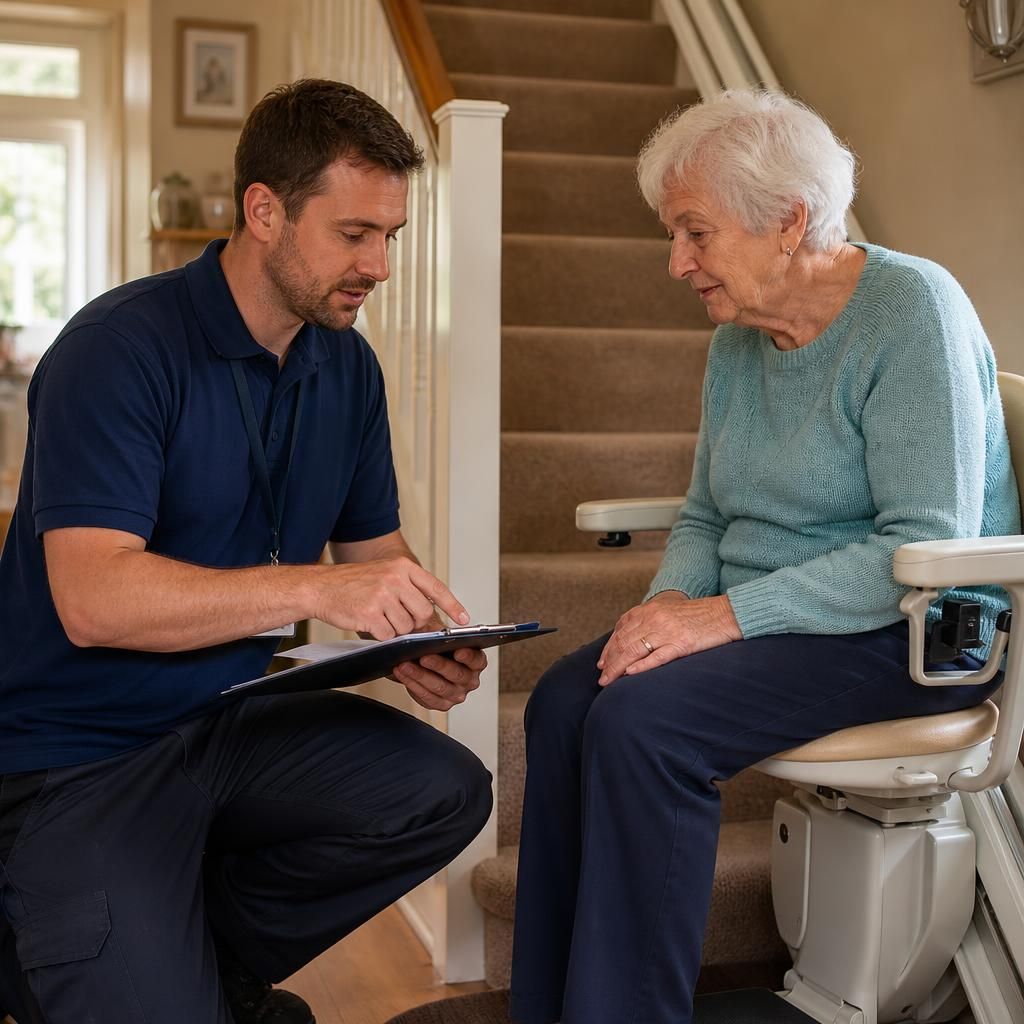
Request a personalised stairlift assessment and itemised quotation
Arrange a personalised stairlift assessment to confirm the most suitable option for your staircase and mobility needs. We can provide an itemised quotation covering installation, adaptations and ongoing service costs.