
What factors can affect the cost of different types of stairlifts?
The cost of a stairlift depends on its type, the shape and length of the staircase, installation requirements, and features such as powered seats or folding rails. Straight stairlifts are usually simpler to fit, while curved, outdoor and heavily customised models generally cost more because they require bespoke equipment and installation.
The cost of a stairlift is mainly determined by the type of lift required, the shape and length of the staircase, the work needed to install it, and the features chosen. A straight stairlift is usually less expensive because it uses a standard rail and a relatively straightforward installation. Curved, outdoor and heavily customised stairlifts generally cost more because their equipment and fitting are designed around the property and the user.
The type of staircase is usually the most significant factor. Before a price can be confirmed, the staircase needs to be assessed for its direction, width, length, number of floors, landings, bends and available space. A short, single-flight staircase with no changes in direction is normally simpler than a staircase with intermediate landings, tight curves or several flights.
- Straight stairlifts: These are fitted to one uninterrupted flight with no bends or intermediate landings. Their standardised rail design can make them quicker and less complex to install.
- Curved stairlifts: These are made to follow the individual staircase. The rail may need to travel around bends, across landings or between floors, so surveying, manufacture and installation are more involved.
- Outdoor stairlifts: These must withstand rain, damp, temperature changes and sunlight. Weather-resistant materials, protective finishes and suitable controls can increase the overall price compared with an indoor model.
- Stairlifts for unusual layouts: Narrow staircases, split-level homes, spiral sections and staircases with awkward landings may require additional design work or a more specialised configuration.
The length and complexity of the rail also affect the cost. A longer rail requires more materials and may need additional support brackets. On a curved installation, every bend, transition and change in gradient has to be measured accurately. The rail may also need to stop in a particular position at the top or bottom to leave a safe route through the hallway or landing.
In some homes, a hinged or sliding rail is needed because a doorway, cupboard, radiator or walkway is close to the bottom of the stairs. A powered option can be useful where the user cannot comfortably operate a manual hinge. However, powered mechanisms add equipment and installation time, so they can increase the final price.
The condition and construction of the staircase can influence installation requirements. Most stairlifts are secured to the steps rather than the wall, but the installer still needs to check that the steps, treads and supporting structure are suitable. Loose, damaged or unusually shallow steps may need attention before the lift can be fitted. Carpeting, flooring, skirting boards and obstructions can also affect the position of the rail and the time required on site.
Where the staircase is particularly narrow, the available clearance must be checked carefully. A compact seat, a different rail position or a folding mechanism may be considered to preserve access for other people. These decisions are not simply about price: they affect safety, comfort and how easily the staircase can continue to be used.
The user’s mobility and posture should be considered when comparing models. A basic lift may be suitable for someone who can sit down, stand up and transfer independently. Another user may need a powered swivel seat, a higher seat position, a perching configuration or controls that are easier to operate. The most appropriate option depends on balance, leg strength, joint movement, height, weight and the ability to use the controls.
Features that can affect the price include:
- powered swivel or lift-up seats;
- powered footrests;
- folding or powered rails;
- larger, supportive or specialist seats;
- adjustable armrests or seat heights;
- additional remote controls;
- different control positions for left- or right-handed use;
- enhanced upholstery or colour choices; and
- weather protection for external installations.
Not every feature is necessary for every user. It is worth separating essential requirements from optional conveniences. For example, a powered swivel may be important if turning at the top of the stairs is difficult, whereas a particular upholstery finish may have little effect on day-to-day use. A proper assessment should explain what each feature does and why it may be suitable.
The installation itself forms part of the total cost, not just the equipment. A straightforward installation may involve securing the rail, connecting the charging point, fitting the seat and testing the controls. More involved work may include assembling a complex curved rail, working across more than one floor, relocating an obstruction or arranging access where the staircase is difficult to reach.
Electrical work may also affect the price. Stairlifts generally use a rechargeable battery system and need a suitable power supply for charging. If a convenient socket is not available, an electrician may need to install one or make another approved adjustment. Any additional building, electrical or joinery work should be identified before installation so that the quotation is clear.
New and reconditioned equipment can have different pricing structures. A reconditioned stairlift may offer good value where a suitable model and rail configuration are available. Straight rails are often easier to match to an existing installation, while curved rails are made for a particular staircase and may not be reusable in another home. Reconditioned equipment should be inspected, serviced and supplied with appropriate warranty and aftercare arrangements. The lowest initial price is not necessarily the best value if the equipment is unsuitable or ongoing support is unclear.
Access and removal requirements can add to the total. If an old stairlift needs to be removed, the work should be included in the quotation where applicable. A lift installed in a narrow hallway, an upper-floor property or a home with restricted parking may require additional planning. These factors do not always change the equipment price, but they can affect the time and resources needed to complete the work safely.
Ongoing costs should be considered alongside the purchase price. Batteries eventually need replacing, and servicing may be recommended to keep the lift operating reliably. Outdoor models may need particular attention because they are exposed to the weather. A service plan, extended warranty or call-out arrangement can change the overall cost of ownership, so check what is included, how faults are handled and whether routine visits are optional or required.
When comparing quotations, check that each one covers the same elements. This should include the stairlift model and configuration, rail length, survey, installation, electrical work, removal of an existing lift, warranty, delivery and any aftercare. A quotation that appears cheaper may exclude an essential part of the work or may be based on a standard configuration that does not meet the user’s needs.
The most reliable way to establish the cost is an in-home assessment. The surveyor can measure the staircase, identify installation constraints, discuss the user’s mobility and explain suitable alternatives. If the layout or requirements are uncertain, ask for more than one option, such as a basic configuration and one with the features that would make transfers or controls easier. This allows the price to be considered alongside safety, comfort, practicality and likely long-term use.
In summary, stairlift costs are affected by the staircase layout, the type and length of rail, indoor or outdoor use, installation conditions, user-specific seating and control requirements, the choice between new and reconditioned equipment, and ongoing support. The correct comparison is not simply between headline prices: it is between complete solutions that are suitable for the home and the person using the stairlift.
The staircase layout is usually the main factor affecting the cost of a stairlift. A straight lift uses a standard rail for one uninterrupted flight, whereas a curved lift requires a rail designed to follow the staircase’s bends, landings and changes of direction.
During an assessment, the installer checks the staircase width, length, number of floors, available clearance and any nearby obstructions. A doorway, radiator or narrow landing may also require a hinged or sliding rail. These details affect the equipment, manufacturing and installation work, so a bespoke quotation is more reliable than comparing headline prices alone.
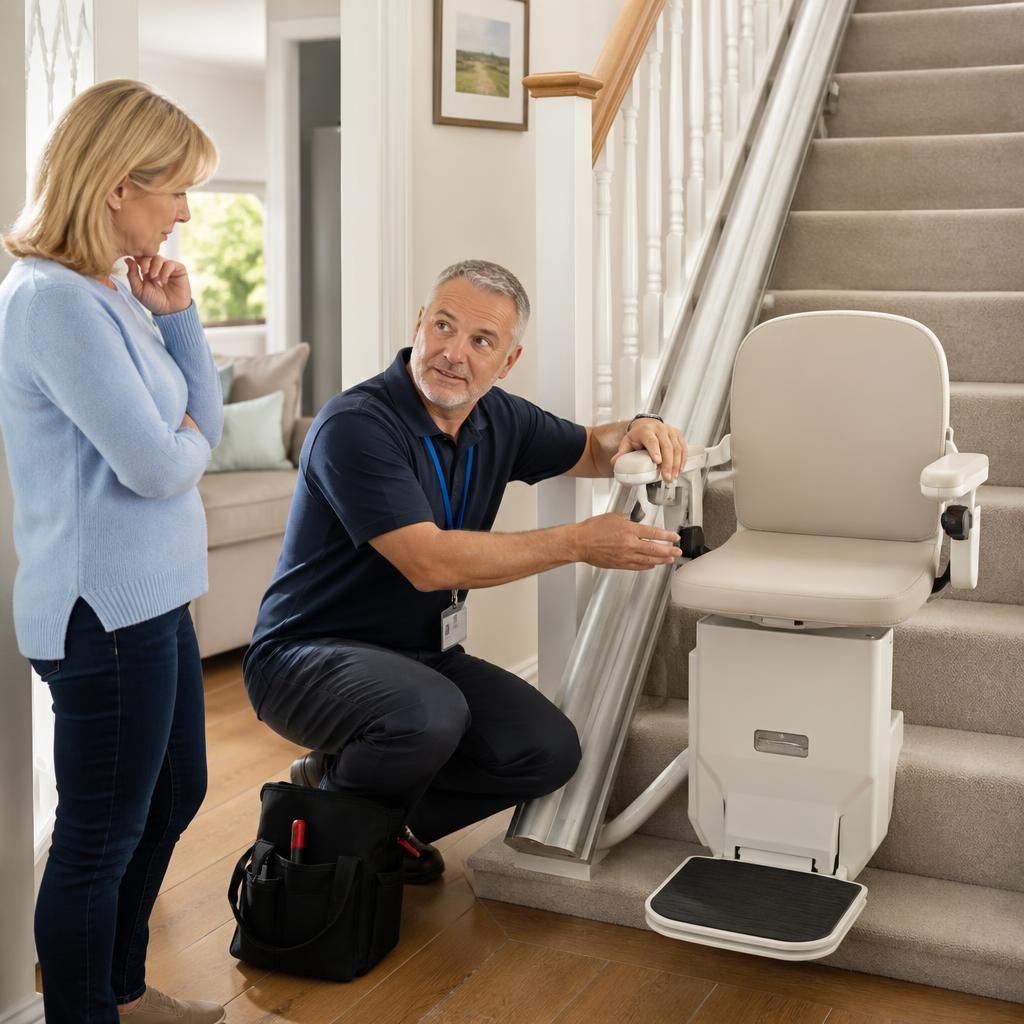
Arrange a Stairlift Assessment and Get a Clear Quote
Arrange an in-home stairlift assessment with Independent Stairlifts to discuss your requirements and identify the most suitable option. You will receive a clear quotation based on your staircase, installation needs and chosen features.