
What additional costs should I expect beyond the initial price of a stairlift?
Beyond the stairlift’s advertised price, you may need to budget for installation, any necessary electrical or structural work, VAT, removal of an existing lift, and ongoing servicing or repairs. A home assessment should confirm which costs are included in your quote and identify any additional work required before installation.
Beyond the advertised price of a stairlift, the main additional costs to check are installation, any electrical or building work, VAT, removal of an existing lift, and future servicing or repairs. Some suppliers include these items in a package price, while others list them separately, so the written quotation should show exactly what is included and what could be charged later.
Installation and fitting
Installation is often included in the quoted price, particularly for a standard straight stairlift, but this should not be assumed. A more complex staircase may require additional fitting time, specialist components or alterations to the rail. Curved stairlifts are designed around the staircase, so the survey and bespoke rail manufacture form a larger part of the overall cost.
Ask whether the quotation includes delivery, fitting, testing, user instruction and removal of packaging. If installation is not included, confirm whether it is a fixed charge or whether it can increase if the installer encounters an unexpected issue.
Home survey and assessment
A professional assessment is used to check the staircase, access, available space at the top and bottom, landing layout, electrical supply and the user’s mobility needs. Many providers offer this assessment without a separate charge, but you should confirm this when arranging it. If a survey fee applies, ask whether it will be deducted from the final purchase price.
The survey is also the point at which potential extra work should be identified. A quotation based only on photographs or general measurements may not account for restricted access, unusual stair geometry or installation requirements around doors and landings.
Electrical work
Most stairlifts require a suitable nearby power socket. If there is no appropriate socket, or the existing electrical supply is unsuitable, an electrician may need to install a new socket or make other minor changes. This may be charged separately unless electrical work is included in the quotation.
Battery-operated stairlifts normally charge through a point on the rail or at a designated position, but they still require a safe mains connection. The survey should establish whether the power supply is adequate and where the charging point will be located.
Structural or access-related work
Most domestic stairlifts can be fitted without major building work because the rail is usually secured to the stair treads rather than the wall. However, additional work may occasionally be needed. Examples include moving a radiator, trimming or adjusting a handrail, modifying a gate, clearing an obstruction, or making safe a damaged or uneven staircase.
These costs should be agreed before work starts. If a staircase or landing needs repair for safety reasons, the stairlift installation may need to be postponed until the work has been completed.
VAT and eligibility for relief
VAT treatment depends on the customer’s circumstances and the type of supply. Some people with a qualifying long-term illness or disability may be eligible for VAT relief on certain mobility equipment and associated work. The supplier will normally need the required declaration before applying the relief, and eligibility should not be assumed simply because a stairlift is being installed in a private home.
If VAT is payable, check whether the displayed price includes it. A quotation should state the VAT position clearly, including any parts of the work that do not qualify for relief.
Removal of an existing stairlift
If an old stairlift is already installed, removal may be included, charged separately or excluded altogether. The cost can depend on whether the lift is being removed for replacement, whether the rail and electrical connections need to be taken away, and whether the old equipment must be disposed of responsibly.
Ask whether making good is included. Removing a lift may leave fixing holes or minor marks in the stairs or wall. Basic removal is not necessarily the same as repairing, redecorating or replacing flooring.
Optional features and adaptations
The initial price may cover a basic specification, with additional charges for features selected to suit the user or the staircase. These can include a powered swivel or folding seat, powered footrest, upgraded upholstery, a different seat size, a manual or powered swivel mechanism, additional controls or a hinged rail to keep a doorway or walkway clear.
These options are not essential in every home, but they can improve transfer safety and usability. The important point is to distinguish necessary adaptations from optional upgrades and to ensure that any selected features appear on the final quotation.
Delivery, access and appointment charges
In unusual circumstances, access to the property may affect the cost or timing of installation. This could include a remote location, restricted parking, difficult access for equipment or a requirement for more than one installation visit. Such charges are not typical for every installation, but they should be identified during the assessment rather than added unexpectedly.
If an appointment has to be cancelled or rearranged, check the provider’s terms before agreeing to the installation date. Any possible call-out or aborted-visit charge should be explained in advance.
Ongoing servicing and maintenance
After installation, a stairlift may need periodic servicing to check the batteries, charging points, safety sensors, drive system, rail, seat and controls. Servicing is a separate cost unless it is covered by a service plan or included for a specified period under the warranty.
Before buying, check what the warranty covers, how long it lasts, whether labour and replacement parts are included, and whether routine servicing is required to keep the warranty valid. A warranty may cover faults but not accidental damage, misuse, consumable items or normal wear.
Batteries, parts and repairs
Stairlift batteries are rechargeable and will eventually need replacement. Their useful life varies according to usage, charging conditions, age and the condition of the charging system. Other parts, such as rollers, switches, sensors, chargers or upholstery, may also need attention over time.
Repair costs can include the engineer’s visit, labour, travel and replacement parts. If you are considering a service plan, compare its exclusions and response arrangements with the likely cost of paying for repairs as needed. For a reconditioned stairlift, ask specifically about the condition of the batteries and which parts have been replaced or tested.
What should be included in your written quotation?
- The stairlift model, configuration and any optional features.
- The survey, delivery, installation, testing and user instruction.
- VAT and the basis on which any VAT relief has been applied.
- Electrical, structural or access-related work that is required.
- Removal and disposal of an existing stairlift, if applicable.
- The warranty period, what it covers and any exclusions.
- Future servicing arrangements, call-out terms and likely charges for parts.
- Any conditions that could cause the price to change.
A reliable quotation should separate the one-off purchase and installation cost from optional extras and ongoing ownership costs. If anything is described as subject to survey, ask what findings could change the price and whether you will be contacted for approval before additional work is carried out.
For an accurate total, arrange a home assessment and describe how the stairlift will be used, including transfers, access at the top and bottom of the stairs, and any existing equipment that needs removing. This allows the quotation to account for the actual staircase and makes it easier to budget for both installation and future care.
The safest way to identify additional stairlift costs is to request a fully itemised quotation after a home assessment. This should show which services are included in the initial price and which could be charged separately.
- Survey, delivery, fitting, testing and user instruction
- Electrical or minor structural work
- Removal and disposal of an existing stairlift
- VAT and any applicable relief
- Optional features, warranty cover and future servicing
Ask the installer to explain any item marked as subject to survey, including what might change the price and whether your approval will be requested before extra work begins. A clear quotation should also distinguish one-off installation costs from ongoing expenses such as servicing, batteries and repairs.
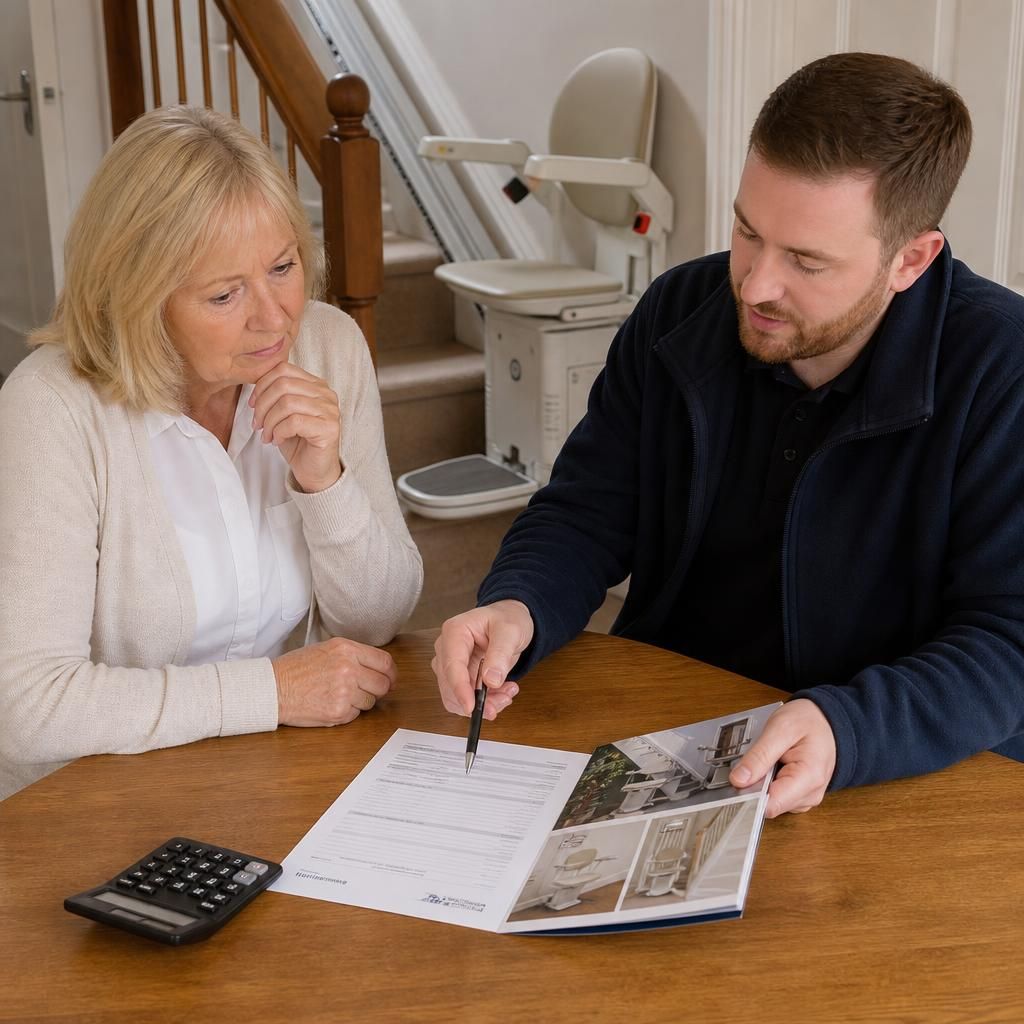
Request a fully itemised stairlift quotation
Request a fully itemised stairlift quotation after a home assessment, showing installation, VAT, optional features, removal and any ongoing costs separately. This will help you confirm what is included in the initial price and budget accurately for future servicing or repairs.