
What factors should I consider when purchasing a used stairlift?
When purchasing a used stairlift, consider its safety and condition, suitability for your staircase and user, professional fitting, available warranty or servicing, and the total cost. A proper assessment should confirm that the stairlift is reliable, compatible with your home and supported by appropriate aftercare.
When purchasing a used stairlift, assess five things before agreeing to buy: its safety and condition, suitability for the user and staircase, the quality of the installation, the warranty and aftercare provided, and the total cost of ownership. A professionally inspected and reconditioned stairlift can be a practical option, but the price alone does not establish whether it is suitable or reliable.
Confirm whether it has been professionally reconditioned. “Used” can simply mean a stairlift removed from another property, whereas “reconditioned” should indicate that it has been inspected, cleaned, tested and prepared for reinstallation. Ask what work has been carried out and whether the inspection included the motor, drive system, controls, batteries, charging equipment, safety sensors, seat mechanism and track. A reputable installer should be able to explain the condition of the lift and identify any parts that have been replaced.
The stairlift should operate smoothly and consistently, without unusual noises, jolting, excessive vibration or unexplained stops. The seat should lock securely in its travelling position, the swivel mechanism should work correctly, and the footrest should be stable. Controls should be easy for the user to operate, including the armrest control, remote controls and any key switch or isolation control. Check that the lift comes to a controlled stop at the top and bottom of the staircase and that safety edges or sensors respond appropriately.
Check that it is suitable for the staircase. A straight stairlift is designed for a straight flight, while a curved stairlift is made for a particular staircase and usually has a bespoke rail. A curved lift removed from another property may not fit a different layout, even if the staircases appear similar. The installer should carry out a proper survey before confirming the price. This should consider the shape and width of the stairs, landings, doorways, bannisters, available parking space and whether the rail could obstruct other people using the staircase.
For a straight lift, the rail may sometimes be adaptable to the staircase, but this should not be assumed. The installer should confirm the exact rail length, the position of the charging points and whether any additional track or installation work is required. For a curved lift, ask whether the existing rail can be used or whether a replacement or modification is needed. Outdoor stairlifts require additional consideration because the equipment must be appropriate for exposure to weather, moisture and changing temperatures.
Consider the user’s needs rather than the lift’s age alone. The seat height, width, depth and weight capacity must be appropriate for the person using it. The user should be able to sit down and stand up safely, with enough support from the armrests and seat. Consider whether they need a powered swivel seat, powered footrest, hinged rail, additional harness or a control that can be operated with limited hand movement. If more than one person will use the lift, it should be comfortable and manageable for everyone who needs it.
A demonstration is valuable. The user should try the stairlift where possible, or an equivalent model if the actual lift has not yet been installed. Pay attention to posture, transfers at the top and bottom, visibility of the controls and whether the user can use the seat belt or harness without assistance. A lift that is technically functional may still be unsuitable if the user cannot transfer safely or operate its controls.
Ask about batteries and other consumable parts. Stairlift batteries gradually lose capacity, particularly if the lift has been stored unused or has not been maintained correctly. Ask whether the batteries have been tested and whether their condition is covered by the warranty. Find out how the lift behaves during a power cut and whether it can complete a journey when operating on battery power. Other parts that may need attention include charging contacts, rollers, belts, switches, upholstery, armrests and remote controls.
Battery condition is especially important if the stairlift is not used regularly. The lift should normally be left connected to its charger in accordance with the manufacturer’s instructions, even when it is not being used. Ask what warning lights or sounds indicate a charging fault and who to contact if the lift stops working.
Verify the installation and aftercare arrangements. Used equipment still needs to be measured, installed and commissioned correctly. The installer should secure the rail appropriately, check clearances, test the controls and safety features, and show the user how to operate the lift safely. Ask whether removal of an existing stairlift, disposal of old equipment, electrical work or making good around the rail is included in the quotation.
Find out who will provide servicing and repairs after installation. A local or national service arrangement can be important if the stairlift develops a fault, particularly where the user relies on it for access to essential rooms. Ask how faults are reported, whether call-outs are included, whether parts are available for that model and whether servicing is recommended at particular intervals. Older or discontinued models may be more difficult or expensive to repair if replacement parts are no longer readily available.
Read the warranty or guarantee carefully. The length of cover is only one consideration. Check whether the warranty covers parts, labour, batteries, call-outs and the cost of returning to the property. Some policies may exclude accidental damage, misuse, pre-existing faults or particular consumable components. Confirm whether the cover applies to the individual lift and installation at your address, and whether it can be transferred if circumstances change.
A clear written warranty should explain what happens if the lift cannot be repaired and whether a replacement or refund is available in that situation. Keep the quotation, warranty terms, installation information and service contact details together. Do not rely solely on a verbal assurance that the stairlift has been checked.
Compare the complete cost, not just the purchase price. The quotation should make clear whether it includes the survey, delivery, fitting, testing, user instruction, removal of existing equipment, warranty cover and future servicing. A lower initial price may not represent good value if the rail requires modification, the batteries need replacing or call-outs are charged separately. Ask about any optional features that are necessary for safe use rather than treating them as extras.
It is also sensible to compare the cost of the used stairlift with a new or reconditioned alternative that provides a similar specification and level of support. The right comparison is between like-for-like solutions: the same type of staircase, user requirements, installation work, warranty and aftercare. If a used model is being offered without a survey, testing information or meaningful support, its apparent saving may not justify the risk or inconvenience.
Check the paperwork and ownership details. Ask for the make and model, installation information, maintenance history where available and any known faults. The seller or installer should be able to explain whether the equipment is being sold outright or supplied under another arrangement. Confirm that you will receive instructions for use and that the stairlift has been tested at your property following installation.
Before making a decision, use a qualified stairlift installer to assess the staircase and the user together. Ask for a written quotation, a description of the equipment’s condition, details of the warranty and a clear explanation of aftercare. If the stairlift is safe, suitable, professionally fitted and supported with accessible parts and servicing, a used or reconditioned model can meet the user’s needs effectively. If any of these points remains unclear, resolve it before committing to the purchase.
A used stairlift should be professionally assessed and fitted before purchase, because its suitability depends on both the user and the staircase. A model that worked safely in another home may not fit your rail layout, clearances or landing arrangement.
An installer should survey the staircase, check the user can transfer and operate the controls safely, and confirm the condition of the motor, batteries, sensors, seat and charging system. The quotation should include installation, commissioning, user instruction and details of warranty and aftercare. This helps ensure the apparent saving on a used stairlift is not offset by unsuitable equipment, unexpected fitting work or difficult repairs.
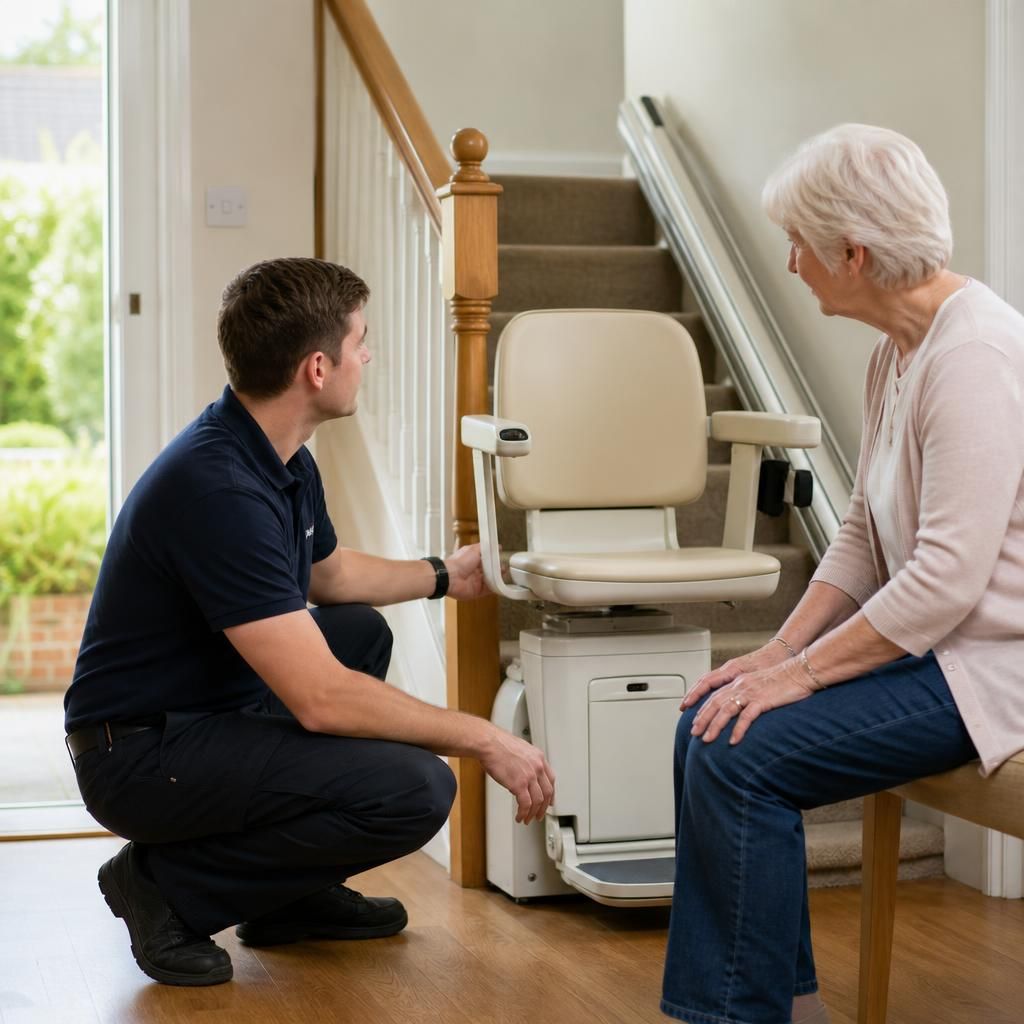
Arrange a used stairlift assessment
Arrange a used stairlift assessment with Independent Stairlifts to confirm that the equipment is safe, suitable for the user and compatible with your staircase. We can also explain the fitting, warranty and aftercare included.