
What are the key features to look for in a used stairlift?
When buying a used stairlift, check its safety features, condition, suitability for your staircase, battery performance and ease of use. A reputable inspection, professional installation, warranty and access to replacement parts are also important for ensuring reliable long-term operation.
The key features to look for in a used stairlift are reliable safety systems, a good mechanical and electrical condition, a suitable rail for your staircase, dependable batteries and controls that are easy to operate. The lift should also be professionally inspected and installed, with a clear warranty and continued access to servicing and replacement parts.
A used stairlift is not simply assessed by its age or appearance. Its suitability depends on the condition of the complete system, including the motor, drive mechanism, batteries, charging points, carriage, seat, controls and rail. A thorough assessment should confirm that it is safe for the intended user and compatible with the staircase.
- Safety features: Check for a working seat belt or harness, safety sensors, a swivel seat lock and armrests that provide stable support. Obstacle sensors should stop the stairlift if it encounters an object on the stairs. The lift should also have a reliable braking system and controls that prevent unintended movement.
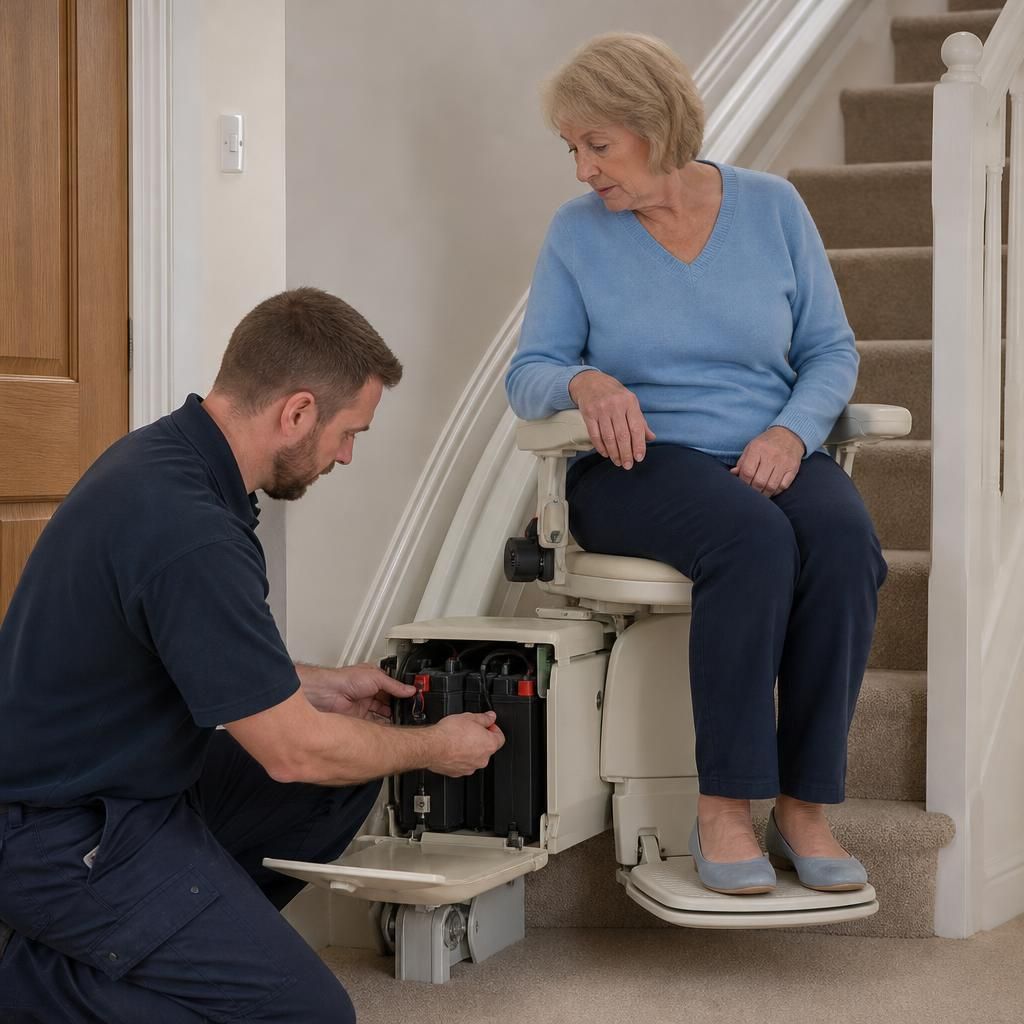
- Battery performance: Batteries are a key consideration because most stairlifts operate from rechargeable batteries, including during a power cut. They should hold charge properly and allow the lift to travel smoothly between charging points. Weak or ageing batteries can cause the lift to stop unexpectedly, so ask whether they have been tested or replaced as part of the reconditioning process.
- Condition of the motor and drive system: The stairlift should start, stop and travel without jolting, unusual noise or hesitation. A professional inspection should include the motor, gearbox, drive components and braking system. Smooth operation is more important than a clean external appearance, although visible damage, corrosion or loose components should be investigated.
- Correct rail and staircase fit: The rail must match the shape, length and layout of your stairs. A straight stairlift is designed for a straight flight, while a curved stairlift may be needed for bends, landings or changes in direction. The installation should leave appropriate clearance and should not obstruct doors, walkways or other household users. A home assessment is the safest way to confirm compatibility.
- Comfortable and supportive seating: Look for a seat that is suitable for the user’s height, weight, mobility and posture. The seat should provide adequate support and allow the user to sit securely throughout the journey. Features such as a swivel seat can make getting on and off safer, particularly at the top or bottom of the stairs. Consider whether the seat, armrests and footrest can be adjusted to suit the user.
- Simple controls: Controls should be clearly marked, responsive and positioned where the user can reach them comfortably. Many stairlifts have controls on the armrest and remote controls at the top and bottom of the stairs. Check that these are easy to use for someone with limited grip, dexterity, eyesight or memory. A manual emergency lowering or release procedure should also be explained clearly.
- Footrest and obstruction protection: The footrest should be secure and stable, with sensors or other protection to help prevent movement if an obstruction is detected. Check that it is positioned at a comfortable height and does not create an avoidable trip hazard when the user gets on or off the lift.
- Charging points and power supply: The stairlift should charge correctly at its designated points, usually when parked at the top or bottom of the rail. Ask for the charging system to be demonstrated and check that the power indicator works. If the stairlift is intended for an outdoor setting, its electrical components and charging arrangement must be suitable for external use rather than adapted from an indoor model.
- Service and reconditioning history: Ask what checks, repairs and replacements have been completed. A reputable supplier should be able to explain how the stairlift was inspected, whether wear parts were replaced and whether it has been tested before installation. Documentation may include service records, inspection details, operating instructions and information about the model.
- Availability of parts and servicing: A used stairlift should have ongoing technical support and access to compatible parts. This is particularly important for older or discontinued models. Before buying, confirm who will carry out repairs, whether replacement batteries and other wear parts are available, and whether servicing can be arranged in your area.
- Warranty or guarantee: Find out exactly what cover is included, how long it lasts and whether it applies to parts, labour, call-outs or batteries. Check for exclusions and ask what happens if a fault develops soon after installation. Written terms are preferable to verbal assurances, and the warranty should be provided by a business able to support the stairlift after the sale.
It is also important to check the stairlift’s user weight capacity and compare it with the user’s current needs. This should include any changes that may reasonably occur during the expected period of use. The supplier should confirm the capacity for the specific model and explain whether the staircase, rail design or seating configuration affects it.
For a curved or outdoor stairlift, additional features may be relevant. Curved models need a rail manufactured or configured for the particular staircase, while outdoor models require materials, covers and controls designed to withstand weather exposure. Ask how the equipment should be protected, where it should be parked and what maintenance is needed to prevent moisture or corrosion-related problems.
Before accepting a used stairlift, ask the installer to demonstrate normal operation, charging, remote controls, the swivel mechanism, safety sensors and the emergency procedure. The user should be able to try the controls and explain how to stop the lift safely. Any unusual noise, vibration, hesitation, battery warning or difficulty using the seat should be addressed before installation is completed.
Price should be considered alongside the condition, specification, installation, warranty and future servicing. A lower purchase price may not represent good value if the stairlift needs immediate battery replacement, has limited parts availability or is not properly fitted to the staircase. A professionally assessed and installed reconditioned stairlift with appropriate support can provide a practical alternative to buying new, provided its features and condition meet the user’s requirements.
Independent Stairlifts can assess the staircase and intended user before recommending a suitable used or reconditioned model. This allows the rail, seating, controls, safety features and installation requirements to be considered together rather than relying on the stairlift’s appearance or advertised age alone.
Battery performance is one of the most important features to check in a used stairlift. The batteries should hold charge, allow smooth travel between charging points and continue to provide dependable operation if there is a power cut. Warning lights, slow movement, unexpected stops or difficulty reaching the charging point can indicate that the batteries need attention.
Ask the installer to demonstrate the stairlift travelling in both directions and confirm whether the batteries were tested or replaced during reconditioning. Also check that the charging points and power indicators work correctly, and find out whether battery replacement is included within the warranty or available through the servicing arrangements.
Arrange your used stairlift assessment
Arrange a used stairlift assessment with Independent Stairlifts to check your staircase, the user’s needs and the condition and suitability of the available model. We can also explain installation, warranty and ongoing servicing before you make a decision.