
What maintenance is required for straight stairlifts to ensure longevity?
To keep a straight stairlift safe and reliable, arrange servicing in line with the manufacturer’s guidance, keep the track and seat area clean, charge the batteries regularly, and report unusual noises, movement or error messages promptly. Routine professional checks can identify wear in components such as the batteries, drive system, safety sensors and seat belt before it affects performance.
Longevity depends on a combination of scheduled professional servicing, simple user checks and prompt attention to faults. For a straight stairlift, the most important maintenance tasks are keeping the rail and seat area clear, charging the batteries correctly, checking safety features, and arranging inspections in accordance with the manufacturer’s guidance.
Arrange regular professional servicing. A trained technician should inspect the stairlift at the intervals recommended for its model and usage. Servicing normally includes checking the drive mechanism, rail, brackets, electrical connections, batteries, charging points, seat belt, swivel or folding mechanisms, arm controls and safety sensors. The technician can also test the lift under operating conditions and identify wear before it causes a breakdown. Heavier use, an outdoor installation or a stairlift used in a dusty or damp environment may justify more frequent attention.
Carry out basic checks before use. Users or carers should look for visible obstructions on the stairs and rail, loose items around the seat, signs of damage, or anything that could interfere with the footrest and safety sensors. Check that the seat is correctly positioned, the arms and footrest are secure, and the seat belt fastens and releases properly. Do not use the stairlift if a safety component appears damaged or if the lift behaves differently from normal.
Keep the rail and lift clean. Dust and debris can affect the carriage, sensors and moving parts. Wipe the rail, seat, armrests, footrest and controls with a soft, slightly damp cloth, following the cleaning instructions supplied with the stairlift. Keep liquids away from the motor, control unit, charging contacts and other electrical parts. Avoid abrasive cleaners, solvents, excessive water and oil or grease unless a qualified technician specifically recommends them. Lubricating the rail or drive system yourself can attract dirt or interfere with components designed to operate without additional lubrication.
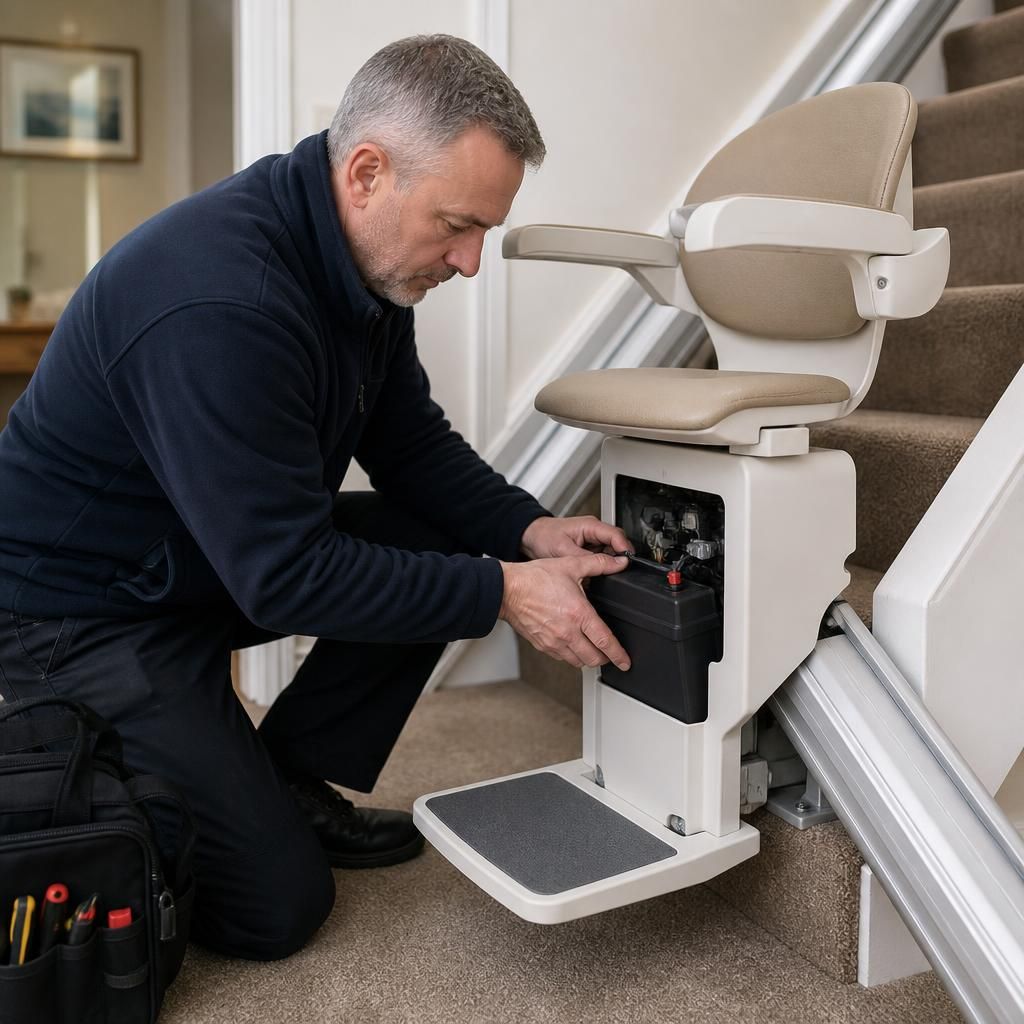
Maintain the batteries correctly. Most modern stairlifts use rechargeable batteries and should be left on their charging points when not in use, unless the manufacturer gives different instructions. Regular charging helps the lift start reliably and reduces the risk of the batteries becoming deeply discharged. If the stairlift is used infrequently, operate it and return it to the charging position in line with the instructions. A lift that travels more slowly, stops sooner than usual, gives a low-battery warning or fails to hold charge may need new batteries or an electrical inspection.
Battery life is affected by usage, age, temperature and charging conditions. Batteries are consumable components, so replacement will eventually be required even when the rest of the stairlift remains in good condition. Do not attempt to replace them with unsuitable batteries or carry out electrical work yourself. A technician can confirm the correct specification and check whether a charging fault, rather than battery wear, is responsible.
Test safety features without bypassing them. The seat belt, swivel seat, arm controls, directional controls, obstruction sensors and emergency stop functions all contribute to safe operation. Follow the user manual when checking these features. Never tape down a switch, disable a sensor, hold an arm control in place or continue using the stairlift after a safety feature has failed. These systems are intended to stop the lift when a hazardous condition is detected.
Watch for signs that attention is needed. Contact the service team if you notice:
- unusual grinding, clicking, squeaking or knocking sounds;
- jerky starts, stops or movement;
- reduced speed, loss of power or shorter travel distance;
- error messages, warning lights or repeated stops;
- the seat, armrests, footrest or swivel mechanism becoming loose;
- the stairlift failing to charge or not responding to the controls;
- damage to the rail, carriage, wiring, seat belt or safety sensors; or
- the lift stopping unexpectedly or moving when a control is released.
Stop using the stairlift if it is unsafe, emits a burning smell, shows exposed wiring, or has suffered impact or water damage. Switch it off if the instructions permit this, keep the staircase clear, and seek professional advice. Do not remove covers or attempt to repair the drive, electrical or safety systems yourself.
Keep the staircase and installation environment suitable. Do not store furniture, rugs, cleaning equipment or other items close to the rail or at the top and bottom landing. Make sure the charging points remain accessible and that household activities do not place moisture or debris around the stairlift. For an outdoor straight stairlift, inspect the cover, seals, charging equipment and exposed surfaces more frequently, and report corrosion or water ingress promptly.
Follow the manual and keep service records. The exact maintenance requirements vary between models, particularly for battery charging, folding rails, powered swivels and outdoor equipment. Keep the operating manual, installation details and service reports in an accessible place. Recording servicing, repairs and battery replacement can help identify recurring problems and provides useful information if the stairlift is moved, sold or transferred to another user.
Routine cleaning and sensible daily checks reduce avoidable wear, but they do not replace a professional service. If your stairlift is due for inspection, has developed a fault or is being used more heavily than when it was installed, contact Independent Stairlifts so the equipment can be assessed and maintained safely.
Regular battery care is one of the most important maintenance tasks for a straight stairlift. Leave the lift on its charging point when it is not in use, unless the manufacturer’s instructions state otherwise. This helps the rechargeable batteries maintain their charge and reduces the risk of the stairlift failing to start when needed.
Arrange a professional inspection if the lift moves more slowly than usual, stops before completing its journey, shows a low-battery warning or fails to hold charge. Batteries are consumable components and will eventually need replacement, but similar symptoms can also be caused by a charging fault. A trained technician can identify the cause and fit the correct replacement safely.
Arrange a professional straight stairlift service
Arrange a professional straight stairlift service with Independent Stairlifts to check the drive system, batteries, safety features and other working components. Contact us if your stairlift is due for servicing or has developed unusual noises, movement or charging problems.