
How often should a stairlift be serviced to ensure optimal performance?
Most stairlifts should be professionally serviced at least once a year, or in line with the manufacturer’s recommendations and any service agreement. Arrange an earlier inspection if you notice unusual noises, jerky movement, reduced battery performance or other changes in operation.
Most stairlifts should be professionally serviced at least once a year. The correct interval is the schedule stated by the manufacturer, your warranty or service agreement, which may require more frequent attention in some circumstances. An earlier inspection is advisable if the lift develops unusual noises, moves unevenly, stops unexpectedly, struggles to charge or shows any other change in performance.
Annual servicing provides a planned opportunity to check the stairlift’s safety systems, mechanical components and electrical operation before a minor issue affects reliability. It is different from the simple checks that you can carry out between visits. A service should be completed by a suitably trained stairlift technician who can inspect, test and adjust the equipment safely.
The recommended interval can depend on several factors, including:
- the manufacturer’s servicing guidance and the terms of any warranty or service contract;
- how frequently the stairlift is used and whether it carries heavier loads regularly;
- the age, model and condition of the stairlift;
- whether it is installed indoors or exposed to outdoor conditions;
- the shape and length of the track, particularly on a curved stairlift; and
- the environment around the lift, including dust, damp, temperature changes or heavy household use.
A stairlift used several times a day may experience more wear than one used occasionally. Outdoor stairlifts can also need closer monitoring because moisture, dirt and temperature changes may affect electrical connections, controls and moving parts. Reconditioned stairlifts should be serviced in accordance with the supplier’s guidance, with their condition and service history taken into account.
During a professional service, the technician will normally assess the lift’s general condition and test its operation. Checks may include the following:
- the seat, armrests, footrest, swivel mechanism and seat belt;
- the controls, remote controls, safety sensors and stop switches;
- the drive system, gears, rollers and track;
- the batteries, charging points and electrical connections;
- the brakes, speed control and movement on the full length of the track;
- the limit switches and other features designed to stop the lift safely; and
- fixings, alignment and any signs of wear, damage or obstruction.
The technician may clean, lubricate or adjust components where appropriate and will explain any repair or replacement that is needed. Parts should not be replaced simply because they have reached a particular age; their condition, performance and the manufacturer’s guidance should be considered. If a safety-critical fault is identified, stop using the stairlift until professional advice has been provided.
Do not wait for the next scheduled service if you notice any of these warning signs:
- jerky, slow or unusually noisy movement;
- the stairlift stopping between charging points or failing to complete the journey;
- the battery not holding its charge, warning lights or repeated low-battery alerts;
- the lift failing to start or responding inconsistently to the controls;
- the seat, swivel action, footrest or safety belt not operating correctly;
- the lift stopping when it encounters a landing, bend or safety sensor; or
- visible damage, a burning smell, exposed wiring or signs of fluid or water ingress.
Some problems are caused by simple issues, such as a charging point being obstructed, a power switch being turned off or an object touching a safety sensor. You can check the user manual and make sure the track and charging areas are clear, but do not remove covers or attempt electrical or mechanical repairs yourself. Contact the service team if the problem remains or if there is any concern about safe operation.
Between professional services, keep the track clear, park the stairlift at its designated charging point and follow the operating instructions. Avoid placing items on the footrest or carrying loads that exceed the manufacturer’s stated limit. Report changes in performance promptly rather than continuing to use the lift until it fails completely. Good day-to-day care does not replace a scheduled service, but it can help identify problems sooner and support dependable operation.
If your stairlift is covered by an ongoing service agreement, check the agreement for the inspection frequency, what is included and how to report a fault. Keep records of service visits, repairs and battery changes, particularly if the stairlift is under warranty or may be transferred to another owner. When arranging a service with Independent Stairlifts, have the model details and a clear description of any symptoms available so the technician can prepare appropriately.
In practical terms, plan for a professional service every year unless the manufacturer or service agreement specifies a different schedule, and arrange an additional check whenever the stairlift’s behaviour changes. This approach helps maintain safety, comfort and reliability while allowing wear or battery deterioration to be dealt with before it causes an avoidable breakdown.
A stairlift should normally have a professional service at least once a year, but it should be checked sooner if its performance changes. An annual inspection allows a trained technician to assess the drive system, batteries, safety sensors, controls and track before wear develops into a breakdown.
Do not wait for the next planned visit if you notice:
- jerky, slow or unusually noisy movement;
- the lift stopping unexpectedly or failing to complete the journey;
- reduced battery performance or repeated low-battery warnings; or
- faults with the seat, footrest, swivel mechanism, controls or safety belt.
Stop using the stairlift if there is visible damage, exposed wiring, a burning smell or any concern about safe operation, and contact a qualified service technician for advice.
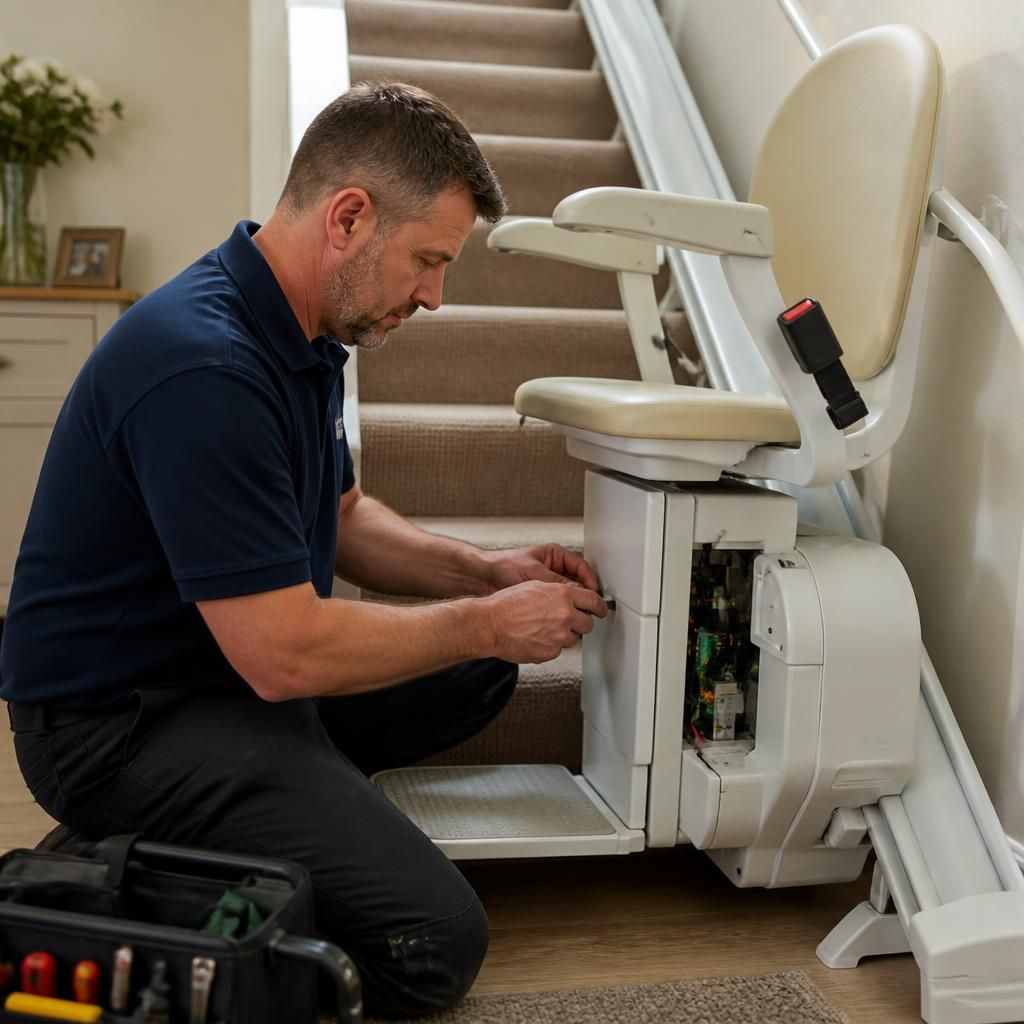
Arrange your stairlift service with Independent Stairlifts
If your stairlift is due for its scheduled service, or its performance has changed, contact Independent Stairlifts to arrange an assessment with a trained technician. Have the model details and any symptoms ready so we can provide the appropriate support.