
What factors should I consider when deciding between stairlift rental and purchase?
When deciding between stairlift rental and purchase, consider how long you expect to need the stairlift, the total cost over that period, your available budget, and whether your staircase requires a straight or bespoke curved model. Renting can suit temporary or uncertain needs, while purchasing may offer better long-term value if the stairlift is likely to be used for several years.
The choice between stairlift rental and purchase usually depends on how long the lift is likely to be needed, the type of staircase, your available budget and the level of flexibility you require. Renting can be appropriate where the need is temporary or uncertain, while purchasing may provide better long-term value when the stairlift is expected to remain in use for several years.
Consider the expected length of use first. Estimate how long the stairlift may be needed, while allowing for the possibility that circumstances could change. Rental is often worth considering after an operation, during rehabilitation, while recovering from an injury, or when a property is being adapted for a short-term requirement. It can also be suitable when you are unsure whether the stairlift will be needed permanently.
If the stairlift is likely to be used indefinitely, purchasing may be more economical over time. With a purchase, the initial cost is higher, but there are no ongoing rental payments. Comparing the total cost across the expected period of use is more useful than comparing only the initial payment.
Compare the complete costs, not just the headline price. For a rental, check what is included in the initial installation charge and the regular rental payment. Depending on the agreement, this may include installation, servicing, repairs, replacement parts and removal when the stairlift is no longer required. Confirm whether any of these services are subject to conditions, call-out charges or separate fees.
For a purchase, consider the supply and installation cost alongside any ongoing servicing, repair or battery replacement expenses. Ask how long the warranty lasts, what it covers and whether labour and parts are included. A lower purchase price is not necessarily the lowest overall cost if the warranty is limited or maintenance is charged separately.
Take the staircase layout into account. A straight stairlift is generally simpler to install and may be available as a rental where a suitable model is already available. A curved stairlift is made to fit the bends, landings and changes in direction of a particular staircase. Its bespoke design can affect both rental availability and the overall cost.
Curved stairlift rental can be a practical option, but the agreement may depend on whether the stairlift can be adapted, reused or removed at the end of the term. If a curved lift has to be manufactured specifically for the property, purchasing may be more suitable in some circumstances. A home assessment is important because the staircase shape, available space and seating position all affect the options.
Review your budget and payment preferences. Renting spreads the cost into regular payments and can reduce the amount needed at the outset. This may be helpful where the stairlift is needed quickly or where a large one-off payment is not suitable. However, regular payments continue for as long as the rental remains active, so calculate the projected total rather than focusing only on the monthly amount.
Purchasing requires more money initially, although payment plans may be available depending on the provider and the equipment selected. A purchase can make budgeting easier over the long term because the rental charge does not continue after the stairlift has been paid for. Make sure any finance arrangement is understood fully, including the total payable and the terms for ending it.
Think about ownership and future flexibility. When you purchase a stairlift, it belongs to you. You may be able to keep it if you move, provided it can be safely installed on the new staircase, or arrange its removal and discuss whether it has any resale or part-exchange value. This is not guaranteed, particularly if the lift is bespoke to the original staircase.
With a rental, the provider normally retains ownership. This can simplify removal when the lift is no longer needed, but you will not own an asset at the end of the agreement. Check the notice period, removal arrangements and whether payments continue until the equipment has been collected.
Check the contract carefully. Before agreeing to rent, confirm:
- the minimum rental period and whether the agreement can be extended;
- the notice required to end the rental;
- what happens if the stairlift is no longer needed sooner than expected;
- whether installation and removal are included;
- which servicing, repairs and replacement parts are covered;
- whether there are call-out, administration or cancellation charges; and
- what happens if the property is sold or you move home.
For a purchase, check the warranty, servicing arrangements, response process for faults and the cost of any work outside the warranty. Ask whether the equipment is new or reconditioned and what checks have been completed if it is reconditioned. The condition, age and availability of replacement parts can affect its long-term value.
Consider the user’s changing needs. A stairlift should be selected for the person’s current mobility, balance, weight, seating needs and ability to use the controls safely. It is also sensible to consider whether their condition may change. Features such as powered swivelling seats, powered footrests, different seat options or upgraded controls can affect the cost but may improve usability.
Where needs are likely to change quickly, rental can provide flexibility to review the arrangement. If the required specification is already clear and the lift will be used regularly for the foreseeable future, purchasing may avoid paying rental charges for equipment that is effectively a permanent part of the home.
Allow for changes in circumstances. A rental agreement may be preferable if there is uncertainty about hospital discharge, recovery, care arrangements or a possible move to another home. Conversely, if the user is expected to remain in the property and needs reliable access between floors on a continuing basis, purchase may offer stronger long-term value.
Do not assume that a stairlift can automatically be transferred to another property. Straight models may sometimes be suitable for a different staircase if the dimensions and layout match, but curved models are normally designed for one staircase. Any transfer would require a professional assessment and safe reinstallation.
Compare like with like before deciding. Ask for a written quotation based on the actual staircase and specification rather than relying on a general estimate. Compare the total expected rental cost with the full purchase cost over the period you are considering. Then weigh the financial difference against the benefits of flexibility, ownership, included maintenance and the convenience of removal.
There is no single option that is right for every household. Rental is usually most suitable for a temporary, uncertain or short-term need where lower initial expenditure and included support are important. Purchase is more likely to suit a permanent requirement, particularly where the stairlift will be used regularly and the expected period of use makes ownership more economical. An assessment of the staircase and the user’s circumstances will provide the most reliable basis for making the decision.
The main financial difference between stairlift rental and purchase is when you pay: rental spreads the cost over the period of use, while purchasing involves a larger initial payment followed by ownership. Compare the total expected cost for the time you are likely to need the stairlift, rather than comparing only the monthly rental charge with the purchase price.
When reviewing a rental quotation, check whether installation, servicing, repairs, replacement parts and removal are included. For a purchase, allow for installation, warranty limits, servicing, repairs and battery replacement. Renting may be more suitable for a temporary or uncertain need, while purchasing can offer better long-term value when the stairlift is expected to remain in regular use for several years.
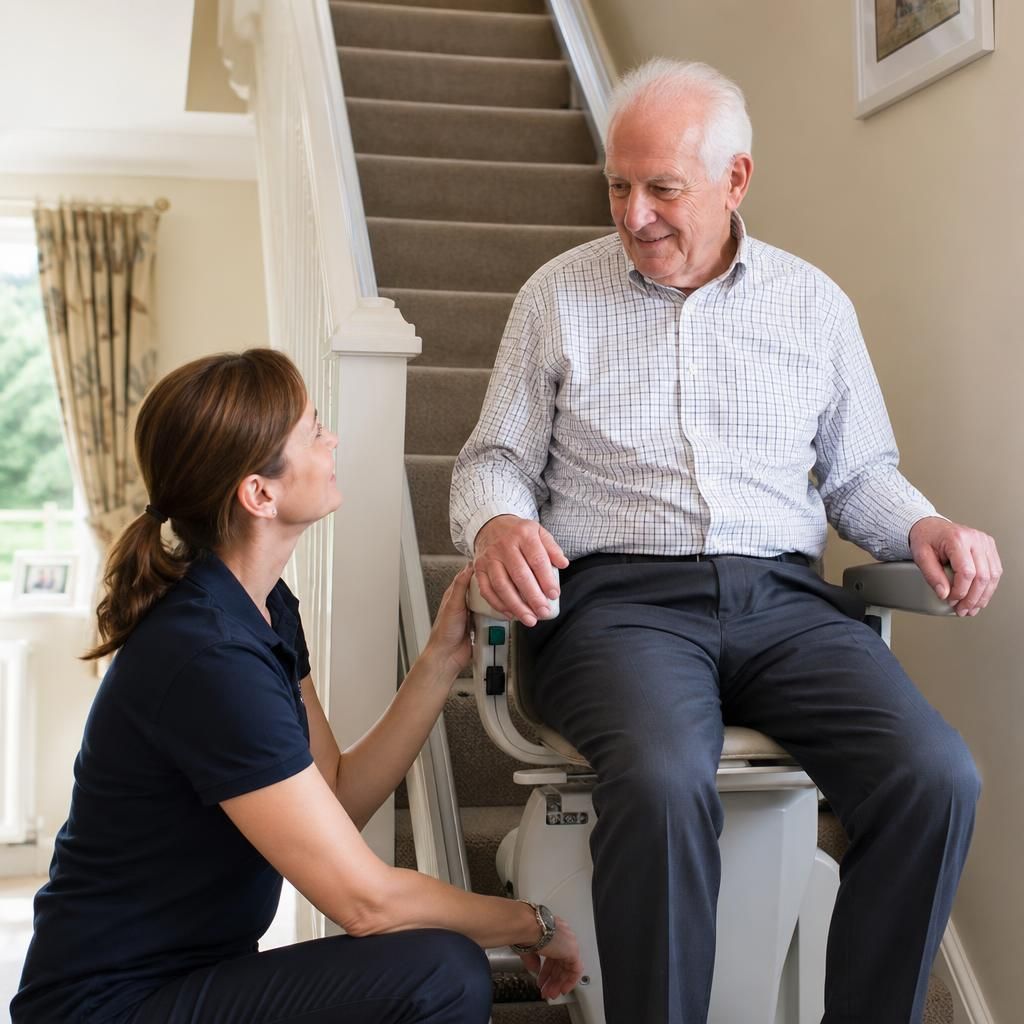
Discuss whether renting or purchasing is right for you
Discuss your circumstances with our team to compare stairlift rental and purchase options based on your staircase, expected length of use and budget. We can help you assess the most suitable arrangement before you decide.