
What should I consider when deciding between a new or reconditioned stairlift?
Choosing between a new or reconditioned stairlift depends on your budget, required features, staircase layout and how long you expect to use it. A reconditioned model may reduce the initial cost, while a new stairlift offers the latest specification and may provide greater choice of options and warranty cover.
A new stairlift is usually the better choice when you need the widest choice of features, upholstery and warranty cover, or expect to use the lift for many years. A reconditioned stairlift can be a practical alternative when the available model meets your mobility needs, fits the staircase correctly and offers suitable servicing and warranty support. The right decision should be based on the complete package rather than the purchase price alone.
Both new and reconditioned stairlifts can provide safe, reliable access between floors. The important differences are the condition and age of the equipment, the choice of specification, the warranty, the expected future maintenance and how closely the lift matches your home and way of using it.
Compare the total cost, not just the initial price
A reconditioned stairlift generally has a lower initial cost because the main equipment has been previously installed. However, the final price still depends on the staircase, the model selected, any required rail adaptations, installation work and optional features. A straightforward staircase may allow a simpler installation, while a curved or unusually configured staircase may require a bespoke rail regardless of whether the stairlift itself is new or reconditioned.
When comparing quotations, check what is included. The price should be considered alongside assessment and installation, removal if the stairlift is no longer needed, warranty cover, servicing arrangements and any likely replacement parts. A lower purchase price may not represent better value if the equipment has limited cover or is unsuitable for your longer-term needs.
Consider the condition and history of a reconditioned model
Reconditioned equipment is not simply second-hand equipment installed without checks. Ask how the stairlift has been inspected, tested, cleaned and prepared for reinstallation. You should also establish whether components subject to wear, such as batteries, rollers, belts or switches, have been assessed and replaced where necessary.
The age and previous use of the stairlift can affect the availability of parts and the likelihood of future maintenance. A reputable installer should be able to explain the model’s condition, identify any limitations and provide appropriate warranty terms. If the history of the equipment is unclear, or no meaningful support is offered after installation, the initial saving may not justify the uncertainty.
Check the warranty and aftercare
Warranty terms can differ between new and reconditioned stairlifts and between suppliers. Read the terms carefully rather than assuming that all faults, call-outs or parts are covered. Check:
- how long the warranty lasts;
- whether it covers labour as well as parts;
- which components are excluded;
- whether batteries and normal wear items are included;
- how to request assistance if the stairlift stops working; and
- whether servicing or ongoing support is available after the warranty ends.
A new stairlift will commonly offer more extensive manufacturer warranty options, although the exact cover depends on the model and supplier. A reconditioned stairlift can still have suitable protection, but the terms should be confirmed in writing before you proceed.
Match the stairlift to your mobility needs
Price should not outweigh suitability. During an assessment, consider how your mobility may change and whether you need features such as powered swivel or folding seats, a powered footrest, adjustable armrests, a larger seat, a higher weight capacity or controls that are easy to operate. You may also need a model that accommodates limited knee movement, difficulty standing or reduced hand strength.
New equipment usually gives you a wider choice of current specifications and allows more features to be selected at the outset. With a reconditioned stairlift, the available model may restrict the choice of seat style, upholstery, controls or powered options. This does not automatically make it unsuitable, but the available specification must be checked against your present and anticipated needs.
Controls should be positioned so that you can operate them safely and comfortably. If more than one person will use the stairlift, consider whether the selected design works for everyone. Remote controls can also be useful for sending the stairlift between floors, but they should be included only if they provide a practical benefit for your household.
Allow for the staircase layout
A straight stairlift is often easier to source as either new or reconditioned equipment, subject to the correct rail length and installation requirements. Curved stairlifts are made for the individual staircase, so the rail is normally the main bespoke element. A reconditioned curved stairlift may be available if its existing rail matches your staircase, but a rail from another property will not normally be suitable without appropriate assessment and modification.
Landings, intermediate floors, narrow steps, doorways and changes in direction can affect the design. The installer should assess whether the stairlift can be parked without obstructing a doorway or walkway and whether other household members can continue to use the stairs safely. Outdoor stairlifts require additional consideration of weather protection, drainage, charging arrangements and the condition of external surfaces.
Think about expected length of use
If the stairlift is needed for a temporary recovery period or for a property that may soon be adapted or sold, a reconditioned option may provide a sensible balance between cost and function. If you expect to rely on the stairlift every day for the foreseeable future, a new model may offer greater choice and a longer period before age-related maintenance becomes a consideration.
This is not a fixed rule. A well-maintained reconditioned stairlift can be suitable for long-term use, while a new stairlift may not be appropriate if its design does not meet your needs. The decision should reflect your likely usage, the condition of the equipment and the level of support available.
Assess reliability, batteries and maintenance
Stairlifts operate from rechargeable batteries and normally continue to charge when parked at the designated charging points. Battery condition is particularly important for reconditioned equipment because batteries have a finite service life. Ask whether the batteries have been tested, what symptoms could indicate deterioration and how replacement is handled.
Maintenance may eventually be required for either type of stairlift. Moving parts, charging equipment, sensors and drive components can be affected by use, dust, moisture or accidental impact. Follow the manufacturer’s cleaning and operating guidance, keep the stairlift on its charging point when not in use and arrange professional attention if it begins to move unevenly, stop unexpectedly or show warning lights. Do not attempt to bypass safety sensors or carry out electrical repairs yourself.
Check safety and installation quality
New or reconditioned equipment should be professionally assessed and installed. The stairlift must be securely fixed, correctly aligned and tested before handover. Safety features such as seat belts, swivel-seat locks, obstruction sensors, braking systems and operating controls should be demonstrated to the user and anyone who may provide assistance.
Ask what happens if the stairlift develops a fault and whether there is a manual lowering or emergency procedure relevant to the model. You should also receive clear instructions for daily use, charging and cleaning. An installation is not complete until you are comfortable using the controls and understand how to obtain support.
Questions to ask before choosing
- Is the quoted stairlift new or reconditioned, and what is its model and specification?
- What checks and replacement work have been completed on reconditioned equipment?
- Will the proposed seat, controls and weight capacity remain suitable if my mobility changes?
- Does the rail fit my staircase, and are any alterations or additional installation work required?
- What exactly is covered by the warranty, including batteries, parts and labour?
- What servicing and breakdown support is available after installation?
- What is included in the quoted price, and could any further costs arise?
- Can the stairlift be removed, relocated or adapted if my circumstances change?
How to make the decision
Choose a reconditioned stairlift when its specification is suitable, its condition has been properly assessed, the installation is appropriate and the warranty and aftercare provide sufficient reassurance. Choose a new stairlift when you need a particular design or feature, want the broadest choice of customisation, or prefer the latest equipment with more extensive warranty options.
A home assessment is the most reliable way to compare both options. It allows the staircase, seating position, transfer ability, controls, charging points and likely installation requirements to be considered together. The resulting recommendation should explain the differences in price, specification, warranty and future support so that you can choose the stairlift that offers the most suitable balance of safety, comfort, reliability and cost.
A reconditioned stairlift can be a suitable alternative to a new model when its condition, specification and support have been properly checked. The lower initial price should be considered alongside the equipment’s age, battery condition, available features, warranty and likely maintenance requirements.
Before choosing reconditioned equipment, ask the installer to explain:
- how the stairlift was inspected, tested and prepared for reinstallation;
- whether wear-related components, including the batteries, have been assessed;
- which parts and labour are covered by the warranty; and
- what breakdown and servicing support is available after installation.
If the model meets your mobility needs and fits the staircase correctly, reconditioned equipment may offer good value. A new stairlift is generally preferable when you need a particular seat, control or powered feature, or want the widest choice of current specifications and warranty options.
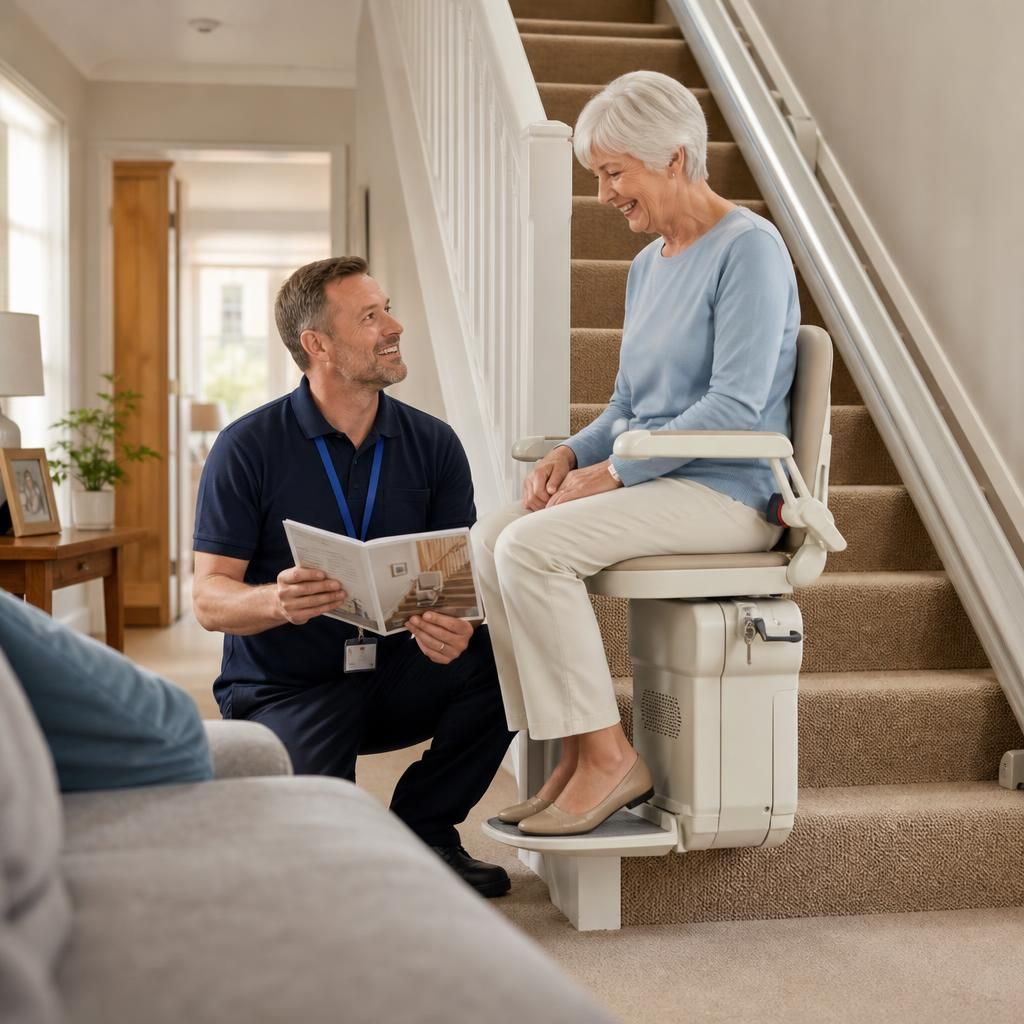
Arrange an assessment to compare your stairlift options
Arrange a home assessment to compare suitable new and reconditioned stairlifts, including their specification, installation requirements, warranty and likely ongoing costs.