
What factors should I consider when estimating the cost of a customised stairlift solution for complex staircases?
Estimating the cost of a customised stairlift for a complex staircase depends mainly on the stairway’s shape and measurements, the rail design required, installation access and the features selected. Landings, multiple bends, tight curves, narrow sections and changes in floor level usually require a bespoke assessment before an accurate quotation can be provided.
The cost of a customised stairlift for a complex staircase is determined by the work needed to design, manufacture and install a safe rail around the staircase, rather than by the stairlift seat alone. The main factors are the staircase layout, the measurements and condition of the stairs, the amount of bespoke rail required, access for installation, the electrical work involved and the features selected.
Staircase shape and measurements
A straight stairlift normally uses a standard rail, whereas a complex staircase requires a rail made to follow the individual route. Curves, intermediate landings, tight turns, narrow sections and changes in direction all affect the design. A staircase that appears similar to another may still require a different solution because of variations in width, tread depth, ceiling height, banister position or the space available at the top and bottom.
The survey should establish:
- Whether the staircase is straight, curved, split-level, open-plan or made up of several flights
- The width and usable space across each section of the stairs
- The position and severity of bends, corners and landings
- Available parking space at the top and bottom
- Doorways, radiators, walls, furniture and other potential obstructions
- Headroom and clearance around the seat, footrest and rail
- Whether the lift needs to serve more than one floor or landing
A longer or more intricate route does not automatically mean that the installation is unsuitable, but it can require more rail sections, additional design work and more detailed testing. The measurements taken during a home assessment are therefore more reliable than estimating from photographs or the number of stairs alone.
Rail design and manufacture
For a complex staircase, the rail is usually the largest bespoke element. Its price can be influenced by the number and tightness of bends, the length of the route, changes between flights and the clearances needed to keep the stairlift safely away from walls and obstructions.
Some layouts need a specially planned start or finish. For example, a folding or extended rail may be appropriate where the lift needs to park away from a doorway or at a safer position beyond the top of the stairs. These arrangements can add to the overall cost and must be checked against the available space. A compact parking position may also require careful consideration of how the user transfers on and off the seat.
Where the staircase is particularly narrow or has unusual geometry, the surveyor may need to balance several requirements at once: keeping the rail close to the stairs, maintaining comfortable clearance, protecting access around landings and avoiding interference with doors or walkways. The most economical rail design is not always the most practical one, so the quotation should explain the proposed route and any alternatives.
Installation access and site conditions
Installation complexity can affect labour time and the equipment required. A straightforward internal staircase may be accessible immediately, while a more difficult site may involve restricted access, several floors, limited parking, fragile finishes or furniture that has to be moved before work begins.
The installer may also need to account for:
- Uneven, damaged or loose stair treads
- Weak fixings or unsuitable surfaces for securing the rail
- Plasterwork, panelling or decorative features close to the staircase
- Limited working space at landings
- External access when materials cannot be brought through the main entrance
- Additional preparation or making-good after installation
Most stairlift rails are fixed to the stairs or suitable structural surfaces rather than relying solely on the wall. However, the condition and construction of the staircase still need to be checked. If repairs, strengthening or removal of an obstruction are required, these may be separate from the stairlift price. Ask for any preparatory work to be identified clearly so that the estimate does not combine confirmed costs with assumptions.
Electrical supply and charging arrangements
A stairlift needs a suitable power supply and charging points positioned so that the batteries can recharge when the lift is parked. In many homes, the existing electrical arrangement is sufficient, but complex layouts or older properties may need additional electrical work.
Possible considerations include the location of the nearest suitable socket, the route for any new cable, access to the consumer unit and whether the power supply can be installed without creating a trip hazard. If an electrician is needed, establish whether that work is included in the quotation or priced separately. Outdoor installations may require weather-resistant equipment and additional protection, which should also be assessed separately from an indoor stairlift.
Seat, controls and safety features
The chosen model and specification affect the price as well as the suitability of the lift. Features that may influence the estimate include the seat style, swivel or powered swivel operation, powered folding footrest, powered hinge rail, remote controls, armrest controls, safety sensors, harness options and upholstery choices.
These features should be selected according to the user’s mobility, balance, strength and ability to operate controls. A powered option may be helpful where the user cannot easily manage a manual movement, but it can add to the purchase price and may introduce additional components that require servicing. Remote controls can allow the lift to be called from another landing, while a folding rail can help protect a doorway or passage. Neither should be treated as essential without considering the layout and the user’s normal routine.
Weight capacity, seat dimensions and transfer space are also important. A lower-cost model is not appropriate if its seat, armrests or footrest do not provide a safe and comfortable fit. The assessment should consider who will use the stairlift, whether more than one person may use it and whether the user’s needs are likely to change.
New, reconditioned and model-specific considerations
A reconditioned stairlift may be an option where the staircase and user’s requirements match an available system. Complex curved staircases are less likely to suit a standard pre-owned rail because the rail is normally made for a particular staircase. In some cases, reusable components may be available, but the rail design, condition, warranty and compatibility must be confirmed.
New equipment may provide more choice over rail routing, seat configuration and powered features. It may also make future servicing or replacement parts more straightforward, depending on the model. When comparing options, look beyond the initial price and check what is included: survey, manufacture, delivery, installation, removal of an existing lift, warranty cover and aftercare may differ between quotations.
Costs that may sit outside the basic estimate
Ask whether the quotation includes removal and disposal of an old stairlift, repairs to the stairs, electrical work, changes to flooring or decoration, difficult-access charges and any follow-up visit. If the installation is being arranged for a rental property, listed building or home with shared access, permissions may also need to be obtained before work starts.
Tax treatment can depend on the user’s circumstances and the type of work supplied. If you believe you may qualify for a relief or exemption, discuss the required declaration with the installer before the quotation is finalised rather than assuming it will apply automatically.
How to obtain a dependable estimate
The most accurate process is an in-person assessment by a suitably experienced surveyor. Provide details of the user’s mobility, the route they need to travel, any transfer difficulties and how the staircase is used by other household members. Photographs can help with an initial discussion, but they cannot confirm clearances, fixing points or the exact rail design.
A useful quotation should describe the proposed stairlift, rail route, parking arrangement, installation work, included features, warranty and any exclusions. It should also explain whether the price is fixed or subject to confirmation after detailed measurements. If there are several viable designs, ask for the practical differences between them, including how each affects access to the landing and everyday use of the stairs.
In summary, estimate the cost by assessing the whole installation: the staircase geometry, bespoke rail, site preparation, electrical requirements, chosen features, equipment type and future support. A tailored survey is essential for a complex staircase because it replaces broad assumptions with measurements and a clear specification.
The bespoke rail is usually the main cost factor when a stairlift is fitted to a complex staircase. Unlike a standard straight rail, it must be measured and manufactured to follow bends, landings, changes in direction and restricted sections while maintaining safe clearance from walls, doors and other obstacles.
An in-person survey is therefore essential. It confirms the route, parking position, fixing points and any access or preparation work required. When reviewing the estimate, check that it explains the proposed rail design, installation work, included features and any exclusions, such as electrical work, repairs or removal of an existing lift.
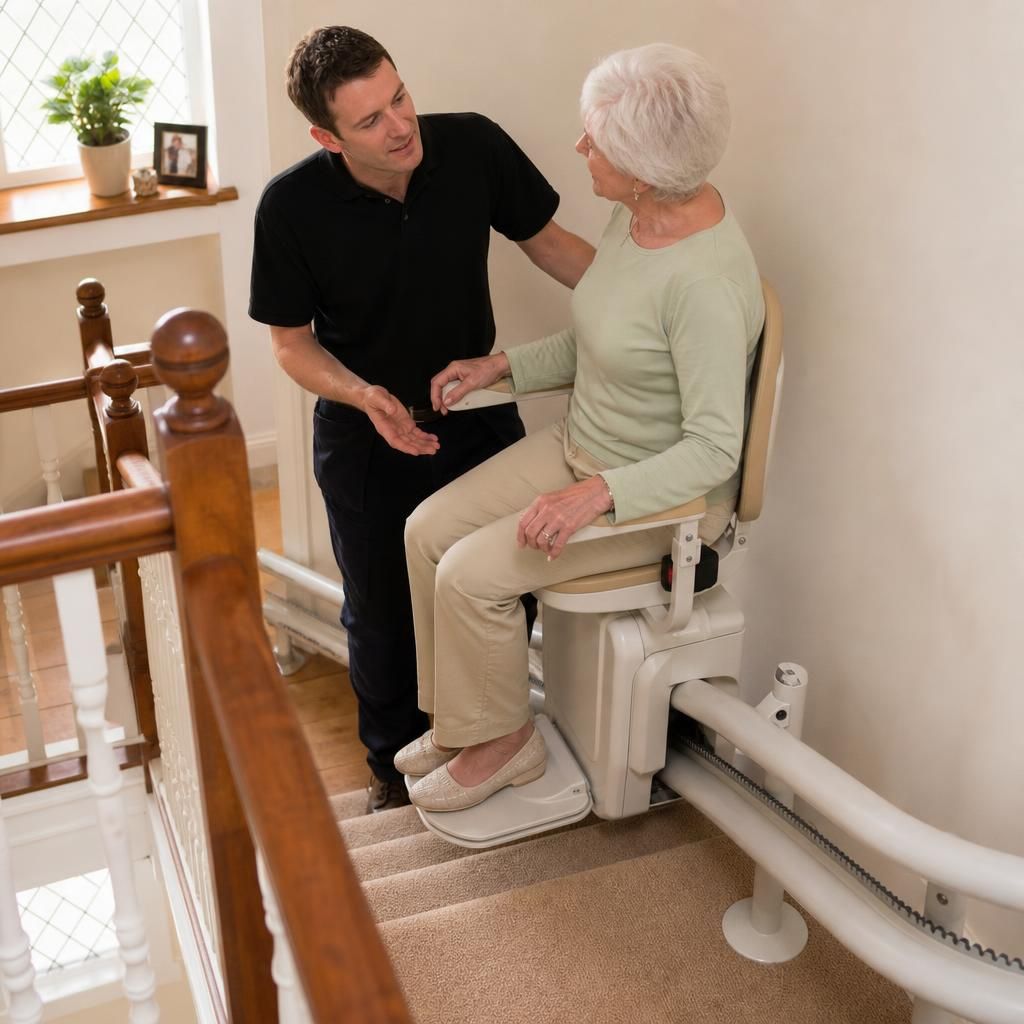
Arrange a Bespoke Stairlift Assessment for Your Complex Staircase
Arrange a bespoke stairlift assessment for your complex staircase so our surveyor can confirm the rail design, installation requirements and total cost. Contact Independent Stairlifts for tailored advice and a clear quotation.