
How does staircase configuration impact the overall cost of a stairlift?
Staircase configuration is a major factor in stairlift cost because it determines the type of rail and installation required. Straight staircases are generally simpler to fit, while curved, multi-flight, narrow or unusually shaped staircases require a bespoke rail and more detailed installation, which typically increases the overall price.
Staircase configuration affects stairlift cost because it determines the rail design, equipment required and complexity of installation. A straight staircase usually needs a standard straight rail and a comparatively straightforward fitting process, whereas curved, multi-flight, narrow or unusually shaped stairs normally require a bespoke rail and more detailed surveying and installation.
The main configuration-related cost factors are:
- Rail type: Straight staircases can generally accommodate a standard rail, while stairs with bends, curves or changes in direction require a rail made to follow the staircase accurately.
- Number of flights: A stairlift serving several flights may need a continuous bespoke rail, additional equipment or a design that manages intermediate landings. This is usually more involved than fitting a lift to one uninterrupted flight.
- Shape and direction of travel: Half-landings, quarter-turns, switchbacks and irregular curves all affect the rail route. Each change in direction has to be measured and designed so the chair can travel safely without obstructing doors, corridors or walking space.
- Available width: Narrow stairs can limit the choice of seat, armrest position and rail design. A compact or hinged arrangement may be appropriate, but the suitability and cost depend on the clearances at the stairs, landings and top and bottom entry points.
- Landings and access points: The amount of space available to get on and off the stairlift can influence whether a standard, swivel or powered swivel seat is suitable. A rail may also need to extend beyond the first or last step to create a safer and more practical parking position.
- Obstructions: Radiators, doors, architraves, cupboards, handrails and low ceilings can affect where the rail is mounted. Moving the rail away from the wall or using a different parking arrangement may require additional design work.
A straight staircase is not automatically the lowest-cost option in every home. The price can be affected by its length, the position of the power supply, restricted access for the installation team and any need to avoid existing fixtures. However, its simpler rail geometry normally makes the assessment, manufacture and fitting less complex than for a staircase with bends.
Curved stairlifts generally cost more because the rail is measured and manufactured for the individual staircase. The rail may need to follow several changes in direction, accommodate more than one flight or include carefully designed parking points. The installation also requires precise alignment and testing along the full route. This bespoke work is the principal reason that a curved stairlift is usually more expensive than a straight model.
Split-level and multi-flight staircases require particular attention. A single lift may be designed to travel between levels, or separate solutions may be considered where the layout, parking space or household needs make that more practical. The most suitable approach depends on the staircase geometry, the available landing space and how the lift will be used. A survey is needed before the cost can be assessed reliably.
Very narrow staircases can affect cost in a different way. The challenge may not be the rail alone, but ensuring that the seated user has adequate clearance and that other people can still use the stairs safely. A slimline design, folding components or a different seat configuration may help, although these options should be selected according to the user’s mobility and transfer needs rather than appearance alone.
The position of the lift when it is not being used is also part of the configuration assessment. Parking at the top or bottom, extending the rail beyond the steps, or folding the rail away from a doorway can change the required rail length and installation method. A powered hinge or swivel may add to the cost, but it can be useful where a fixed rail would obstruct an entrance or landing.
Outdoor or exposed staircases introduce further configuration considerations. The rail and controls need to suit the external environment, while the installation may involve weather protection, different mounting surfaces or additional routing for the power supply. Steps that are uneven, open-sided or made from unusual materials may require extra preparation before the lift can be installed safely.
During an assessment, the installer should consider the full route rather than measuring only the steps. This includes the stair width, rise and angle, landings, entry and exit positions, nearby doors and fittings, wall or tread mounting points, electrical access and suitable parking areas. The user’s height, mobility, transfer ability and preferred direction of travel are also relevant because they can affect the seat and control specification.
For this reason, online estimates are useful as an initial guide but cannot confirm the cost of a bespoke installation. The final quotation should be based on an in-home survey and should explain whether the staircase requires a standard or bespoke rail, what installation work is included and whether any optional features are being recommended for access or safety.
When comparing quotations, check that they describe the same configuration and scope of work. Ask whether the price includes the rail, fitting, testing, removal of any existing equipment and the agreed warranty or aftercare. If the staircase has multiple flights, restricted width or unusual turns, make sure the quotation specifically reflects those features rather than assuming that a straight-stairlift price applies.
In summary, the simpler and more uniform the staircase, the more likely it is that a standard stairlift and installation approach will be suitable. Bends, intermediate landings, narrow sections, obstructions and unusual mounting conditions increase design and fitting requirements, which can raise the overall cost. A detailed assessment is the most reliable way to identify the right configuration and avoid unexpected installation charges.
Staircase configuration affects stairlift cost mainly because it determines whether a standard straight rail or a bespoke curved rail is required. A straight, uninterrupted flight is usually simpler to measure, manufacture and install, while bends, intermediate landings and changes in direction require the rail to be designed to the individual staircase.
Curved installations also need careful consideration of parking positions, stair width, doorways and available clearance. These details can affect the rail route and whether features such as a swivel seat or hinged rail are suitable. An in-home survey is therefore essential for confirming the configuration and providing an accurate quotation.
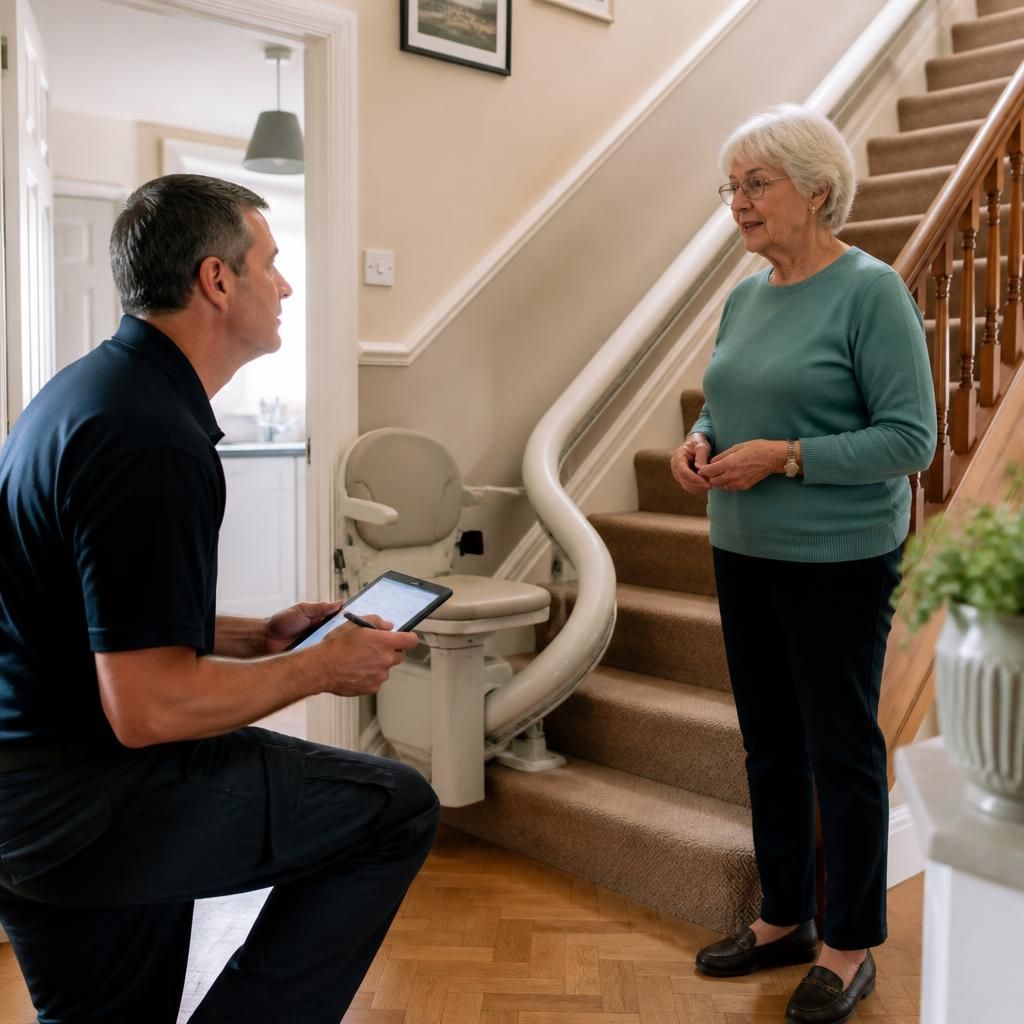
Arrange a staircase assessment for an accurate stairlift quote
Arrange an in-home staircase assessment with Independent Stairlifts to confirm the most suitable stairlift configuration and receive an accurate quotation. The assessment will consider the full staircase, available clearances, parking positions and any installation requirements.