
How do stairlift model choices affect the cost of installation and maintenance over time?
The stairlift model affects both the initial installation cost and the likely maintenance requirements: straight models are usually simpler to fit, while curved, outdoor and highly customised models require more specialist equipment, surveying and servicing. New models may offer longer warranties and more predictable support, whereas reconditioned models can reduce the upfront cost but may need earlier replacement parts or maintenance depending on their age and condition.
The stairlift model you choose affects both the price of installation and the cost of keeping the lift reliable over its working life. Straight stairlifts are generally the simplest and most economical to install, while curved, outdoor and heavily customised models require more specialist design, components and servicing. A new stairlift usually provides the most predictable warranty and parts support; a reconditioned model can reduce the initial price, but its age, condition and future parts requirements need to be considered.
The most useful comparison is not simply the purchase price. Consider the total cost of ownership: the survey and installation, any alterations to the staircase or electrical supply, servicing, replacement parts, warranty cover, potential call-out charges and the likely availability of support for that particular model.
Straight stairlifts
A straight stairlift runs along a single, uninterrupted flight and normally uses a standard rail. This makes the installation process more straightforward than fitting a lift to a staircase with bends or intermediate landings. The survey is still important, as the installer must check the stair width, available clearance, seating position, parking space, power supply and the condition of the steps or banister.
Because the rail is less complex and the installation normally takes less specialist fabrication, a straight model often has the lowest installation cost. Maintenance can also be relatively predictable because the lift has fewer rail sections, bends and moving interfaces. Routine servicing still matters: the seat, armrests, footrest, drive system, batteries, safety sensors and charging points should be checked in line with the manufacturer’s guidance.
The final price can increase if the staircase has restricted access, unusually narrow steps, limited parking space or a need for additional electrical work. Options such as powered swivelling seats, powered footrests, hinged rails and upgraded upholstery may also affect both the purchase price and the number of components that need checking during servicing.
Curved stairlifts
A curved stairlift is made for a staircase with bends, landings, changes of direction or more than one flight. The rail is designed around the individual staircase rather than selected from a standard straight length. This bespoke design and manufacture is the main reason a curved model usually costs more to install.
The installation may involve more detailed surveying, specialist measurements, a custom rail and additional fitting time. If the staircase has tight curves, several landings or limited standing space, the design may also need to address how the user gets on and off the lift safely at each level. A folding or hinged rail may be needed where a doorway or passage is close to the bottom of the stairs.
Maintenance costs are not automatically high simply because a lift is curved, but there are more rail sections, joints, charging positions and moving components to inspect. A service may include checks on the drive mechanism as it travels through bends, the condition and alignment of the rail, batteries, safety edges, seat rotation and any powered accessories. Replacement parts can also be more model-specific, so it is sensible to confirm how long parts and technical support are expected to remain available.
When comparing curved stairlift quotations, check what is included in the price. The quotation should make clear whether it covers the survey, manufacture, delivery, installation, removal of an existing lift, electrical work, warranty and any required alterations to the staircase or surrounding area.
Outdoor stairlifts
Outdoor stairlifts are designed for external steps, such as access to a garden, driveway or raised entrance. Their installation cost reflects not only the stair configuration but also the harsher operating environment. Components may need additional protection against rain, damp, dirt, temperature changes and direct sunlight. The installer must also consider drainage, the surface condition, nearby power supplies and safe access in wet or icy conditions.
Maintenance may be more demanding than for an indoor model because weather can accelerate corrosion, affect electrical connections and place more pressure on covers, seals and controls. Keeping the rail and steps clear of leaves, mud, snow and standing water is part of normal care. Covers should be used where supplied, but they must not be fitted in a way that traps moisture or interferes with the lift’s operation.
An outdoor model may therefore have higher long-term costs if it requires more frequent cleaning, inspection or replacement of weather-exposed parts. Ask which components are covered by the warranty, what servicing is recommended for the installation environment and whether the power supply needs additional protection.
New stairlifts
A new stairlift normally costs more at the outset than a comparable reconditioned model, but it may offer clearer warranty terms, the latest available controls and a more predictable supply of replacement parts. The expected maintenance requirement still depends on use, staircase design, the model selected and how well the lift is cared for.
Newer models may include features that improve ease of use, such as diagnostic displays, automatic charging, powered swivelling seats or powered footrests. These can be valuable where the user has limited strength or movement, but each additional electrical or mechanical function can add components that require inspection and may eventually need repair. The right approach is to choose features that address a genuine access or safety need rather than paying for options that will not be used.
Reconditioned stairlifts
A reconditioned stairlift can reduce the initial cost, particularly where a suitable standard straight model is available. However, the condition and history of the individual lift are more important than the label alone. Ask about its age, previous use, inspection process, replaced parts, battery condition, warranty and the availability of future support.
A reconditioned model may need maintenance or replacement parts sooner than a new equivalent, although this is not inevitable. Batteries, drive components, rollers, switches and upholstery can all be affected by age and use. A reputable assessment should identify whether these parts are serviceable and whether the model remains suitable for the user and staircase.
The initial saving should be weighed against the possibility of earlier repair, a shorter remaining service life or more limited parts availability. A reconditioned stairlift can be a practical choice when its specification, condition and warranty are appropriate, but the cheapest quote is not necessarily the lowest long-term cost.
How customisation changes lifetime costs
Customisation can improve safety, comfort and usability, but it may affect both installation and maintenance. Examples include:
- Powered swivel seats and footrests: useful where transferring on or off the lift is difficult, but they add motors, switches and wiring to the system.
- Hinged or powered rails: helpful where the rail would otherwise obstruct a doorway or walkway, but the hinge mechanism needs to remain correctly aligned and clear.
- Perching seats or altered seat dimensions: may suit limited knee movement or a narrow staircase, although the design must still provide a stable and comfortable travel position.
- Remote controls and call-send functions: make it easier to bring the lift to another level, while requiring functioning controls and batteries.
- Specialist upholstery or support accessories: can improve comfort and positioning, but replacement materials or bespoke parts may be less readily available.
Ask whether an accessory is included in the warranty and whether it changes the recommended service schedule. A simple design with the necessary functions is often easier and less costly to maintain than a highly specified model with features that are rarely used.
Questions to ask before choosing a model
- Is the quoted installation price based on a standard or bespoke rail?
- Does the price include surveying, delivery, fitting, testing and removal of an old stairlift if required?
- Which parts and labour are covered by the warranty, and for how long?
- Are batteries, powered accessories and call-outs treated differently under the maintenance terms?
- How readily available are replacement parts for this model, particularly if it is reconditioned?
- What servicing is recommended for the staircase design and the level of daily use?
- Will the lift be straightforward to remove, relocate or adapt if your circumstances change?
A proper home assessment is the best way to establish the likely cost. It allows the installer to match the model to the staircase, the user’s transfer needs and the intended frequency of use, rather than comparing specifications in isolation. The most economical choice over time is usually the model that fits the staircase correctly, provides only the customisation needed and has dependable warranty and parts support.
A stairlift model affects its total cost through the complexity of installation, the number of components requiring inspection and the availability of replacement parts. A straight indoor model is usually simpler to install and maintain, while curved, outdoor and highly customised models may require more specialist work throughout their service life.
When comparing options, look beyond the initial quotation and check:
- what the warranty covers, including batteries and powered accessories;
- whether replacement parts and technical support are expected to remain available;
- how often servicing is recommended for the model and its environment; and
- whether the features included are necessary for the user’s safety, comfort or transfers.
A reconditioned stairlift can reduce the upfront cost, but its age, condition and service history should be confirmed. The most suitable long-term choice is normally the model that fits the staircase and user correctly, while avoiding unnecessary complexity.
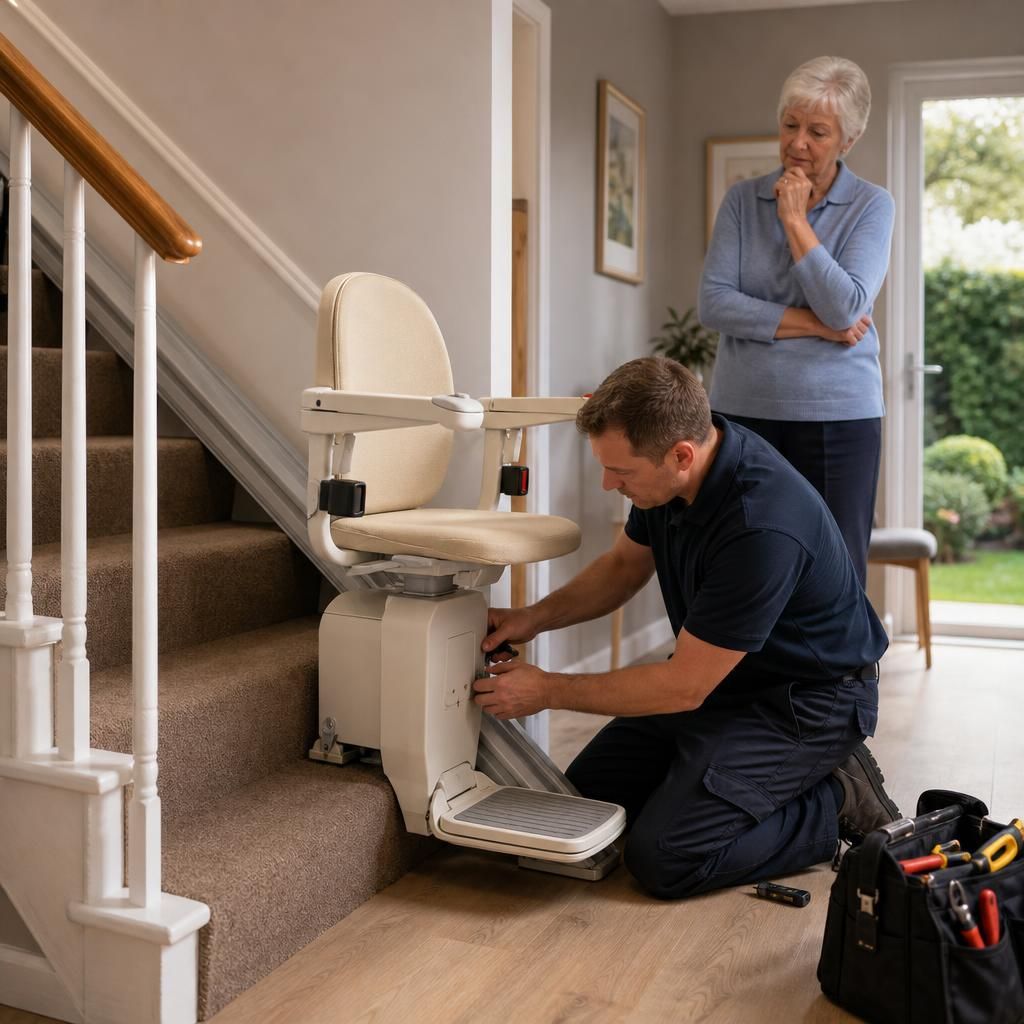
Compare stairlift models with a personalised home assessment
Arrange a personalised home assessment to compare stairlift models, installation requirements and likely maintenance costs for your staircase and needs.