
How do specific customisation options, like upholstery or remote controls, affect the overall price of a stairlift?
Customisation options can increase a stairlift’s price when they require upgraded materials, additional controls or a different seat design, although some features are included as standard on particular models. Upholstery choices, powered seat functions and extra remote controls may add to the quotation, so the exact impact depends on the stairlift model and the user’s requirements.
Stairlift customisation options can increase the overall price when they involve upgraded materials, additional electrical components or a different seat and control configuration. Upholstery and remote controls are usually relatively simple choices, while powered seat functions, specialist seating and adaptations for particular users may have a more noticeable effect on the quotation. The exact cost depends on the stairlift model, the features included as standard and the work required to install and configure them.
Upholstery and finish
Upholstery choices generally affect the price through the material, colour, trim and seat specification. Some stairlifts include a standard fabric or finish, with a selection of alternative colours available without a significant adjustment. More durable, stain-resistant or premium upholstery may be offered at an additional cost. This can be useful where the stairlift is used frequently, needs to withstand heavier wear or must coordinate with existing furnishings.
The seat design also matters. A standard seat may be suitable for many users, but a wider, more supportive or specially shaped seat can cost more because it uses different components and may require a different model. Features such as additional cushioning, adjustable arms or a choice of seat coverings should be considered alongside the user’s posture, balance and ability to transfer safely. Appearance is important, but comfort and safe use should remain the main considerations.
Remote controls
Remote controls allow the stairlift to be called to the top or bottom of the stairs when it is parked elsewhere. A handset is often supplied as part of the standard package, but extra handsets or upgraded controls may affect the price. This is particularly relevant when more than one person uses the stairs or when a family member needs to move the lift out of the way.
The cost may also depend on the type of control. A conventional handset uses buttons to operate the lift, while some models may offer larger buttons, simplified controls or a different control position to accommodate limited dexterity or reduced vision. These adjustments can make the stairlift easier to operate, but they should be selected during the assessment rather than added without checking compatibility.
Powered seat and positioning features
Powered options commonly have a greater effect on the price than upholstery or an additional handset. Examples include a powered swivel seat, powered folding footrest or powered retractable seat belt. These features use motors, switches and associated wiring, so they may require a higher-specification stairlift and additional installation checks.
A powered swivel seat can help a user turn towards the landing before standing, while a powered footrest can be useful where bending down manually is difficult. These options are not automatically necessary for every installation. The appropriate choice depends on the user’s mobility, strength, balance and the amount of space available at the top or bottom of the stairs.
Controls, safety and accessibility adaptations
Custom controls may include a different joystick position, larger operating buttons, a modified armrest arrangement or a control that can be used with one hand. Some models also allow adjustments to the seat height, seat width or footrest arrangement. The price impact varies because certain adjustments are built into a model, whereas others require special parts or a different stairlift specification.
Safety-related equipment should not be treated as an optional cosmetic upgrade. Seat belts, sensors, diagnostic systems and obstruction detection may be standard on the selected stairlift, or may form part of a particular model’s specification. The assessment should establish which safety features are included and whether any additional adaptation is needed for the staircase or the user.
How customisation affects the quotation
Customisation can affect the price in several ways:
- The feature itself may be an optional upgrade rather than part of the standard model.
- A higher specification may be needed to support the chosen seat, controls or powered function.
- Specialist components may need to be ordered and fitted.
- Some changes can affect installation time, testing or commissioning.
- A feature may be available on one stairlift model but not another, making direct price comparisons misleading.
For this reason, two stairlifts serving the same staircase can have different prices even when their basic travel requirements are similar. A quotation should identify the model, rail arrangement, seat specification, controls, included safety equipment and any optional extras separately. This makes it clearer which costs relate to the staircase and installation, and which relate to personal preferences or accessibility requirements.
When reviewing your options with Independent Stairlifts, explain how the lift will be used, who will operate it and whether there are particular difficulties with standing, sitting, reaching controls or transferring at either landing. The assessment can then distinguish between features that improve safety or independence and those that are primarily a matter of appearance. If you are comparing a new and reconditioned stairlift, check that the required customisation is available for the chosen model, as reconditioned stock may offer less choice of upholstery, controls or powered functions.
The most suitable option is not necessarily the one with the greatest number of extras. A correctly specified stairlift should provide the necessary support and controls without adding features that are unsuitable, incompatible or unlikely to be used. A tailored quotation will show the effect of each selected customisation before you make a decision.
Upholstery and remote controls usually have a smaller effect on stairlift price than powered seating or specialist adaptations, but the final cost depends on the model and what it includes as standard. A standard upholstery finish or handset may be included, while premium coverings, additional handsets or adapted controls can be quoted as optional extras.
When reviewing your quotation, check whether each feature is included, upgraded or supplied separately. Larger buttons, alternative control positions and additional remote controls may improve ease of use for someone with limited dexterity, while hard-wearing upholstery can be practical for frequent use. Independent Stairlifts can confirm which options are compatible with your stairlift and show their individual effect on the overall price.
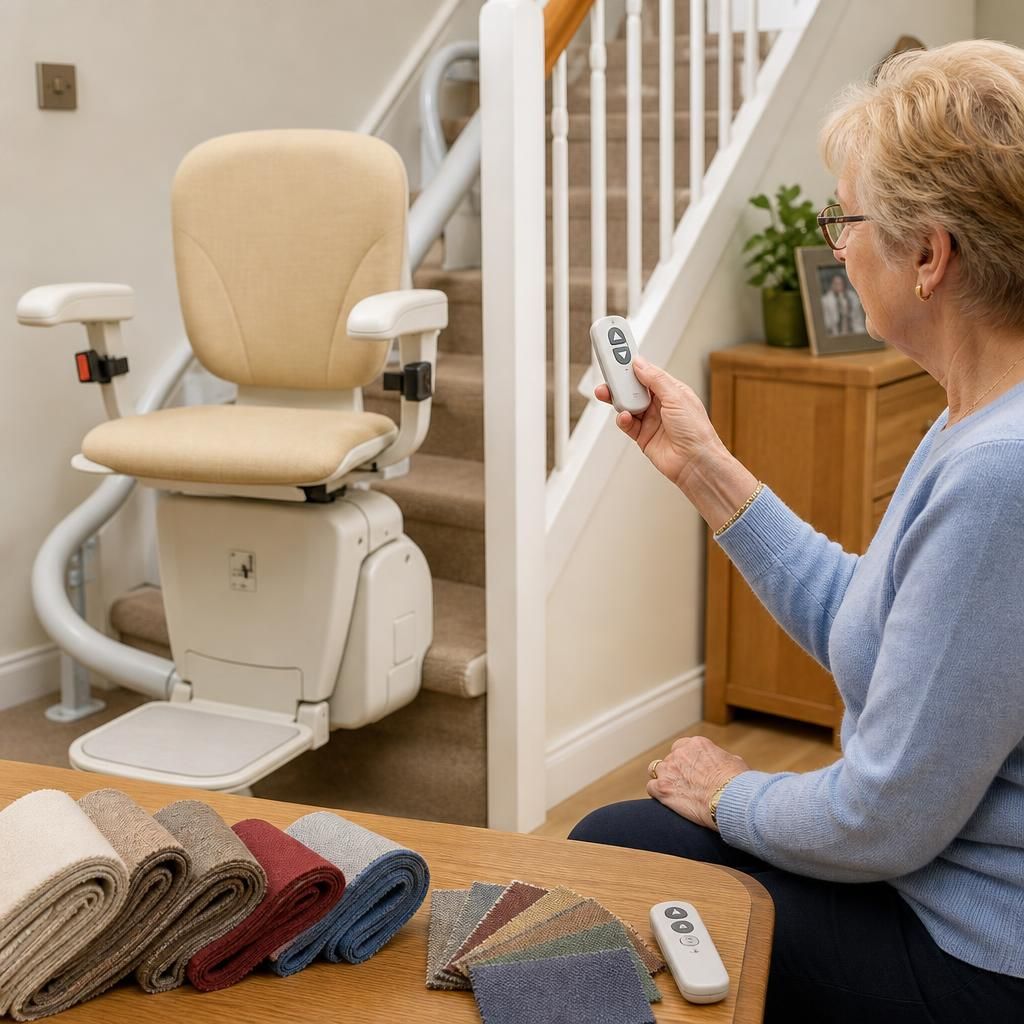
Discuss your stairlift customisation options with Independent Stairlifts
Discuss your upholstery, remote control and accessibility requirements with Independent Stairlifts to confirm compatibility and understand how each option affects your quotation.