
How does the cost of hiring a stairlift compare to the cost of buying one over time?
Hiring a stairlift usually costs less initially and can be more economical for temporary or uncertain mobility needs, while buying may offer better value over a longer period of use. The overall comparison depends on the hire agreement, installation and removal charges, servicing included, and the purchase price and future maintenance costs.
Hiring a stairlift normally costs less at the outset, while buying one can provide better value when it is needed for a long or indefinite period. The point at which buying becomes more economical depends on the purchase price, the hire charge, how long the stairlift will be used, and which services are included in each agreement. Installation, removal, servicing, repairs and the type of staircase can all materially change the comparison.
How the two payment structures differ
When you hire a stairlift, you usually pay an initial installation charge followed by a regular rental payment. The agreement may include servicing and repairs, although this varies, so the terms should be checked carefully. Some agreements may also include removal when the stairlift is no longer required, while others charge separately for collection or cancellation.
Buying involves a larger payment at the beginning. This may include the stairlift, survey, fitting and an initial warranty or service period. Once the stairlift belongs to you, there are generally no ongoing hire payments, but you remain responsible for servicing, repairs outside the warranty and eventual removal. A purchase may be for a new or reconditioned stairlift, and the price can vary considerably between a straight, curved or outdoor installation.
When hiring is often the lower-cost option
- Temporary mobility needs: If the stairlift is only required during recovery from an operation, injury or illness, hiring avoids paying the full purchase price for equipment that may have a limited period of use.
- Uncertain duration: Hiring can be appropriate where it is not yet clear how long the stairlift will be needed. It allows the decision to be reviewed rather than committing to ownership immediately.
- Limited upfront budget: The initial cost is usually lower than buying, which can make hiring easier to manage when immediate access is important.
- Included servicing: Where maintenance and breakdown support are included, hiring can make costs more predictable and reduce the risk of an unexpected repair bill.
However, hiring does not automatically remain the cheaper choice. Regular payments continue for as long as the agreement lasts, and a long rental period can eventually exceed the cost of purchasing a suitable stairlift.
When buying is often better value
- Long-term use: If the stairlift is likely to be needed for several years or for the foreseeable future, avoiding continuing hire payments may make ownership more economical.
- Stable requirements: Buying can suit someone whose mobility needs and home environment are unlikely to change, particularly where the stairlift is being installed as a permanent accessibility measure.
- Greater choice: Ownership may provide more choice over specification, upholstery, controls and additional features, subject to the stairlift being suitable for the staircase and the user’s needs.
- Potential future value: A purchased stairlift may have some residual value or could potentially be transferred or removed, although this should not be assumed and depends on its condition, age, model and staircase design.
Buying still carries ongoing responsibilities. Batteries, servicing and repairs may need attention after the warranty ends, and a curved stairlift is normally made for a particular staircase. This can make it harder to reuse or resell than a standard straight model.
Installation and removal can change the calculation
The headline hire charge or purchase price is only part of the total cost. Ask whether the quoted amount includes the home assessment, fitting, adaptations, VAT where applicable, servicing, replacement parts, removal and making good any fixings after removal. A curved stairlift usually requires a rail designed around the staircase, so its installation and later removal may cost more than for a straight stairlift. Outdoor models may also require weather-resistant equipment and additional installation work.
For a hire agreement, check whether there is a minimum rental period, notice requirement, refundable deposit, delivery charge or early termination fee. Also confirm whether the removal charge is payable even if the stairlift is no longer required unexpectedly. For a purchase, establish what happens when the stairlift reaches the end of its useful life and whether removal is included in any aftercare package.
Maintenance and repair costs
Maintenance is one of the main differences between hiring and buying. A hire contract may include routine servicing and repairs caused by normal use, but exclusions can apply. For example, accidental damage, misuse or consumable items may be treated differently. Before signing, ask who pays for engineer visits, replacement batteries and parts, and whether there is a limit to the support provided.
With a purchased stairlift, the manufacturer or installer may provide warranty protection for a defined period. After that, servicing and repairs are normally the owner’s responsibility. A service plan can make this more predictable, but its cost should be added to the long-term ownership calculation. A stairlift that is not maintained properly may become less reliable and could cost more to repair later.
A practical way to compare the total cost
- Ask for the complete installed purchase price, including any warranty and service arrangements.
- Ask for the full hire cost, including the initial fitting charge and every regular payment.
- Confirm whether servicing, breakdown repairs, batteries, removal and collection are included in each option.
- Identify minimum terms, deposits, cancellation charges and any annual or periodic price changes.
- Estimate how long the stairlift is likely to be needed, while allowing for uncertainty rather than assuming the shortest possible period.
- Compare the total cost over that period, then consider what happens if the stairlift is needed for longer than expected.
A simple comparison is to multiply the regular hire payment by the expected rental period, then add installation and any other charges. Compare that total with the purchase price, expected servicing and likely removal costs. This does not need to be an exact prediction; it is a way to identify whether the decision is mainly short-term or long-term. If the two options are close in cost, the included maintenance, cancellation terms and flexibility may be more important than the headline price.
Other factors that affect value
Cost should be considered alongside suitability and flexibility. Hiring may make it easier to remove the stairlift when circumstances change, which can be useful if the user moves home or no longer needs it. Buying may offer more control over the equipment, but the owner must arrange its removal and should not assume it can be installed easily at another property. A stairlift should always be assessed for the specific staircase and user rather than selected on price alone.
Funding may also affect the decision. Some people may be eligible for assistance through a local authority, health or social care assessment, or VAT relief subject to the relevant conditions. These possibilities depend on individual circumstances and should be checked before comparing the final amounts payable.
Overall, hiring is usually most suitable when the need is temporary, uncertain or when keeping upfront costs low is important. Buying is generally more likely to offer value when the stairlift will be used continuously for a long period and the owner is prepared to cover future maintenance and removal. The most reliable comparison is based on written, like-for-like quotations that set out all installation, support and end-of-use charges. A personalised assessment can also confirm whether the proposed stairlift is appropriate for the staircase before you commit to either payment structure.
The cost of hiring a stairlift is usually lower at the outset, while buying may cost less overall when the stairlift is needed for a long period. Compare the complete cost of each option rather than the initial payment alone.
- For hiring, include the fitting charge, every rental payment, servicing, repairs, removal and any cancellation or minimum-term charges.
- For buying, include the purchase price, installation, warranty, servicing after the warranty ends, repairs and eventual removal.
- Check whether batteries, engineer visits and replacement parts are included in the hire agreement or service plan.
Hiring can be the more economical choice when mobility needs are temporary or uncertain. If the stairlift is likely to remain in regular use for several years, purchasing may provide better long-term value because the rental payments stop. A written, like-for-like quotation based on the specific staircase will show which arrangement is more suitable.
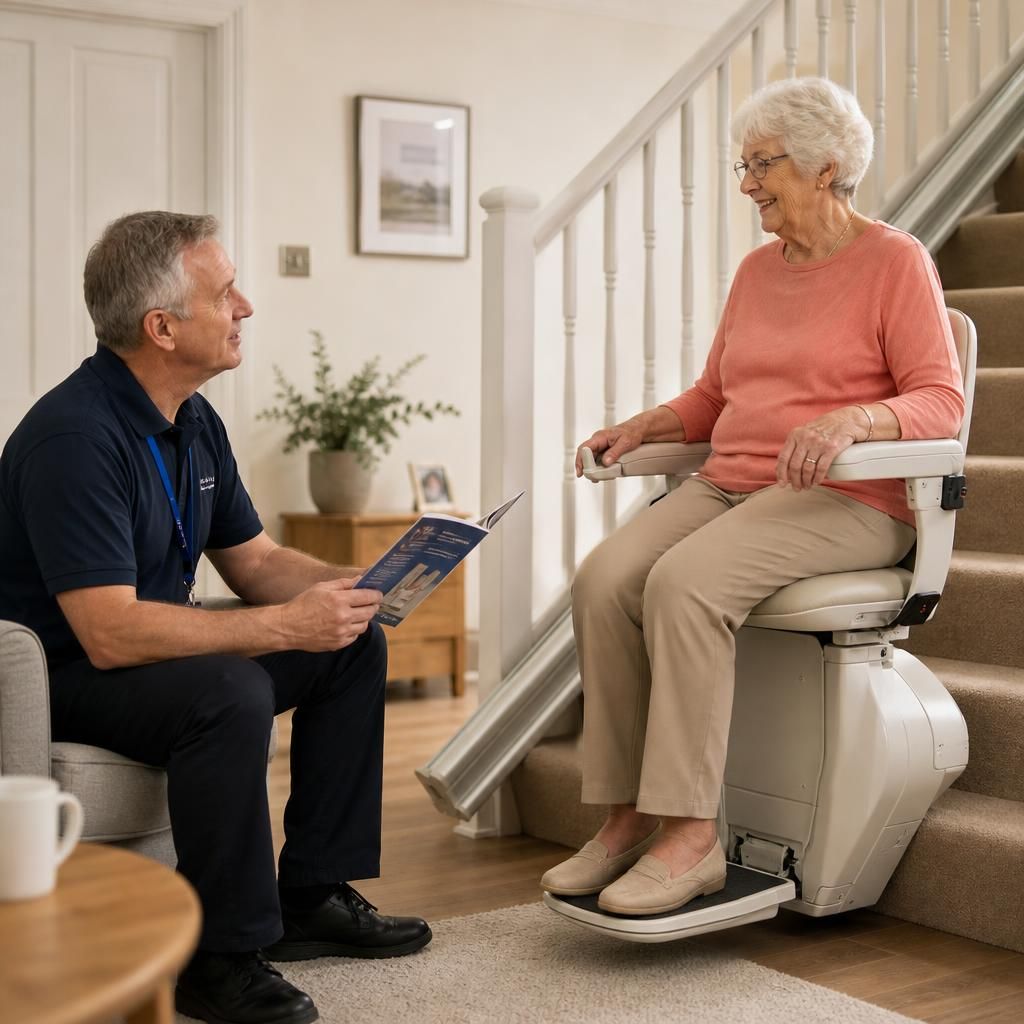
Compare your stairlift hire and purchase options
Contact Independent Stairlifts for a personalised assessment and a written comparison of hire and purchase options based on your staircase, expected period of use and required aftercare.