
What are the key factors affecting stairlift costs in the UK?
Stairlift costs in the UK are mainly affected by the shape and length of the staircase, whether the lift is new or reconditioned, the features selected, and the complexity of installation. A home assessment provides an accurate price by identifying the equipment, adaptations and fitting requirements for your particular property.
Stairlift costs in the UK are chiefly affected by the staircase design, the type and condition of the stairlift, the features selected and the complexity of installation. A straight stairlift fitted to a standard staircase is usually less involved than a curved model, while outdoor installations and properties requiring adaptations can have additional costs. An accurate quotation therefore depends on assessing the actual staircase and the user’s requirements rather than relying on a general price guide.
The shape and layout of the staircase is often the most significant factor. A straight stairlift runs along a single flight and normally uses a standard rail. A curved stairlift requires a rail made to follow bends, landings, intermediate steps or changes in direction. The design and manufacture of that rail are more specialised, so curved stairlift costs are generally higher than those for straight models.
Staircases with unusually narrow steps, tight turns, steep gradients, split levels or limited space at the top or bottom may also require a more carefully planned installation. In some homes, the lift needs to park beyond the top step or move around a landing without obstructing a doorway. The available space can influence the rail design, parking position and whether additional safety features are appropriate.
The length and construction of the rail also affect the quotation. A longer staircase may require more rail and additional installation time. On a curved staircase, every bend and transition has to be measured accurately so that the stairlift travels smoothly and leaves suitable access for other people using the stairs.
Whether the stairlift is new or reconditioned has a direct effect on the initial cost. A reconditioned stairlift may offer a lower-cost solution where a suitable model and rail are available. However, curved rails are normally made for a specific staircase, so a previously used curved stairlift may not be suitable for a different home unless the rail can be adapted or replaced. The condition, age, specification, warranty and availability of replacement parts should all be considered alongside the purchase price.
The model and specification selected can change the cost. Different stairlifts may have different seat designs, weight capacities, controls, travel speeds, battery systems and folding arrangements. A basic specification may be suitable for one user, while another may need powered controls, a swivel or lift-up seat, a higher-capacity model or a configuration that makes transfers easier. The most suitable option should be based on safe and comfortable use rather than adding features that are not needed.
Features that can increase the price may include:
- Powered swivel, lift-up or reclining seat functions.
- Powered footrests or folding rails.
- Specialist seating, larger seats or increased weight capacity.
- Additional remote controls or alternative control positions.
- Longer rails or powered parking arrangements.
- Weather-resistant equipment and protective covers for outdoor use.
Installation complexity is another important factor. Most stairlifts are secured to the stairs rather than the wall, but the installer still needs to consider the stair construction, access around the staircase, the location of charging points and the position of the lift when parked. Additional work may be necessary if the staircase has unusual materials, restricted access, damaged steps or limited room for safe transfers.
An outdoor stairlift usually has more demanding installation and equipment requirements than an indoor model. The lift must be suitable for exposure to rain, temperature changes and other weather conditions, and the installation may need careful planning around external steps, drainage, power and secure parking. These requirements can increase both the equipment and fitting costs.
Adaptations and associated work should be identified before accepting a quotation. Possible examples include removing an existing stairlift, adjusting a handrail, relocating an obstruction, improving lighting or making minor changes to the area where the user gets on and off the lift. These items are not automatically required, but if they are needed, they should be explained clearly and included in the overall cost.
The home assessment is important because it converts general stairlift pricing into a property-specific quotation. During an assessment, the staircase can be measured, the user’s mobility and transfer needs considered, and practical issues such as doors, radiators, landings and available parking space checked. The assessor can also determine whether a straight, curved or outdoor model is appropriate and whether the selected controls and seat position can be used safely.
A proper quotation should make clear what is included. Check whether it covers the stairlift, rail, delivery, installation, testing, user instruction, warranty and removal of any existing equipment. It is also sensible to ask whether future servicing, call-outs, batteries, repairs or extended warranty cover are included or charged separately. The lowest initial price may not represent the lowest overall cost if important services are excluded.
Ongoing ownership costs can influence the value of a stairlift over time. Battery replacement, servicing, repairs and warranty arrangements depend on the model, its age, how frequently it is used and the support package selected. Reconditioned equipment may have a lower initial cost, but its remaining warranty and maintenance history should be checked. A new stairlift may cost more initially while offering longer manufacturer support or a wider choice of specifications.
VAT treatment may also affect the amount payable in some circumstances. Eligibility for VAT relief depends on the user’s disability or long-term condition and the specific rules applying at the time. It is important to provide the information requested by the supplier and confirm how any VAT relief is applied before the order is completed; it should not be assumed automatically.
To compare stairlift costs properly, consider the complete installation rather than the equipment price alone. Ask for a written breakdown covering the stairlift type, rail design, optional features, installation, adaptations, warranty and likely ongoing charges. A home assessment with a stairlift specialist is the most reliable way to identify the factors affecting the price and choose a solution that is suitable for both the staircase and the person using it.
A home assessment is one of the most important factors affecting stairlift costs in the UK because it identifies the equipment, rail design and installation work required for a particular staircase. A straight stairlift on a standard flight may need a relatively simple installation, while bends, intermediate landings, narrow steps or restricted parking space can require a more specialised solution.
During the assessment, the stairlift specialist should consider the staircase layout, available space, stair construction, access at the top and bottom, and the user’s ability to transfer safely in and out of the seat. This helps establish whether any additional features or minor adaptations are needed and ensures the quotation reflects the complete installation rather than the lift alone.
Ask for the quotation to clarify whether it includes delivery, fitting, testing, user instruction, warranty, removal of existing equipment and any required adaptations. Comparing these details gives a more accurate picture of the overall cost than relying on a standard advertised price.
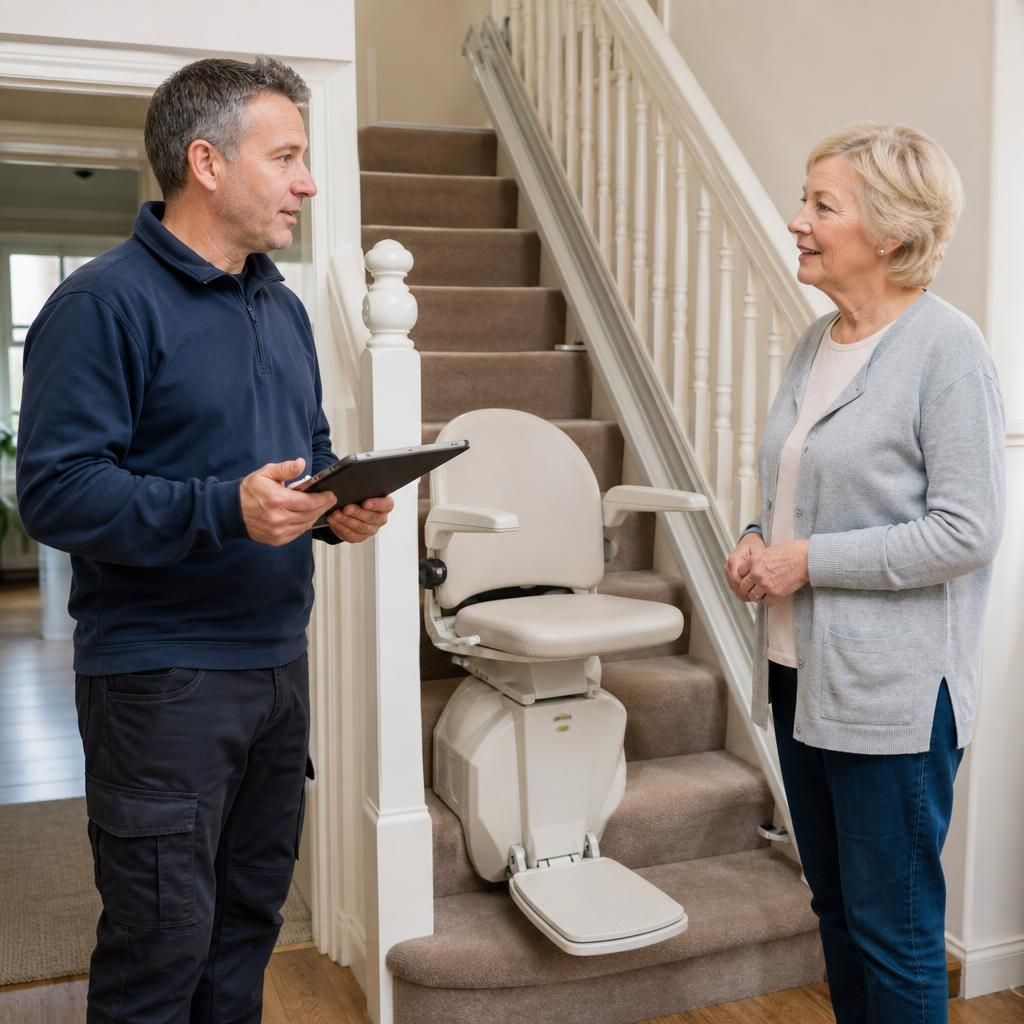
Arrange a home assessment for an accurate stairlift quotation
Arrange a home assessment with Independent Stairlifts for an accurate quotation based on your staircase, mobility needs and installation requirements. We can explain the available options and clarify what is included in the overall cost.