
What are the key benefits of consulting with a stairlift specialist before purchasing?
Consulting with a stairlift specialist before purchasing helps you identify the most suitable stairlift for your staircase, mobility needs and home layout. A professional assessment can also confirm the likely costs, recommend appropriate features and ensure the lift is installed safely and correctly.
Consulting a stairlift specialist before purchasing helps you choose a lift that is suitable for your staircase, mobility needs, home layout and budget. A professional assessment identifies practical issues that may not be apparent from photographs or standard product descriptions, while also providing advice on suitable features, installation requirements, likely costs and future maintenance.
A specialist can assess the staircase accurately
Staircases differ considerably in width, shape, landing space, flooring and access. A specialist can assess whether a straight stairlift is appropriate or whether a curved model is needed to follow bends, intermediate landings or changes in direction. They can also consider outdoor stairs, narrow staircases, steep sections and limited space at the top or bottom.
This assessment is important because a stairlift must fit the staircase without creating avoidable obstructions. The position of the rails, the available parking area and the space required for the seat, footrest and controls can all affect how easily other people use the stairs.
The recommendation can be matched to your mobility needs
A specialist will consider how you approach the stairs, sit down, stand up and transfer on and off the seat. They can discuss features such as a powered swivel seat, adjustable arms, a powered or folding footrest, a higher seat position, extra support or different control arrangements where these are appropriate.
The right choice depends on more than the staircase alone. Balance, joint movement, strength, height, weight, confidence and whether the user operates the lift independently can all affect the most suitable specification. A practical assessment allows these points to be considered together rather than selecting a model solely on its advertised price.
You can compare the relevant types of stairlift
Specialist advice can clarify the differences between new and reconditioned stairlifts, straight and curved designs, and indoor and outdoor models. A reconditioned lift may offer a lower initial cost where a compatible model is available, but the condition, warranty, installation and aftercare should be checked as part of the comparison.
For a straightforward staircase, a standard specification may be sufficient. A more complex staircase or a user with particular support requirements may need additional equipment or a bespoke installation. A specialist can explain which features address a genuine need and which may not provide useful value in your circumstances.
It gives you a clearer understanding of the total cost
A consultation can separate the cost of the stairlift itself from installation, alterations, additional features, servicing arrangements and any work needed to prepare the area. For a curved stairlift, the rail is normally made to suit the individual staircase, so the design and assessment have a direct effect on the quotation.
Ask for the quotation to state what is included, including delivery, fitting, demonstration, warranty cover and removal of an existing lift if relevant. You should also ask whether future servicing, call-out visits, batteries or repairs are covered or charged separately. This makes it easier to compare quotations on a like-for-like basis rather than choosing on the headline price alone.
Potential installation problems can be identified early
A home assessment can identify radiators, doors, handrails, low ceilings, nearby furniture, uneven flooring and restricted access. The specialist can explain whether the lift can be installed without moving an obstruction, or whether a minor adjustment would improve safety and usability.
They can also check where the stairlift will be parked when it is not in use and whether it could affect a doorway, hallway or landing. Discussing these points before ordering reduces the risk of unexpected changes on installation day.
Safety and correct operation are considered from the outset
Professional advice helps ensure that the chosen stairlift is suitable for the staircase and the person using it. The installer should explain safe transfers, the use of the seat belt, operating the controls, charging and what to do if the lift stops or an obstruction is detected.
Correct fitting is equally important. The rail must be installed securely, the lift should travel smoothly and the controls should be positioned where the user can operate them comfortably. After installation, a proper demonstration gives the user and their family an opportunity to practise and raise questions before relying on the lift.
You can plan for changing needs
Mobility needs may change over time. Someone who can currently manage a standard seat may later benefit from easier transfers, additional support or a different control arrangement. Discussing likely future requirements with a specialist can help avoid selecting a lift that is difficult to use later.
This does not mean paying for every available feature in advance. It means identifying the features that may be important, understanding whether they can be added later and choosing a specification that provides suitable support without unnecessary expense.
You receive practical advice about aftercare
A stairlift is a powered mobility aid, so it needs appropriate care after installation. A specialist can explain routine cleaning, charging, battery care, servicing recommendations and the process for reporting a fault. You can also confirm the length and terms of the warranty and whether support is available if the lift needs attention.
Good aftercare information is particularly useful when more than one person may need to operate the lift or when a family member is arranging the purchase on someone else’s behalf. Keeping the installation instructions and service details in an accessible place can also make future support simpler.
Questions to ask during the consultation
- Which type of stairlift is suitable for the shape and width of the staircase?
- Will the proposed rail, seat and footrest leave enough space for other people to use the stairs?
- Which features are recommended for the user’s current mobility needs, and why?
- Is a new or reconditioned stairlift more appropriate for this installation?
- What is included in the quoted price, and are there any possible additional charges?
- How long is the installation expected to take, and will any preparation work be required?
- What warranty, servicing and fault-support arrangements are provided?
- What happens if the user’s needs change or the stairlift is no longer required?
A consultation does not commit you to buying a particular model. It gives you the information needed to compare suitable solutions, understand the full cost and make sure the proposed stairlift works safely within your home. For the most useful assessment, explain how the stairs are currently used, describe any difficulties with transfers or controls and raise any concerns about future mobility before accepting a quotation.
A stairlift specialist can identify installation requirements that may not be clear from a photograph or standard product description. During a home assessment, they check the staircase, landings, doorways, handrails, radiators and available parking space to confirm where the rail and lift can be positioned safely.
This advice helps prevent unexpected alterations, access problems or additional charges on installation day. It also ensures the proposed stairlift leaves practical space for other people to use the stairs and can be operated comfortably by the intended user.
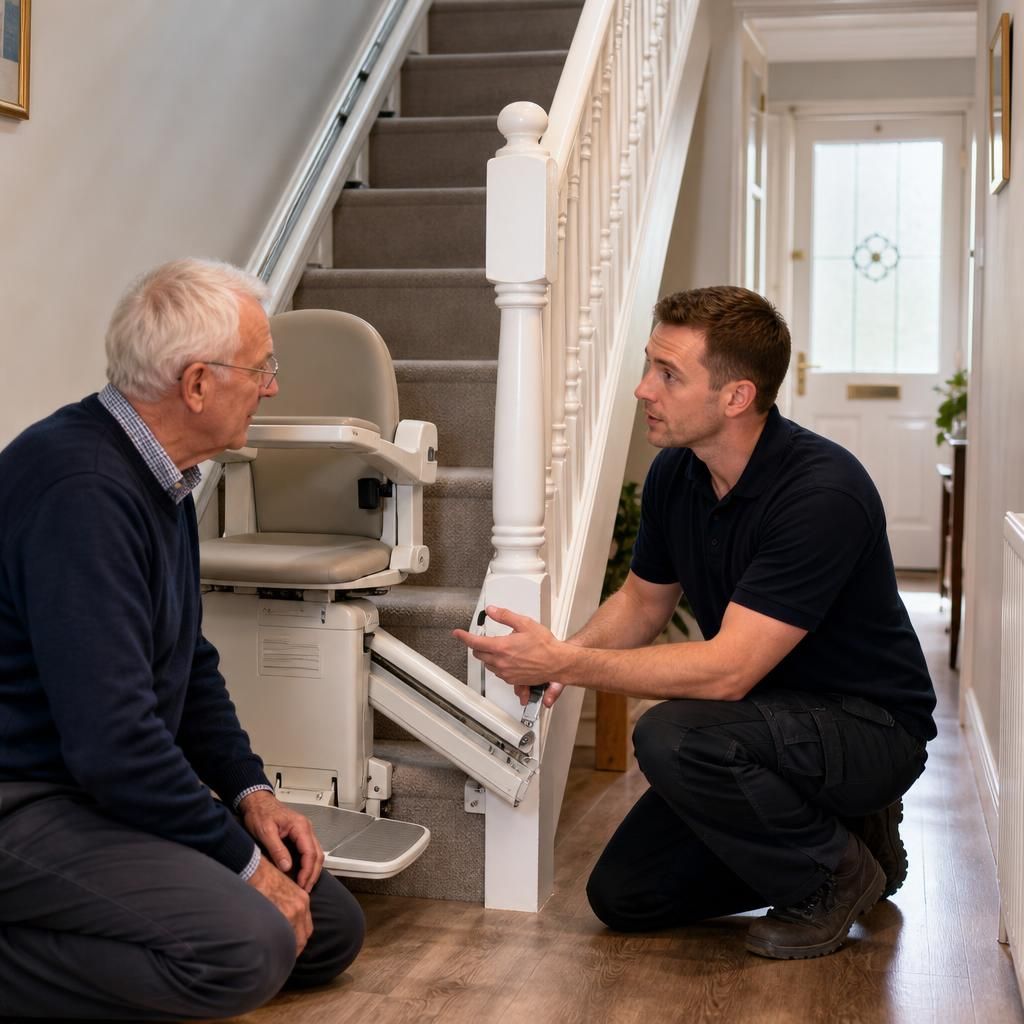
Arrange Your Stairlift Consultation
Arrange a consultation with a stairlift specialist to assess your staircase, discuss the user’s mobility needs and receive advice on suitable options and likely costs.