
How does a home assessment influence stairlift pricing?
A home assessment influences stairlift pricing by identifying your staircase layout, the type of lift required and any installation work needed. It enables a specialist to provide a tailored quote based on your home and mobility needs, rather than relying on a standard estimate.
A home assessment affects stairlift pricing by establishing exactly what equipment, fitting work and safety features your staircase requires. Rather than applying a standard price, the assessor examines the staircase, access around it and the user’s mobility needs before preparing a tailored quotation. This helps identify whether a straight, curved or outdoor stairlift is appropriate and whether any additional installation work is needed.
The staircase layout is usually the most significant consideration. A straight stairlift generally follows one uninterrupted flight and has a comparatively straightforward installation. A curved stairlift is made to follow the shape of the stairs, including bends, intermediate landings, changes in direction and unusual angles. Its rail must be measured and manufactured for the individual staircase, so the design and fitting requirements can affect the price.
An assessment also checks whether the staircase is genuinely straight throughout its usable length. A small change in direction, a turn at the top or bottom, or a landing that requires the rail to continue around a corner can change the type of stairlift needed. Where the staircase has more than one flight, the assessor can discuss whether one continuous curved lift or separate lifts would be more suitable for the layout and the person using it.
The condition and construction of the stairs can influence installation requirements. The assessor will consider the available fixing points, the strength and condition of the treads, the position of banisters and the clearance beside the stairs. Most stairlifts are fixed to the steps rather than the wall, but the structure must still be suitable for secure installation. If access is restricted, a landing is particularly narrow or an obstruction needs to be addressed, the quotation should explain any additional work clearly.
At the top and bottom of the staircase, the assessment considers how the stairlift will be parked and how safely the user can get on and off. A standard finish may be possible where there is sufficient landing space. In a tighter area, the design may need a swivel seat, a folding or retractable rail, a different parking position or another space-saving option. These features can affect the equipment price and the time needed to install it.
The user’s mobility needs are part of the pricing assessment, not a separate consideration. The assessor will discuss how the stairlift needs to be used, including transfers on and off the seat, balance, joint movement, posture and whether another person may need to assist. The most suitable model may require features such as powered swivelling, a powered footrest, a larger seat, a different armrest arrangement or controls that are easier to operate. Selecting equipment that reflects the user’s actual abilities can prevent the cost and disruption of replacing an unsuitable lift later.
Weight capacity, seat dimensions and the way the user sits can also affect the choice of model. A compact design may suit a narrow staircase, while a wider or more supportive seat may be needed for comfort and stability. The assessment should balance these requirements with the available stair width and the ability of other household members to use the staircase safely.
Electrical and access requirements may be identified during the visit. The assessor can check where the stairlift will charge, whether a suitable power supply is available and whether the parking positions allow the batteries to charge correctly. A stairlift normally uses rechargeable batteries, so the location of the charging points and the condition of the electrical supply are relevant to installation. If alterations, additional electrical work or other preparation are required, these should be included in the quotation rather than left as an unexpected cost.
Outdoor stairlifts require a separate assessment because exposure to rain, frost, dirt and temperature changes affects the equipment specification and installation. The assessor will look at the external steps, drainage, landing areas, weather protection and safe access to the property. The outdoor environment may require weather-resistant components or protective arrangements, which can change the overall price compared with an indoor installation.
The assessment helps separate the equipment price from installation costs. A quotation may reflect the stairlift itself, the rail or track, delivery, fitting, testing and any agreed extras. The final price can also depend on whether the lift is new or reconditioned. A reconditioned stairlift may be suitable for some straightforward installations, but availability, rail configuration, specification and warranty terms need to be checked against the staircase and the user’s needs. A curved rail made for another staircase, for example, may not be suitable for a different layout.
A home assessment is also an opportunity to identify practical issues that are not obvious from photographs or a telephone conversation. These may include a door or radiator close to the stairs, limited space at a landing, a change in floor level, a narrow hallway or the need to keep an escape route clear. Resolving these points during planning can affect the recommended model, fitting method and total quotation.
The assessment process normally involves several stages:
- Reviewing the staircase shape, width, length, landings, turns and available parking areas.
- Checking the structure, fixing points, clearances, banisters and possible obstructions.
- Discussing the user’s mobility, transfers, preferred controls and any assistance required.
- Considering suitable stairlift types and features, including options for narrow or complex staircases.
- Identifying electrical, access or preparation work that may be needed before fitting.
- Explaining the recommended specification, installation arrangements, warranty and any ongoing service requirements.
- Providing a quotation based on the assessed installation rather than an unverified standard estimate.
A remote estimate can be useful as an initial guide, but it may not account for every feature of the property. Measurements supplied over the phone or from photographs can miss changes in angle, restricted clearances or structural details. A physical assessment gives the installer the information needed to confirm suitability and reduce the risk of price changes caused by unexpected installation conditions.
When reviewing the quotation, check that it describes the stairlift type, the rail or track arrangement, included features, fitting work, removal of any existing equipment and the warranty or servicing arrangements. Ask which items are included in the stated price and whether any work is conditional on further inspection. If your mobility or circumstances change before installation, tell the specialist, as the specification may need to be reviewed.
The assessment does not necessarily make a stairlift more expensive. Its purpose is to establish the correct solution and identify costs accurately before work begins. A simple staircase may require only a standard installation, while a curved, narrow or external staircase may need more specialised equipment and fitting. By assessing the property and the intended user together, Independent Stairlifts can provide a clearer quotation and help ensure that the chosen stairlift is safe, practical and suitable for the home.
A home assessment influences stairlift pricing by confirming the staircase layout and the installation work required. The assessor checks the number of flights, bends, landings, available clearance and suitable parking positions, so the quotation reflects the actual rail design and fitting requirements rather than a standard estimate.
This is particularly important where a staircase appears straight but includes a turn, a narrow landing or an obstruction near the top or bottom. These details may affect whether a straight or curved stairlift is suitable and whether features such as a powered swivel seat or a folding rail are needed. Identifying them before installation helps ensure that the quoted price includes the appropriate equipment and any necessary preparation work.
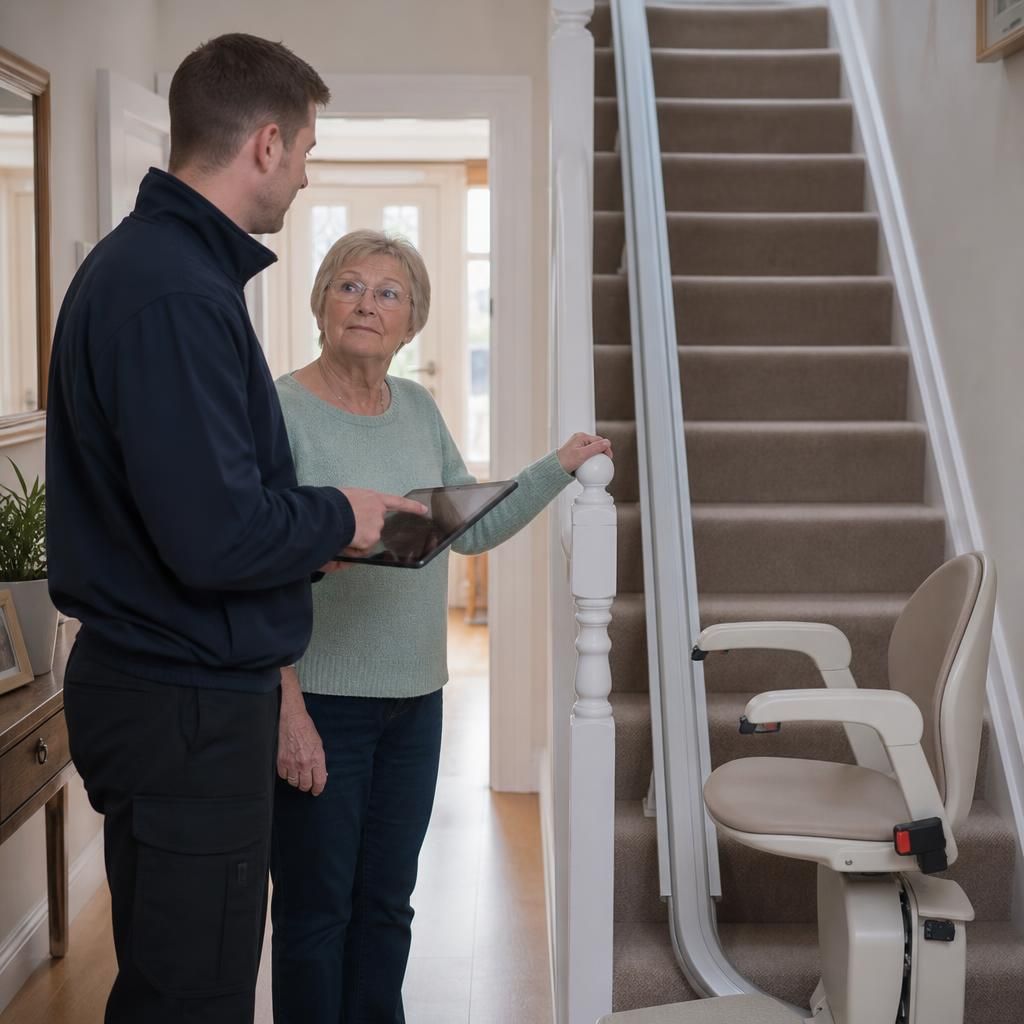
Arrange Your Home Assessment for a Tailored Stairlift Quote
Arrange a home assessment with Independent Stairlifts to confirm the right stairlift for your staircase, mobility needs and installation requirements. You’ll receive a tailored quotation based on the assessed work and equipment required.