
What specific criteria should I evaluate to determine the most cost-effective stairlift installation option for my home?
To identify the most cost-effective stairlift installation, compare the total fitted cost of suitable options rather than the lift price alone. Assess your staircase layout, whether a new or reconditioned model is appropriate, required features, warranty and ongoing maintenance, then obtain a professional assessment and like-for-like quotations.
The most cost-effective stairlift installation is the one that provides safe, dependable access at the lowest suitable total fitted cost over its expected service life. To assess the options properly, compare the staircase layout, lift condition, included installation work, essential features, warranty, servicing and future removal costs rather than comparing the equipment price alone.
Start with the staircase itself
The shape and construction of your staircase usually have the greatest effect on the price and the type of lift available. A straight stairlift normally has a simpler rail and installation process. A curved stairlift requires a rail made to follow the staircase, including bends, landings or changes in direction, so it generally involves more design and manufacturing work.
During an assessment, consider:
- Whether the staircase is straight, curved, narrow, split-level or unusually shaped.
- The available space at the top and bottom for getting on and off safely.
- Whether doors, hallways or other household access routes could be obstructed.
- The position of the staircase in relation to walls, radiators, banisters and sockets.
- Whether the stairs, wall or handrail need any preparation before fitting.
- Whether the lift must stop short of a doorway or finish on a landing.
A lower-priced lift that cannot be positioned safely, leaves insufficient clearance or requires unexpected alterations is not a cost-effective choice. A proper home assessment should confirm the practical solution before you accept a quotation.
Compare like-for-like fitted quotations
Ask each provider to quote for the same specification and check exactly what is included. A quotation may cover the lift and standard fitting but exclude electrical work, removal of an existing lift, additional rail sections, parking or access difficulties, repairs to the staircase, or follow-up servicing.
Check whether the quoted price includes:
- The survey, design and manufacture of any bespoke rail.
- Delivery, installation and testing.
- Removal and disposal of an old stairlift, where applicable.
- Any necessary brackets, charging points or minor preparation work.
- User instruction and handover.
- The length and scope of the warranty.
- VAT, if it applies to your circumstances.
Written quotations should identify possible additional charges and state whether the price is fixed. If two quotes differ significantly, the difference may relate to the lift condition, specification, installation complexity or aftercare rather than simply a different margin.
Decide whether new or reconditioned is appropriate
A reconditioned stairlift can reduce the initial cost, particularly where a suitable standard model is available for a straightforward staircase. It should have been professionally inspected, cleaned, tested and fitted, with replacement of worn components where necessary. Confirm its age, condition, battery status, warranty and availability of replacement parts before making a decision.
A new stairlift may be more cost-effective when the staircase needs a bespoke curved rail, when several users require different adjustments, or when you want the longest available warranty and the latest configuration. The cheapest purchase price is not necessarily the lowest overall cost if an older lift needs more servicing or has limited parts availability.
Separate essential features from optional features
Choose features according to the user’s mobility, balance, strength and home environment. Essential safety and usability features can include a suitable seat height, secure armrests, a reliable seat belt, obstruction sensors, swivel or powered controls where needed, and controls that the user can operate comfortably.
Optional upgrades may include a powered swivel seat, powered footrest, automatic folding mechanisms, extra controls, a different upholstery finish or a heavier-duty specification. These may be worthwhile if they solve a genuine access or handling problem, but they should not be added solely because they are available. Ask how each feature affects the price, maintenance requirements and reliability, and whether a simpler specification would meet the user’s needs safely.
Assess the user as well as the staircase
The most economical suitable option must remain practical if the user’s mobility changes. Consider the user’s height, weight, ability to transfer, grip strength, sitting balance, vision and ability to use controls. A lift that is difficult to enter, uncomfortable or unsuitable for the user may later need adapting or replacing.
If more than one person will use the stairlift, compare their requirements before choosing the model. A standard option may be sufficient for one user, while another may need a wider seat, a different control arrangement or powered movement. Discuss these requirements during the assessment rather than selecting the lowest specification first.
Include lifetime and ownership costs
Ask about the costs that arise after installation. These can include routine servicing, replacement batteries, call-out charges outside the warranty, repairs and eventual removal. Battery-powered stairlifts normally recharge at designated points, but batteries are consumable components and will eventually need replacing.
Compare the warranty terms carefully. Check its duration, what parts and labour it covers, whether it includes call-outs, and whether any servicing conditions apply. A slightly higher initial price may be better value if it provides broader cover, dependable local support and access to parts for the expected life of the lift.
Also establish what happens if you move home, no longer need the lift or need it removed. Some installations can be removed with limited disruption, while a curved rail is usually designed for one staircase and may have little resale value elsewhere. Clarifying this at the outset avoids treating removal as an unexpected cost.
Check installation and access requirements
Installation is often straightforward, but the total price can increase where access is difficult, the staircase is unusually narrow, the rail needs complex positioning or preparatory work is required. Ask whether the installer will protect flooring and walls, how long the work is expected to take, and whether the stairs will remain usable during installation.
If there is already a stairlift, confirm whether it will be removed before the new one is fitted and whether old brackets, fixings or charging equipment will be taken away. If building work, rewiring or structural repairs are proposed, ask why they are necessary and whether they are included in the quotation.
Use a professional assessment before choosing
A home assessment is the best way to determine whether a straight, curved, outdoor or reconditioned stairlift is genuinely suitable. The assessor should examine the staircase, observe how the user transfers on and off the seat, discuss likely future needs and explain alternatives where appropriate.
Before accepting an option, ask for:
- A written specification describing the exact lift and rail.
- A full fitted price with exclusions clearly identified.
- Confirmation that the lift meets the relevant safety and installation requirements.
- Warranty and servicing terms in writing.
- An explanation of any assumptions or potential extra charges.
- Time to consider the quotation without pressure.
It is also sensible to compare a stairlift with other accessibility solutions where relevant. A stairlift may be the most practical choice for regular access between floors, while a bath lift, recliner or alternative mobility aid may address a different problem. The right comparison is between solutions that meet the user’s actual access requirements, not between products with different purposes.
Finally, check whether any VAT relief or financial assistance may apply to the individual user and installation. Eligibility depends on personal circumstances and the type of work, so obtain current advice rather than assuming that a quoted price will automatically be reduced. In practice, the most reliable decision combines a suitable home survey, transparent like-for-like quotations, carefully chosen features and realistic allowance for maintenance. This approach helps avoid paying for unnecessary specification while preventing false savings that compromise safety or long-term usability.
The most cost-effective stairlift is identified by comparing the total fitted cost of suitable options, not the advertised price of the equipment alone. A like-for-like quotation should state whether it includes the home survey, bespoke rail, delivery, installation, testing, user instruction, removal of an existing lift and VAT where applicable.
Before choosing, check the warranty, servicing arrangements, battery replacement costs and any possible charges for difficult access or preparatory work. A lower initial price may not represent good value if the lift is unsuitable for the staircase, has limited cover or requires expensive alterations. Ask for every quotation and exclusion in writing so you can compare safe, appropriate solutions on the same basis.
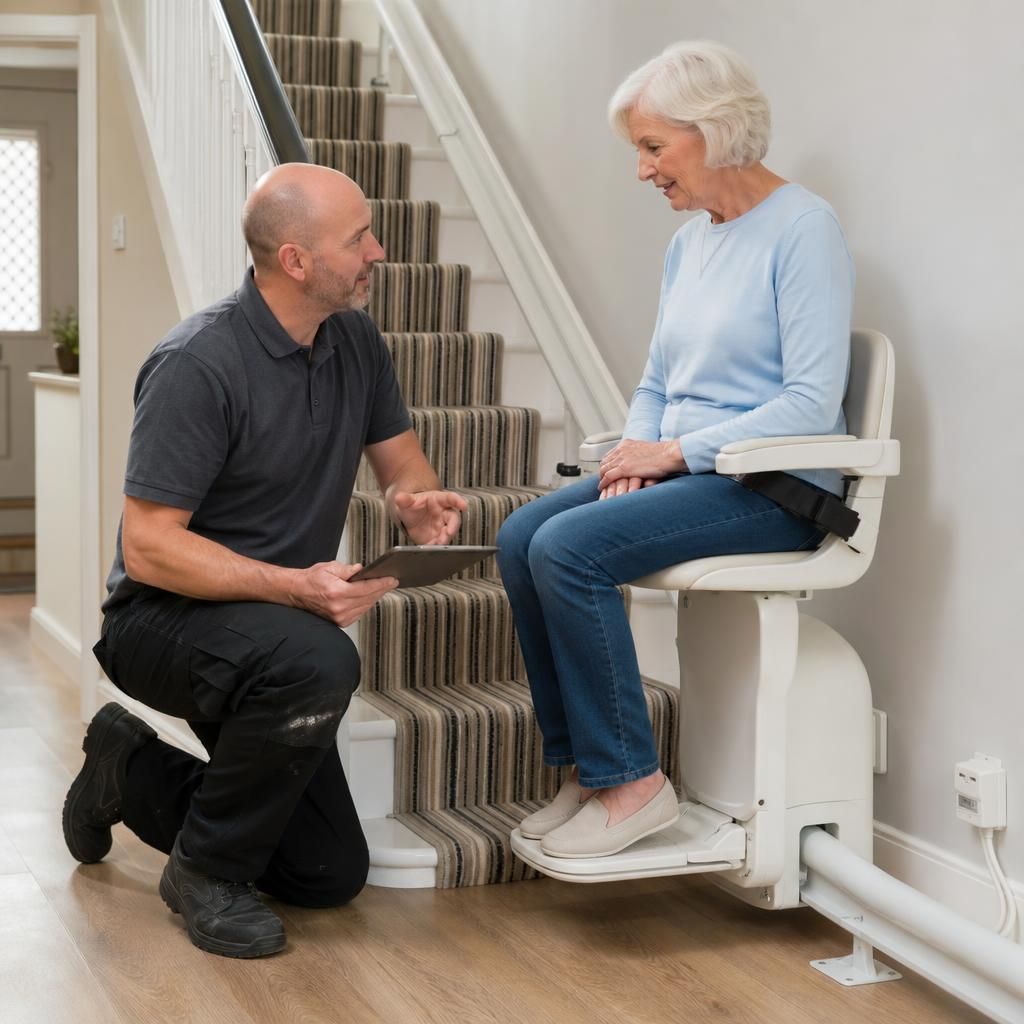
Arrange your home stairlift assessment
Arrange a home stairlift assessment to confirm which installation option suits your staircase, mobility needs and budget. You’ll receive practical advice and a clear quotation based on the work required.