
What factors most significantly impact the total cost of a stairlift installation?
The total cost of a stairlift installation is influenced most by the staircase design, particularly whether it is straight, curved, narrow or multi-level, as well as whether you choose a new or reconditioned model. The lift’s features, fitting requirements, access to the property and any necessary electrical or structural adjustments can also affect the final price, which is why a tailored home assessment is important.
The factors that most significantly affect the total cost of a stairlift installation are the shape and length of the staircase, the type and condition of the stairlift, and the complexity of fitting it safely in the property. A straight stairlift on a simple, accessible staircase is usually less complex to install than a curved or multi-level system. The final price can also change according to the seat and control features selected, whether electrical work is needed, and whether the installation requires additional site preparation.
Staircase design and configuration
The staircase itself is usually the most important cost factor. A straight staircase can generally be fitted with a standard rail, provided there are no unusual obstructions or access issues. A curved staircase requires a rail designed to follow the individual route, including bends, landings, changes in direction and variations in gradient. This makes the rail more bespoke and increases the time needed for surveying, manufacturing and installation.
Cost can also be affected by:
- the overall length of the staircase;
- the number and tightness of any bends;
- intermediate landings or changes between flights;
- narrow sections, restricted headroom or limited clearance;
- the position of the bottom and top parking points; and
- whether the stairlift needs to serve more than one floor.
A staircase that appears straight may still need a more detailed assessment if it has a half-landing, a turn at the top or bottom, unusually narrow steps or a doorway close to the rail. These details can affect both the equipment required and the installation method.
New or reconditioned equipment
Choosing between a new and reconditioned stairlift can have a substantial effect on the initial cost. A reconditioned model may provide a more economical option where a suitable system is available and compatible with the staircase and the user’s needs. It should still be inspected, prepared and installed professionally, so the cost is not based solely on the age of the equipment.
A new stairlift may offer a wider choice of configurations, finishes, controls and powered features. It can also be the more practical option for a particularly demanding staircase or where a precise bespoke rail is required. The important comparison is between complete installed solutions rather than equipment prices alone. Check what is included in the quotation, such as the survey, fitting, demonstration, warranty and removal of any existing equipment.
Rail type and installation requirements
The rail must be securely installed while allowing sufficient clearance for the stairlift and other people using the stairs. In some homes, the rail can be fixed directly to the steps. In others, the installer may need to account for unusual step construction, fragile surfaces, skirting boards, radiators, doors or other nearby fixtures.
Additional work may be needed if the preferred parking position cannot be used without obstructing a doorway or walkway. A hinged rail, powered swivel seat, altered parking position or different access arrangement may provide a safer solution, but each can affect the specification and total cost.
Seat, controls and safety features
The standard stairlift specification may be suitable for many users, but additional features can change the price. Depending on the model, these may include:
- powered swivel, folding or adjustable seating;
- powered footrests or a powered hinged rail;
- different seat widths, upholstery or support arrangements;
- additional remote controls;
- enhanced armrest or joystick controls;
- folding components for use in a narrow staircase; and
- weather-resistant components for an outdoor installation.
Features should be selected because they address a specific access, transfer or safety requirement, rather than simply because they are available. For example, a powered swivel seat may help someone who finds it difficult to turn safely at the top of the stairs, while a compact folded design may be more important where other household members need to pass the stairlift.
Indoor or outdoor location
Outdoor stairlift installations normally require equipment designed to withstand rain, temperature changes and exposure to other weather conditions. The staircase may also have uneven surfaces, limited shelter or a different power supply arrangement from an indoor installation. These factors can increase the preparation and fitting requirements, as well as the specification of the lift itself.
Electrical and property preparation
Many stairlifts are designed to use a suitable domestic electrical supply, but the installation team still needs to confirm that the charging point can be positioned safely and conveniently. If the existing supply is unsuitable, additional electrical work may be required. This should be identified during the assessment rather than assumed after the installation has started.
Other preparation may include moving an obstruction, protecting a wall or floor during fitting, making good minor fixing points, or arranging access through a narrow entrance. Major structural alterations are not normally part of a standard stairlift installation, but a difficult property layout can affect the labour and planning involved.
Access to the property and fitting conditions
The time and resources required to complete an installation can vary according to how easily the property can be accessed. Restricted parking, several entrances, narrow hallways, upper-floor accommodation or limited space for handling equipment may require additional planning. These issues do not necessarily prevent installation, but they should be discussed during the home assessment so the quotation reflects the actual conditions.
Where an old stairlift is being replaced, the removal of existing equipment may also affect the total cost. The installer should confirm whether removal, disposal and any necessary adjustment to the staircase or electrical supply are included.
Assessment, fitting and aftercare
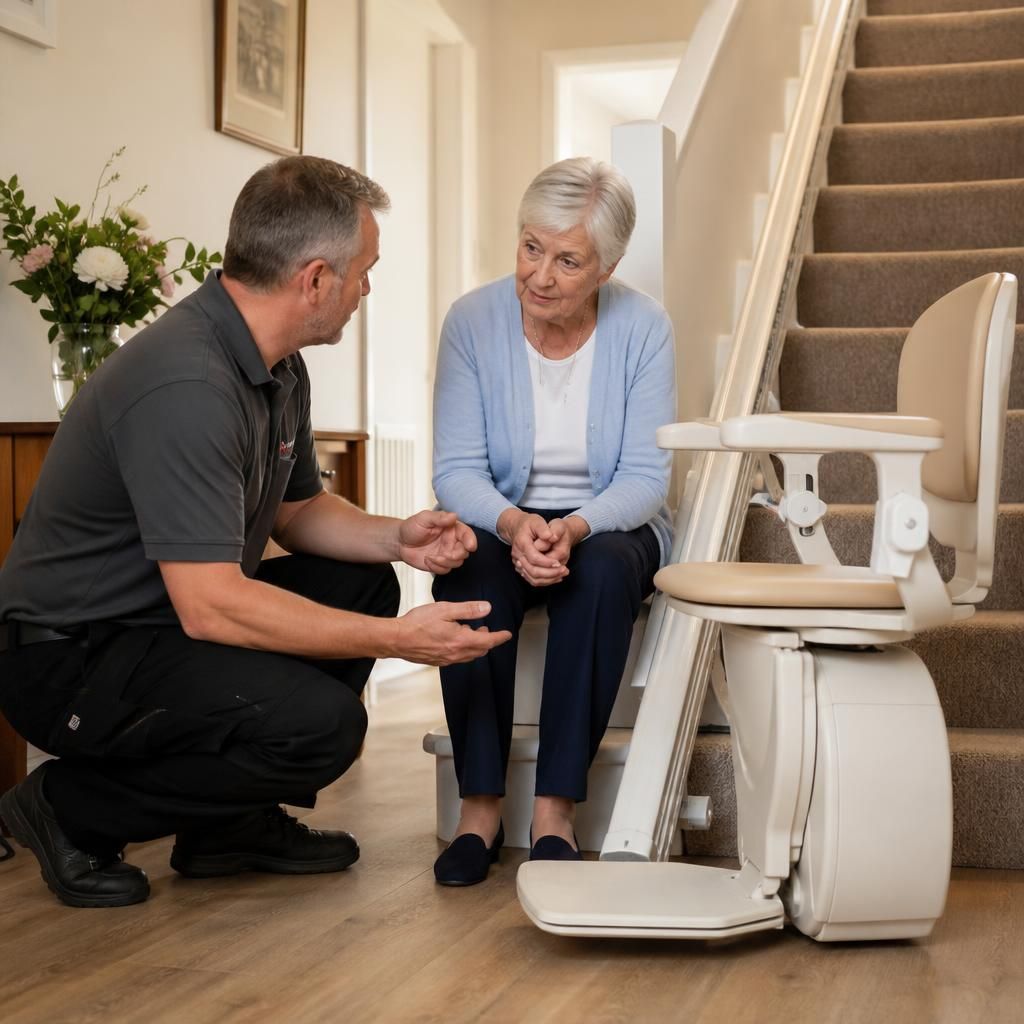
A professional assessment is important because the correct price depends on measurements, the staircase layout and the user’s way of approaching, sitting on and leaving the stairlift. The assessment should consider mobility, transfers, walking space, the needs of other people in the household and any likely change in requirements.
Installation costs should be considered alongside the support provided afterwards. Clarify the length and terms of the warranty, what servicing is available, how faults are reported and whether routine maintenance or replacement parts are charged separately. These are not always part of the initial installation price, but they are relevant when comparing the overall value of different options.
How to obtain an accurate total cost
The most reliable way to establish the total cost is to arrange a tailored home assessment and request an itemised quotation. The quotation should identify the stairlift model and rail type, whether the equipment is new or reconditioned, the installation work included, any optional features, electrical or preparation work, removal of existing equipment and warranty or aftercare arrangements.
A low equipment price may not represent the lowest complete cost if essential fitting work or features are excluded. Conversely, paying for features that do not improve access may add unnecessary expense. Comparing complete, like-for-like quotations against the user’s actual needs provides a more accurate basis for choosing a safe and suitable stairlift.
The staircase layout is usually the most significant factor in the total cost of a stairlift installation. A straight staircase may use a standard rail, while a curved, narrow or multi-level staircase requires a rail designed around its bends, landings and available clearance. This additional design and fitting work can increase the overall price.
A home assessment confirms the staircase measurements, parking position, access points and the user’s transfer needs. It also identifies whether options such as a powered swivel seat, hinged rail or electrical preparation are necessary. An itemised quotation based on these findings gives a more accurate total cost than comparing equipment prices alone.
Arrange Your Tailored Stairlift Assessment
Arrange a tailored home assessment with Independent Stairlifts to confirm the most suitable stairlift, installation requirements and total cost for your staircase.